New Delhi, January 19 – February 2026, In a time when India’s development trajectory demands both vision and rigour, GRAAM (Grassroots Research and Advocacy Movement) launched the 3PE Workshop – Public Policy & Programme Evaluation, under the initiative Empowering Youth for Evidence-led Development.
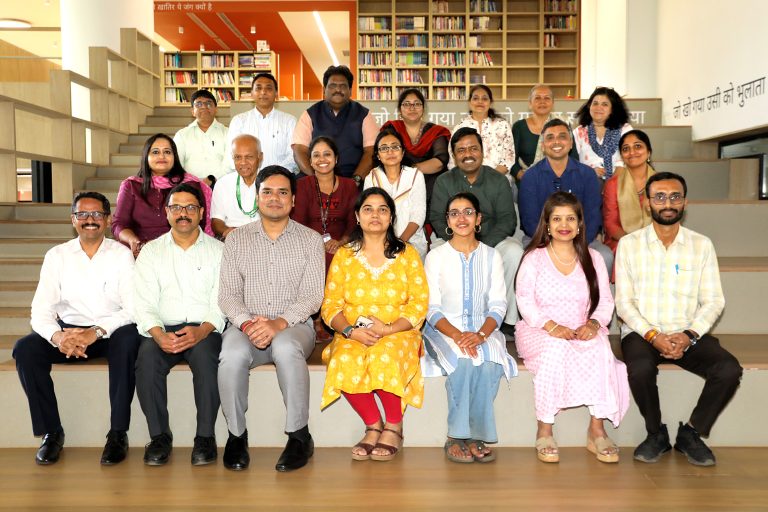
This intensive month-long capacity-building programme brought together 20 young professionals from across 15+ states to strengthen their engagement with public policy, constitutional values, and evidence-based decision-making.
Hosted at PRIA (Participatory Research in Asia),New Delhi, the workshop served as a vital bridge between high-level research and the vibrant, unpredictable realities of the people.
The Vision: Evidence-Informed Governance for India’s Future
The 3PE Workshop addresses a critical void in India’s development ecosystem: the need for professionals who can translate complex research into actionable policy, understand the practical functioning of government institutions, and design rigorous evaluation frameworks.
GRAAM’s core philosophy, which guided the workshop’s curriculum, is built upon four essential pillars for sustainable development:
- Evidence-based decision-making grounded in credible data and rigorous analysis.
- Governance literacy to understand how policies are formulated, funded, and implemented.
- Community participation to ensure interventions are responsive to grassroots realities.
- Ethical leadership that centers equity, inclusion, and constitutional values.
Setting the Foundation: A Collaborative Inauguration
The journey began with a powerful assembly of institutional partners committed to strengthening India’s development sector. The inaugural session featured Ms. Judith Weinberger-Singh (Resident Representative – India, Hanns Seidel Foundation), Dr. Kaustav Kanti Bandyopadhyay (Director, PRIA), and Dr. Basavaraju R. Shrestha (Executive Director, GRAAM).
The opening conversations emphasized that data-driven governance must be combined with empathy. The partners reinforced the role of youth in shaping policies that are responsive to people, institutions, and grassroots realities, setting a tone of collaborative and ethical learning.
A Month-Long Journey: The 19-Day Intensive Program
The 3PE Workshop was structured to move participants from a foundational understanding of the Indian state to advanced analytical methodologies and real-world field application.
Week 1: The Indian State and Governance Architecture
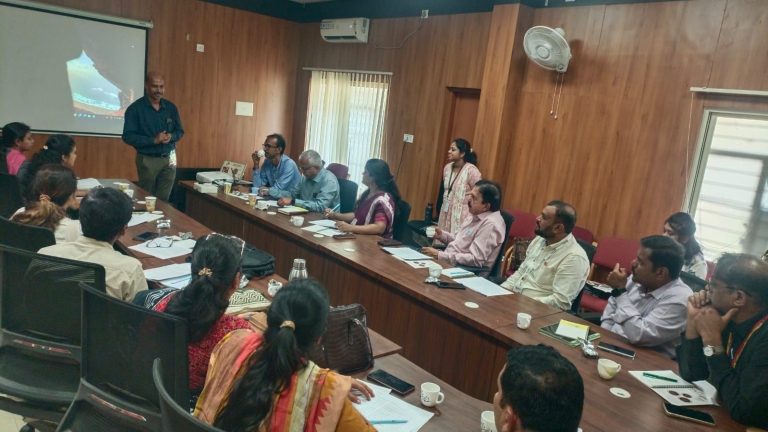
The first week focused on the “plumbing” of the government. Mr. Rajesh Saxena (Former Joint Secretary, GoI) provided an in-depth look at administrative processes and decision-making pathways. Participants explored how policies move through the system and the realistic approaches required to engage with government institutions.
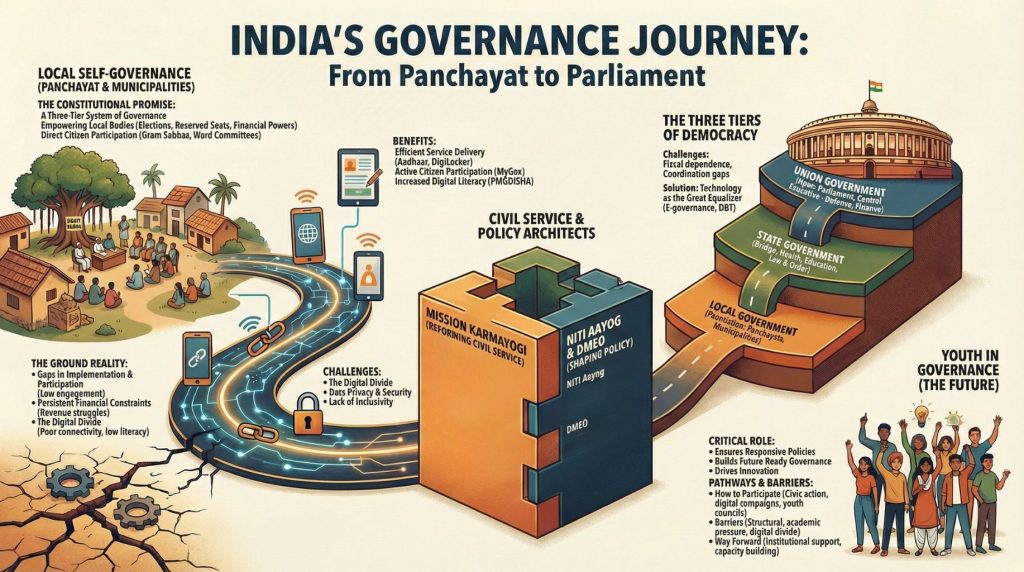
The focus then shifted to Citizen-Centric and Participatory Governance. Led by Dr. Kaustav Kanti Bandyopadhyay and Dr. Basavaraju R. Shrestha, the sessions examined the shift from seeing citizens as “beneficiaries” to active agents in decision-making. Discussions explored the 73rd and 74th Constitutional Amendments and the importance of centering marginalized voices in policy design.
Dr. Dinesh Kumar Nayak introduced the architecture of Public Finance, teaching fellows to read budgets as diagnostic instruments. This was followed by an exploration of the Political Economy of Governance, where participants reflected on why well-intentioned reforms often fail due to institutional constraints and misaligned incentives.
Week 2: Systems Thinking and Policy Foundations
The second week introduced participants to Systems Thinking, led by Prof. Aditya Trivedi, Prof. Kamal Madishetty, and Prof. Shubham Sharma. Fellows learned to identify feedback loops and leverage points to diagnose unintended policy consequences.
A significant milestone occurred with an engagement led by Dr. R. Balasubramaniam (Member HR, Capacity Building Commission, Govt of India, and Founder of GRAAM). He unpacked the evolution of the state and the role of public policy in addressing inequality. His public lecture on “Building State Capacity for Viksit Bharat” highlighted the shift toward outcome-oriented, citizen-centric governance.
The week also covered Digital Governance and the Geopolitics of Technology, emphasizing the importance of trust and transparency in India’s Digital Public Infrastructure. Mr. Vikal Jain provided hands-on training in government data ecosystems, teaching fellows how to analyze and visualize public data using Power BI and Excel.
Week 3: Programme Evaluation and Research Design
Evaluation is at the core of GRAAM’s mission. Week three focused on the Theory of Change (ToC) and Logical Frameworks. Led by Dr. Basavaraju and Dr. Ananya Samajdar, participants learned how social change unfolds through clear causal pathways. They explored the OECD–DAC REESI+C framework to assess relevance, effectiveness, efficiency, equity, and sustainability.
Dr. Arunoday Majumder unpacked qualitative methodologies, emphasizing that understanding policy outcomes requires deep engagement with lived experiences. This was complemented by Ms. Rai Sengupta (UNICEF), who explored the unique challenges of evaluating climate programmes. Dr. Arun Karpur later introduced Randomized Controlled Trials (RCTs) and the logic of counterfactuals as tools for estimating impact.
Week 4: Quantitative Methods and AI Integration
The final week sharpened the participants’ technical edge on Quantitative Data Collection, facilitated by Dr. Arun Karpur and Ms. Pushpa.
Sessions covered Survey Design, Sampling, and Measurement Error, ensuring that fellows understood the full workflow of data collection. Dr. Arun Karpur led a critical examination of empirical research, exploring quasi-experimental methods like regression analysis.
The week also focused on Evaluation Report & Presentation, led by Mr. Sarath.
The session highlighted how evaluation reporting converts raw data into actionable insight. Participants explored reporting as a continuous lifecycle, from defining scope to disseminating recommendations, emphasizing methodological transparency and integration of quantitative clarity with qualitative insight.
As a forward-looking programme, the workshop also explored AI in Public Policy. Led by Shobhit Mathur and Yashowardhan Tiwari, participants learned how AI tools like Google Gemini and Perplexity AI can support analysis while preserving human judgment. The week concluded with a focus on Policy Brief Writing, training fellows to convert raw data into concise, action-oriented documents for decision-makers.
Field Immersion: Testing Theory against Grassroots Reality
Theory was put to the test during a three-day field immersion in Sonipat, Haryana. Working in teams, fellows tested their survey tools and conducted interviews and Focus Group Discussions (FGDs) with beneficiaries and frontline workers.
By observing the implementation of social protection and health programmes firsthand, the fellows developed a grounded understanding of enrollment processes, service access, and the role of local administrative functionaries. This immersion reinforced the programme’s emphasis on bridging analytical learning with the complexities of real-world implementation.
Valedictory: Celebrating the Next Generation of Leaders
The programme concluded with a valedictory session graced by Sh. Lakshit Sareen (Additional Deputy Commissioner, Sonipat, Haryana). He encouraged the fellows to apply evidence with rigour and carry forward a commitment to public service.
The fellows presented their field immersion findings to a distinguished panel, including Shri Surendra Nath Tripathi (Former DG, IIPA), Ms. Usha Subramaniam (HSF India), and Dr. Basavaraju R. Shrestha. These presentations synthesized field observations with the analytical frameworks developed over the month, marking the formal close of their training.
Impact and the Way Forward
The 3PE Workshop represents a significant investment in India’s governance ecosystem. These 20 young professionals leave equipped with:
- Practical knowledge of government functioning and institutional engagement.
- Analytical skills spanning both qualitative and quantitative research methods.
- Ethical grounding in participatory and inclusive governance.
- Field experience that connects policy theory to implementation realities.
As these fellows move into placements across various government departments and development organizations, they carry with them the tools and the mindset of continuous learning and ethical inquiry. GRAAM remains committed to supporting this cohort through ongoing mentorship, ensuring they remain at the forefront of Evidence-Led Development in India.
Partnerships That Made It Possible
The success of this initiative reflects strong collaboration among institutions committed to strengthening India’s development ecosystem. Led by GRAAM, with support from HSF India, and hosted in collaboration with PRIA and Rishihood University, the programme brought together diverse expertise and perspectives.Together, these partners created a learning environment that was rigorous yet accessible, theoretical yet grounded, and ambitious yet deeply practical.
Looking Ahead: Continuing the Journey
The 3PE Workshop marks the beginning, not the end, of these young professionals’ engagement with evidence-led development.
As fellows move into placements across government departments and development organizations, they carry with them tools, frameworks, and most importantly a mindset of continuous learning, ethical inquiry, and commitment to public service.
GRAAM remains committed to supporting this cohort through ongoing mentorship, networking opportunities, and platforms for continued learning and knowledge exchange.
#EvidenceLedDevelopment #PublicPolicy #Governance #YouthLeadership #ProgrammeEvaluation #GRAAM #3PEWorkshop #CapacityBuilding #PolicyResearch #DevelopmentSector #ViksitBharat #DataDrivenGovernance