
Introduction
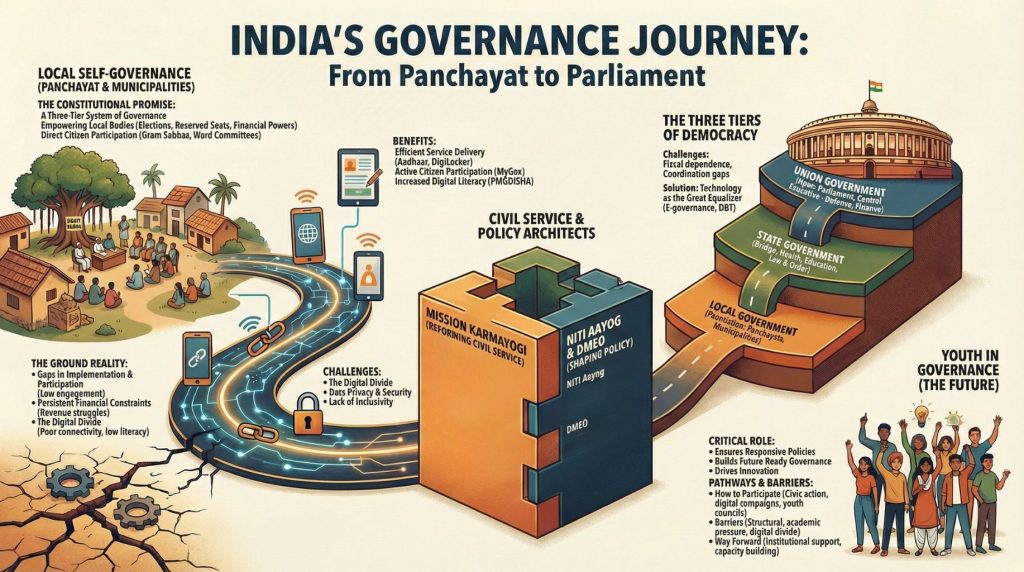
Local self-governance in India gained constitutional recognition through the 73rd and 74th Constitutional Amendments (1992), which sought to deepen democracy by decentralising power and strengthening grassroots institutions. These amendments institutionalised Panchayati Raj Institutions (PRIs) in rural areas and Urban Local Bodies (ULBs) in urban regions, thereby bringing governance closer to the people. The objective was not merely administrative decentralisation, but political empowerment, participatory development, and inclusive decision-making.
As part of our academic engagement and field exposure under the Youth for Governance Fellowship, we examined the functioning of local self-governance institutions through visits to Gram Panchayat offices and community interactions. These field engagements provided valuable insights into both the strengths and limitations of decentralised governance in practice.
Decentralisation and Grassroots Democracy
Decentralisation refers to the transfer of powers, responsibilities, and resources from higher levels of government to local bodies. The 73rd Constitutional Amendment introduced a three-tier Panchayati Raj system, Gram Panchayat, Taluk Panchayat, and Zilla Panchayat – while the 74th Amendment strengthened municipalities, municipal councils, and municipal corporations.
In principle, these institutions promote grassroots democracy by enabling direct citizen participation through platforms such as Gram Sabhas and Ward Committees. During our Gram Panchayat visit, we observed that while Gram Sabhas are legally mandated, their functioning often falls short of intent. Participation levels were low, and discussions were frequently dominated by a small group of individuals. This suggests that although decentralisation exists structurally, its democratic spirit remains weak without sustained citizen awareness and engagement.
Empowerment of Panchayats and Urban Local Bodies
The constitutional amendments aimed to empower local bodies through:
- Regular elections every five years
- Reservation for women and SC/ST communities
- Devolution of functions under the 11th and 12th Schedules
- Financial powers to levy taxes and collect fees
Despite these provisions, field observations revealed a clear gap between constitutional intent and ground reality. A major challenge highlighted by Panchayat members was financial constraint. Although Panchayats possess taxation powers, resistance from villagers to pay local taxes results in limited revenue for development works. This reflects a lack of public awareness regarding the role of local taxation in community development.
In urban contexts, delays in municipal elections such as those observed in the Mysuru City Corporation raise serious concerns about democratic accountability. Prolonged administrative control without elected representatives weakens citizen participation and undermines the essence of local self-governance.
Youth Participation in Gram Sabhas and Ward Committees
Youth participation is a critical component of vibrant local democracy. The constitutional framework provides space for youth engagement through Gram Sabhas, Ward Committees, and local planning processes. However, interactions at the Gram Panchayat revealed minimal youth involvement. Many young people perceive local governance as ineffective or irrelevant, leading to widespread disengagement.
At the same time, Panchayat officials emphasised the need for youth support in areas such as digital services, awareness campaigns, and community mobilisation. This highlights the untapped potential of youth as change agents, provided institutional mechanisms actively encourage and value their participation.
Use of Digital Tools: e-Panchayat and Municipal Dashboards
To enhance transparency and efficiency, the government has introduced digital initiatives such as e-Panchayat, e-Khata, and municipal dashboards. While these platforms exist, our field experience revealed a significant digital divide.
In rural areas, digital libraries often lack reliable internet connectivity, and digital literacy remains low. Villagers frequently depend on intermediaries to access online services, undermining the purpose of digital governance. Panchayat officials also acknowledged the need for continuous training to effectively utilise these tools. As a result, digital platforms remain underutilised due to infrastructural and capacity-related challenges.
Governance Challenges Observed During the Field Visit
Our Gram Panchayat visit highlighted several critical governance issues:
- Implementation gaps in welfare schemes, including misuse of funds under MGNREGA
- Weak monitoring and accountability mechanisms
- Persistence of Pati Panchayat practices, indicating the need for behavioural and attitudinal change
- Rapid and unplanned urbanisation, leading to challenges in waste management, water supply, and land use
- Limited technical capacity among Panchayat staff in areas such as solid waste management and agricultural technology
During the expedition, we were initially given an orientation by the Panchayat Development Officer (PDO), who stated that there were no major challenges in implementation. According to him, funds were sufficient and schemes such as the Jal Jeevan Mission (JJM) had been fully implemented, ensuring regular water supply.
However, subsequent field interactions revealed a contrasting reality. Teachers at the local school highlighted the absence of basic infrastructure, including functional toilets, adequate benches, and a dedicated Anganwadi building. Despite repeated representations to the Gram Panchayat over the past three years, these issues had not progressed beyond verbal assurances.
Similarly, household-level interactions contradicted claims of full JJM implementation. Residents reported that tap water supply was available only for 20–30 minutes per day. Irregular waste collection was another major concern, forcing residents to dispose of waste in undesignated areas. These findings underline serious implementation gaps, weak grievance redressal systems, and the urgent need for stronger accountability and monitoring mechanisms in local self-governance.
Conclusion and Call to Action
The 73rd and 74th Constitutional Amendments have laid a robust foundation for democratic decentralisation in India. They have expanded political inclusion, empowered marginalised groups, and created institutional spaces for citizen participation. However, our field-based observations reveal that the promise of local self-governance remains only partially fulfilled.
Financial constraints, weak implementation, limited public participation, digital exclusion, and inadequate capacity building continue to hinder the effectiveness of local institutions. For decentralisation to move beyond policy intent and translate into lived democratic practice, the following are essential:
- Timely elections and strengthened political accountability
- Meaningful financial devolution and increased tax awareness
- Continuous capacity building for Panchayat representatives and staff
- Active and sustained youth participation
- Reliable digital infrastructure and improved digital literacy
Local self-governance cannot thrive as a top-down administrative exercise. It must be reclaimed as a shared democratic responsibility. Citizens must participate actively, youth must engage as partners in governance, and institutions must be held accountable to the communities they serve. Strengthening local self-governance is not merely a policy imperative, it is central to building responsive, inclusive, and sustainable development at the grassroots level.


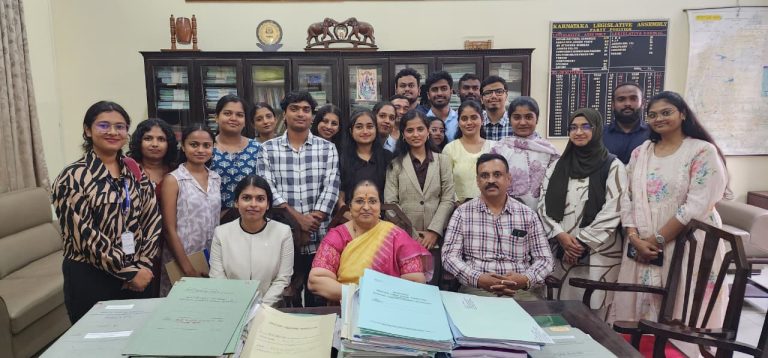
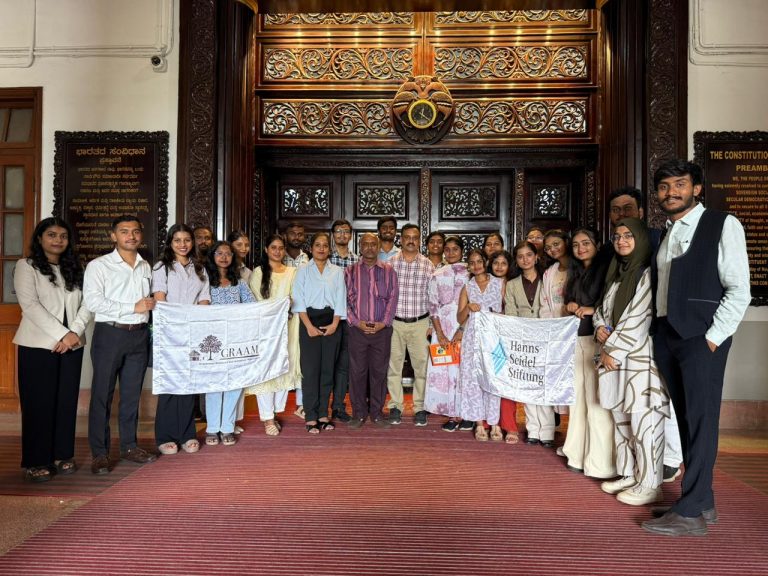
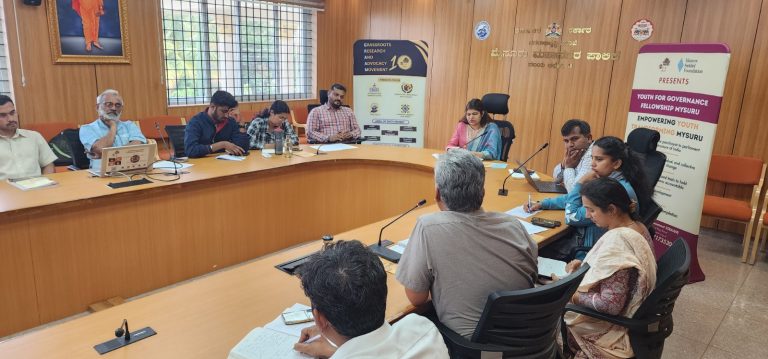
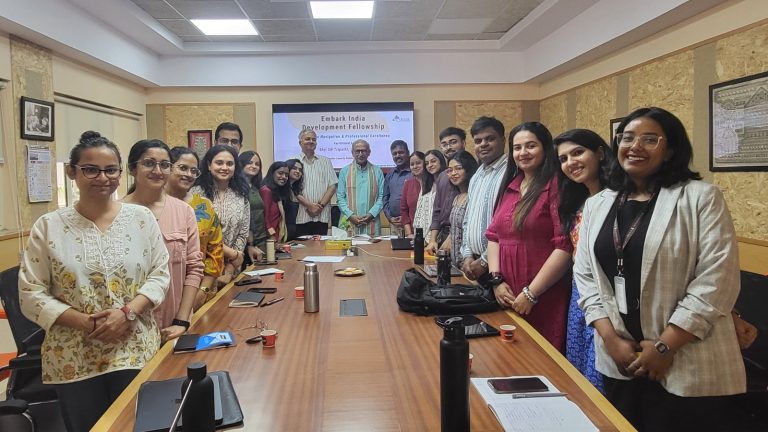

Youth participation in Urban local bodies are very important part of the present time