Dr. Basavaraju R Shreshta
Executive Director, Grassroots Research And Advocacy Movement (GRAAM) & National Coordinator – G20 Delivering Democracy Working Group (2023), India
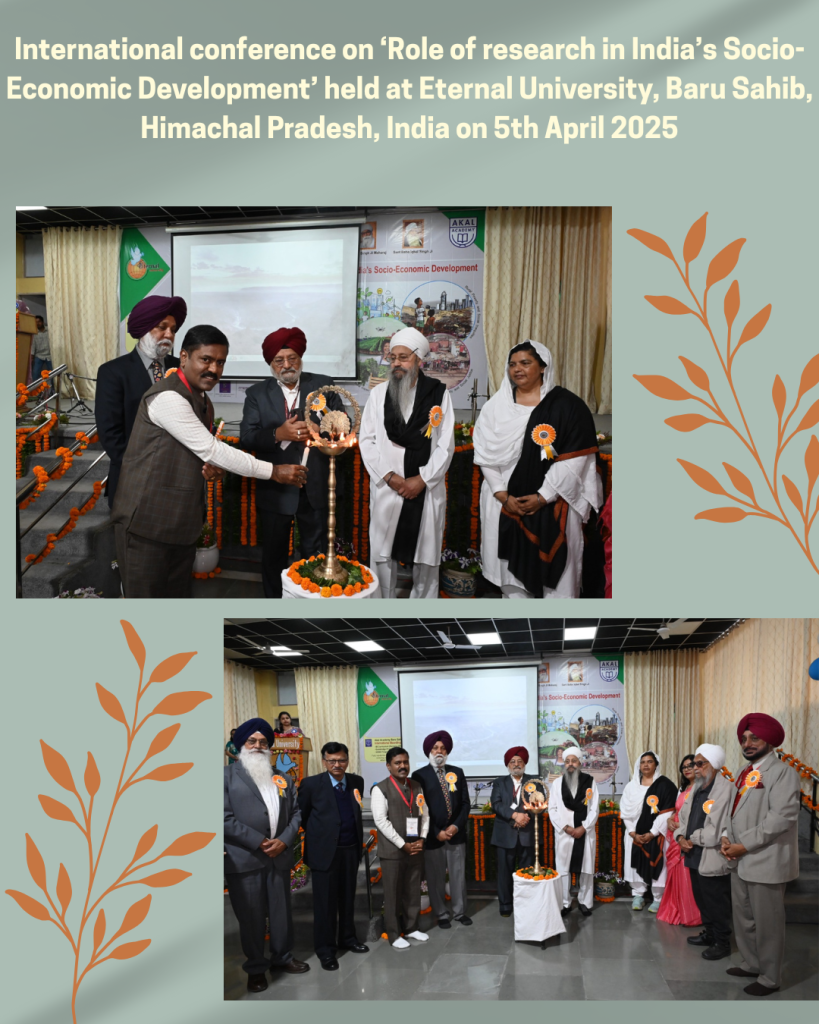
A blog post based on the keynote address by Dr. Basavaraju R Shreshta in the international conference on ‘ROLE OF RESEARCH IN INDIA’S SOCIO- ECONOMIC DEVELOPMENT’ held at Eternal University, Baru Sahib, Himachal Pradesh, India on 5th April 2025
A Lesson from the Field: Where Theory Meets Reality
Being invited to deliver the keynote at the International Conference on the Role of Research in India’s Socio-Economic Development at Eternal University, Baru Sahib, was a true honor. While the initial theme was broad, my thoughts kept returning to a paradigm I deeply believe in: the transformative power of interdisciplinary research.
As someone who transitioned from being a development practitioner to a researcher, my greatest learning has always come from the field, from engaging directly with communities. I often find more profound insights in those interactions than within the pages of academic literature.
So, when I took the stage at Eternal University, I felt it was crucial to begin not with abstract theories, but with a story – a personal experience that fundamentally shaped my understanding of development and the absolute necessity of viewing it through multiple lenses.
It was in 2007, early in my career, I was working in a rehabilitation camp for people displaced during the Bangla-Pak War. My role was to facilitate a focused group discussion. As the participants gathered, I struck up a casual conversation. My attention was drawn to a pregnant woman, visibly in her late stages.
Driven by my recent training in reproductive and child health, I started asking her the standard questions about antenatal care and nutrition. Her initial responses were hesitant, but I persisted. When I inquired about her dietary intake, her reply, delivered with a starkness that silenced the room, was, “You talk about eating healthy meals? I have given up eating.”
Her answer remains etched in my memory
“If I eat, I have to defecate. And for a pregnant woman without a toilet at home, having to walk kilometers multiple times a day is simply impossible.”
That single, raw exchange was a profound lesson. It illuminated the intricate web of development challenges, the deep interconnectedness of seemingly disparate issues, and the absolute necessity of a multidisciplinary approach to truly grasp the root causes, not just the superficial symptoms.
India’s Development in numbers – A story of Progress
This understanding is crucial when we consider the remarkable socio-economic progress India has made. Between 2014 and 2024, our nation has risen from the 10th to the 5th largest global economy. Our GDP per capita saw a significant 60% increase from 2014 to 2023, and our Human Development Index improved by 48.4% between 1990 and 2022.
We’ve witnessed :
- Near-universal access to electricity
- A dramatic surge in rural households with tap water
- Substantial growth in housing for the urban poor
- Our rural roads have expanded significantly, our airport infrastructure has more than doubled
- Our achievements in space, nuclear energy, manufacturing (now the second-largest mobile phone producer globally), and a vibrant startup ecosystem are undeniable.
- And a digital transformation reshaping governance and service delivery
Yet, despite these commendable strides, we must acknowledge the persistent challenges: rural poverty, uneven financial inclusion, and the urgent need for sustainable development. Achieving the Sustainable Development Goals (SDGs) by 2030 requires significant resources, and the estimated $200 billion annual funding gap, as highlighted by NITI Aayog, underscores the magnitude of the task ahead.
The Road Ahead: Complex Challenges Need Collaborative Solutions
I firmly believe in the power of interdisciplinary research. Traditional, siloed approaches, confined within the boundaries of individual disciplines, often fall short in addressing these complex, interconnected issues. For me, interdisciplinary research is the synergistic collaboration – the deliberate coming together of diverse minds from science, technology, social sciences, humanities, and policy research – to unlock new perspectives, generate novel insights, and ultimately drive transformative socio-economic progress.
From Policy to Practice: Insights from GRAAM’s Model
My experiences at GRAAM have deeply reinforced this conviction. Our very ethos is rooted in an interdisciplinary approach. Consider our work on a rural housing scheme where land procurement targets were consistently missed despite available funds. An analysis solely through an economic or engineering lens would have likely missed the critical bottleneck. It was only by bringing together economists, social scientists, and experts in revenue services and land administration that we identified the inadequate accountability measures within the land procurement policy. This diverse expertise allowed us to propose more realistic land valuation methods and a more effective implementation strategy.
The Role of Higher Education in Collaborative Research
I am encouraged by the emphasis on interdisciplinary higher education in India’s National Education Policy. Moving forward, universities have a crucial role to play in fostering this collaborative spirit. We need to establish formal partnerships with Think-and-Act tanks like GRAAM and other grassroots organizations, facilitate joint research projects, integrate interdisciplinary learning into curricula, create enabling environments for collaboration, and address the practicalities of such partnerships.
Eternal University, with its commitment to empowering young women, has a unique opportunity to champion this approach, equipping future leaders with the diverse skills and perspectives necessary to tackle India’s most pressing challenges.
In conclusion, I believe that interdisciplinary research is not just a desirable trend; it is an absolute imperative for India’s progress. By breaking down disciplinary silos, fostering genuine collaboration, and embracing the richness of diverse perspectives, we can unlock truly innovative and cost-effective solutions, paving the way for a more inclusive, sustainable, and prosperous future for all. My hope is that we continue to bridge these silos and work together to build the India we all aspire to see.