– By G Mallikarjuna Swamy, Head-Projects and Community Action
Wishing all the pioneers of grassroots governance a Happy National Panchayati Raj Day 2025!
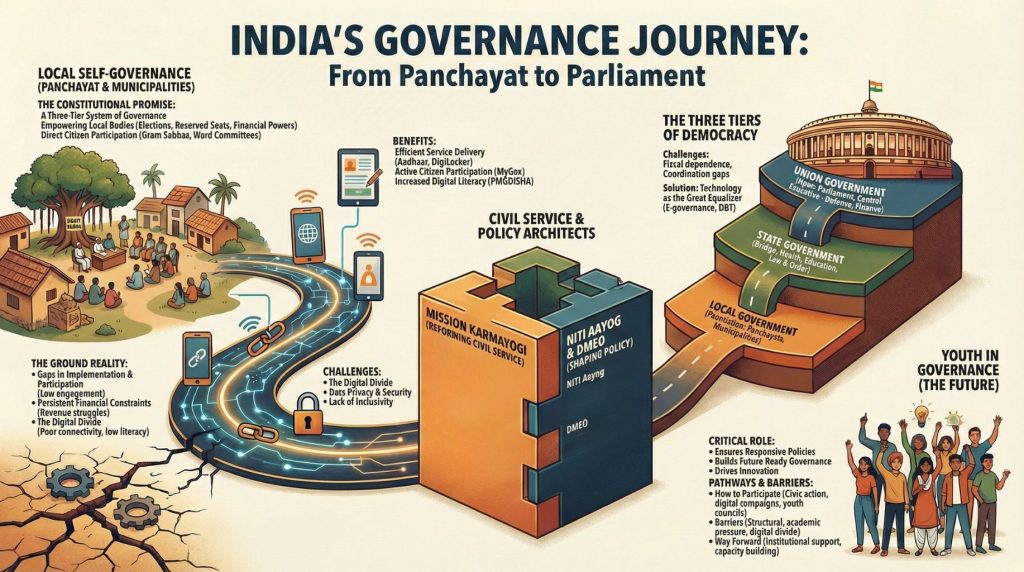
It has been over three decades since India’s landmark step towards constitutional decentralization through the 73rd Constitutional Amendment Act. In a country as diverse and populous as India, where the majority still reside in rural areas, effective governance demands a decentralized and inclusive approach.
The Vision Behind Decentralized Governance in India
Our founding leaders recognized that central or state-level administration alone cannot effectively address the distinct needs of every region. While pre-independence governance efforts—particularly in Karnataka—experimented with reforms, they were often top-down and failed to empower the people. Post-independence, several national committees explored the Panchayati Raj System, but a structured model remained elusive.
Mahatma Gandhi’s idea of Gram Swaraj—self-reliant villages—has been the philosophical cornerstone of local self-governance. In this light, the contribution of Shri Abdul Nazir Saab deserves special recognition.
Nazir Saab: Karnataka’s Pioneer of Decentralization
A visionary leader from Gundlupet, Chamarajanagar district, Nazir Saab was known for his political acumen and humility. As a respected member of the Legislative Council and Karnataka’s Minister for Rural Development and Panchayati Raj (RDPR), he championed decentralized administration at a time when most states were hesitant.
During national debates following the Ashok Mehta Committee’s recommendations, Nazir Saab boldly advocated for a two-tier Panchayati Raj System. Under his leadership, Karnataka passed the Zilla Parishads, Taluk Panchayat Samithis, Mandal Panchayats, and Nyaya Panchayats Act, 1983, creating a robust decentralized governance framework.
Key Features of Karnataka’s Decentralized Governance Model (1983):
- 25% reservation for women in local governance
- Establishment of Gram Sabhas for participatory decision-making
- Direct elections to select local representatives
- Creation of the role of ‘Pradhan’ as a powerful Mandal Panchayat leader
- Recognition of Zilla Parishad President with the status of a Minister of State
This innovative system significantly improved access to public services at the grassroots level. Its success drew national attention, prompting the then Prime Minister to commission a study on Karnataka’s Panchayati Raj model. The findings laid the groundwork for nationwide constitutional reforms.
From State Model to National Framework: Impact of Karnataka’s Reforms
While West Bengal, Rajasthan, and undivided Andhra Pradesh had also initiated decentralized governance models, Karnataka’s systematic and inclusive implementation became the gold standard.
This led to the introduction of the 64th Constitutional Amendment Bill, which initially failed in the Rajya Sabha. Undeterred, Prime Minister P.V. Narasimha Rao revived and refined the proposals, resulting in the landmark 73rd Constitutional Amendment Act (1992)—effective from April 24, 1993, now commemorated as National Panchayati Raj Day.
Key Features of the 73rd Constitutional Amendment:
- Mandatory Panchayat elections every five years
- Establishment of a State Election Commission
- Creation of a State Finance Commission
- 33% reservation for women
- Mandated Gram Sabhas for participatory governance
- Inclusion of 29 subjects under Panchayat jurisdiction (11th Schedule)
The first official celebration of National Panchayati Raj Day took place in 2010, reinforcing India’s commitment to grassroots democracy.
Karnataka’s Ongoing Leadership in Panchayati Raj
Following the constitutional mandate, Karnataka enacted the Karnataka Panchayat Raj Act, 1993, aligning with the 73rd Amendment. Decades later, the Act was revised and renamed the Karnataka Gram Swaraj and Panchayat Raj Act, reinforcing the spirit of self-governance and accountability.
Key reforms included:
- Disqualification of non-performing elected representatives
- Strengthened planning and accountability mechanisms
- Enhanced decentralized development planning from village to state level
Karnataka’s Panchayati Raj model remains a beacon for other states, particularly in its approach to bottom-up planning, inter-departmental convergence, and community participation.
Integrated Governance for Holistic Rural Development
Karnataka’s model has successfully fostered cross-sectoral collaboration among departments such as:
- Education
- Health
- Women and Child Development
- Agriculture and Allied Sectors
- Animal Husbandry
- Rural Development and Panchayat Raj
Through initiatives like KDP (Karnataka Development Program) quarterly review meetings, Gram Panchayats have been empowered to assess, coordinate, and drive holistic rural development.
Conclusion: Decentralization for Sustainable and Inclusive Development
Karnataka has not only shaped India’s Panchayati Raj history but continues to set benchmarks in decentralized governance. The Karnataka Gram Swaraj and Panchayat Raj Act institutionalizes participatory planning, transparency, and inter-sectoral collaboration.
Yet, planning is only the beginning. True transformation lies in effective implementation, empowered institutions, and accountable leadership. Karnataka’s model shows that with innovation and inclusivity, rural India can be both self-sufficient and sustainable.
Moving Forward: Priorities for Deepening Democracy
- Sustaining community-driven governance
- Improving public service delivery
- Strengthening financial autonomy of Panchayats
- Encouraging technology use for transparency
- Fostering inter-sectoral rural development
Karnataka’s unwavering commitment to Gram Swaraj and local democracy continues to guide India’s journey toward deeper decentralization and a stronger, more responsive democratic fabric.