From Grassroots to Governance – Exploring India’s multi-tier democracy, its linkages, challenges, and the promise of technology.
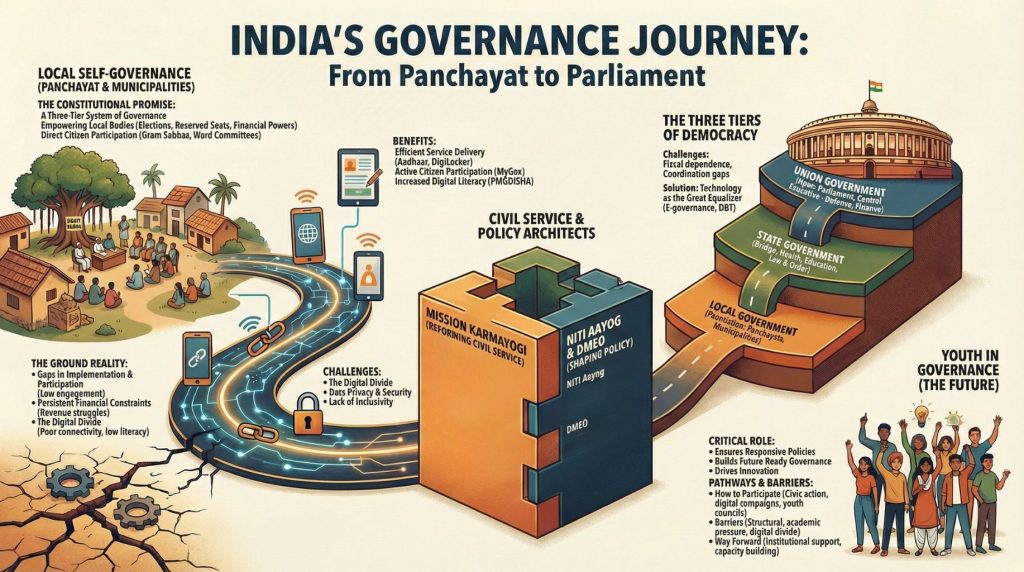
The Living Pulse of Indian Democracy: From the quiet deliberations under a village banyan tree to the resounding debates in Parliament, India’s governance system embodies one of the most inclusive democratic experiments in the world. It is a system designed to reflect the will of over 1.4 billion people. Stretching across a billion-plus citizens, this system is designed to ensure that power doesn’t remain confined to Delhi’s corridors, but reaches the smallest hamlet of the nation. At its heart lies a commitment to “government of the people, by the people, and for the people”, achieved through a multi-tier structure that harmonizes local participation with national vision.
India’s governance system is a living embodiment of democratic decentralization, a vast network stretching from the humble village panchayat to the majestic halls of Parliament. It is a system designed to reflect the will of over 1.4 billion people, enabling participation, representation, and accountability at every tier. The Indian model is not merely an administrative hierarchy; it is an intricate federal framework built on cooperation, coordination, and shared responsibility between the Union, States, and local governments.
1. The Multi-Tier Governance and Federal Structure – Power Shared, Not Concentrated
India’s governance model is not a single pyramid of power, but a network of interlinked tiers, local, state, and national, each with distinct responsibilities yet united by shared goals. “India is a Union of States,” declares Article 1 of the Constitution, a statement that captures both unity and diversity within governance.
a. The Three Tiers at a Glance
Local Governments: Panchayats and Municipalities
Empowered through the 73rd and 74th Constitutional Amendments (1992), local self-governments give citizens a direct hand in decision-making. Panchayats manage rural development, while urban local bodies (ULBs) handle city governance from waste management to infrastructure.
State Governments: The Mid-Level Pillars
States bridge local concerns with national policies. They oversee subjects such as health, education, and law & order. The Seventh Schedule divides powers into Union, State, and Concurrent Lists, creating a constitutional map of responsibility.
Union Government: The Apex Policy-Maker
At the top sits the Parliament and Central Executive, responsible for national priorities — defense, foreign affairs, finance, and inter-state coordination.
b.Cooperative Federalism in Motion
India’s federalism thrives on cooperation rather than competition. Institutions like the Finance Commission, NITI Aayog, and Inter-State Council ensure fiscal balance and policy coordination. This “quasi-federal” design allows diversity in governance while maintaining national unity.
2. Institutional Linkages: Governance as a Chain that Connects, Not a Ladder
India’s democracy works because its institutions are interlinked rather than isolated.The strength of India’s democracy lies in how seamlessly these institutions communicate and cooperate.
- Policy Linkages: National missions such as Swachh Bharat Abhiyan and PM Awas Yojana begin as central policies but find life through state machinery and panchayat-level implementation.
- Fiscal Linkages: Devolution of funds follows a structured path from the Union Finance Commission to the State Finance Commissions, ensuring local bodies receive financial support for their functions.
- Administrative Linkages: The All India Services (IAS, IPS, IFS) create a professional thread across tiers, ensuring consistency in governance standards nationwide.
- Political Linkages: Every five years, citizens elect representatives at each level, panchayat members, MLAs, MPs strengthening democratic accountability and creating a ladder of leadership.
3. The Systemic Fault Lines: Persistent Systematic Issues and Challenges
While India’s governance framework is robust in design, it faces real-world complexities that often hinder effective functioning. Despite its depth, India’s governance system grapples with real challenges:
- Fiscal Dependence: Local bodies often remain dependent on grants, undermining their autonomy and decision-making capacity.
- Coordination Gaps: Overlapping jurisdictions between departments and governments lead to delays and inefficiencies.
- Political and Social Capture: Panchayats, meant to empower the marginalized, are sometimes controlled by local elites, limiting genuine participation.
- Capacity and Skill Deficits: Lack of trained personnel and weak data systems restrict evidence-based decision-making at the grassroots.
- Transparency and Accountability: Bureaucratic opacity and corruption continue to challenge citizen trust.
“The health of democracy depends not only on good laws, but on the strength of institutions and the people who run them.”
– Barack Obama
4. Reforms: Building a Stronger Governance Chain of Democracy
- Reforming governance means empowering every tier, especially the base. For governance to truly flow from Panchayat to Parliament, reforms must focus on empowerment, efficiency, and equity.
- Empowering Local Governments: Strengthen fiscal independence through predictable revenue-sharing, local taxation powers, and performance-linked incentives.
- Capacity Enhancement: Continuous training for elected representatives and civil servants to improve administrative competence and digital literacy.
- Participatory Planning: Promote Gram Sabhas and ward committees as active platforms for community-based decision-making.
- Institutional Synergy: Enhance coordination between District Planning Committees, state governments, and national ministries to align developmental priorities.
- Accountability Frameworks: Strengthen audit systems, citizen report cards, and social audits to ensure transparency in governance outcomes.
5. The Digital Bridge: Technology as a Great Governance Equalizer
In the 21st century, technology is the new architecture of governance. Technology has become the invisible thread stitching India’s multi-tier democracy together. It is transforming how citizens connect with the State from paperwork to portals, from queues to clicks.
- e-Governance Initiatives: Platforms like e-Gram Swaraj, MyGov, and UMANG foster citizen participation and service delivery efficiency.
- Direct Benefit Transfers (DBT): Aadhaar-linked payments ensure that subsidies and welfare schemes reach the right beneficiaries without leakages.
- Data-Driven Governance: Dashboards and digital mapping tools empower administrators to make real-time, evidence-based decisions.
- Online Grievance Redressal: Portals like CPGRAMS and Jansunwai promote transparency and responsiveness.
- Digital Connectivity: Projects like BharatNet are bringing broadband to every village, bridging the rural-urban divide and empowering local councils with information access.
“In a country as vast as India, technology doesn’t just assist governance, it equalizes it.”
–Ashwini Vaishnaw
A Living Continuum of Democracy: India’s governance system is more than a constitutional structure, it is a living continuum of democratic participation. As rightly stated by Dr. K. Sudhakar “From Panchayat to Parliament, India’s democracy is vibrant, inclusive and deeply rooted in our civilizational ethos”. From the Panchayat that decides on a village’s well to the Parliament that frames national policy, every tier reflects the same democratic heartbeat.
The journey from local to national governance is one of shared responsibility, continuous adaptation, and technological evolution. As India marches deeper into the digital age, the synergy between its institutions will determine how effectively democracy delivers not just as a political ideal, but as a lived experience for every citizen.
“From Panchayat to Parliament, India’s governance story is one of voices, visions, and vibrant participation, the truest reflection of democracy in motion.”