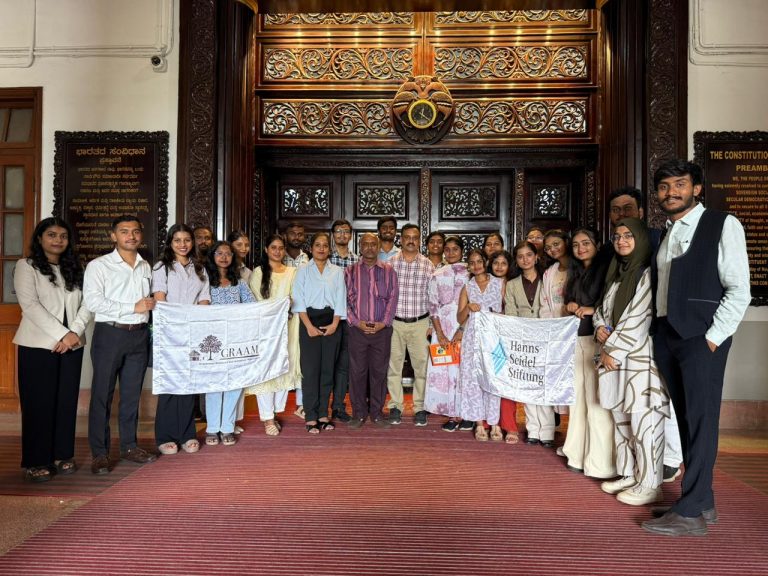
The Governance Expedition to New Delhi as part of the Youth for Governance Fellowship – 2025 was a journey that I will always remember, not just for the institutions we visited, but for the way it shaped my thinking. What began as an academic exposure soon became a deeply personal learning experience. From travelling together as fellows to stepping into institutions that shape the country’s policies and democratic processes, every moment contributed to my understanding of governance beyond textbooks.
This visit gave me the opportunity to see, listen, observe, and reflect. Being present in spaces where decisions are discussed and policies are shaped helped me connect my academic background in social work with the larger framework of governance. More importantly, it encouraged me to reflect on my own role as a young citizen and the ways in which youth can meaningfully contribute to building a more just, inclusive, and responsive system of governance.
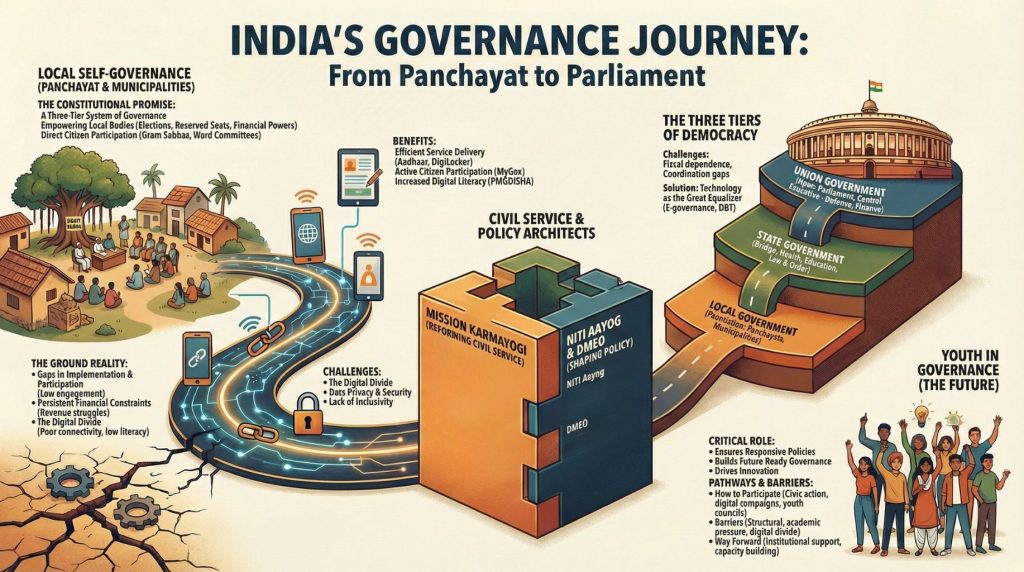
India’s approach to governance and development has evolved significantly in recent years, moving away from rigid, centralized planning toward a more flexible, participatory, and evidence-driven model. At the centre of this transformation is NITI Aayog, along with its specialised evaluation arm, the Development Monitoring and Evaluation Office (DMEO). Together, they represent a shift in how policies are designed, monitored, and improved to create real impact on the ground.
NITI Aayog, the National Institution for Transforming India, was established on 1 January 2015, replacing the Planning Commission of India. Unlike its predecessor, NITI Aayog does not function as a fund-allocating authority. Instead, it serves as a policy think tank and knowledge hub, focusing on long-term vision, strategic policy inputs, and cooperative federalism. The institution emphasizes a bottom-up approach, encouraging active participation from States, districts, and local bodies in shaping India’s development agenda. Its work aligns national priorities with global commitments such as the Sustainable Development Goals, while keeping governance flexible, inclusive, and forward-looking.
Within NITI Aayog, the Development Monitoring and Evaluation Office plays a crucial role in ensuring that policies translate into measurable outcomes. Established in September 2015, DMEO strengthens the monitoring and evaluation ecosystem of government programmes. It focuses on tracking flagship schemes, evaluating their effectiveness, and providing evidence-based feedback for policy improvement. Through structured outcome frameworks, independent evaluations, and data analytics, DMEO helps shift governance from an input-based approach to one that is outcome- and impact-oriented.
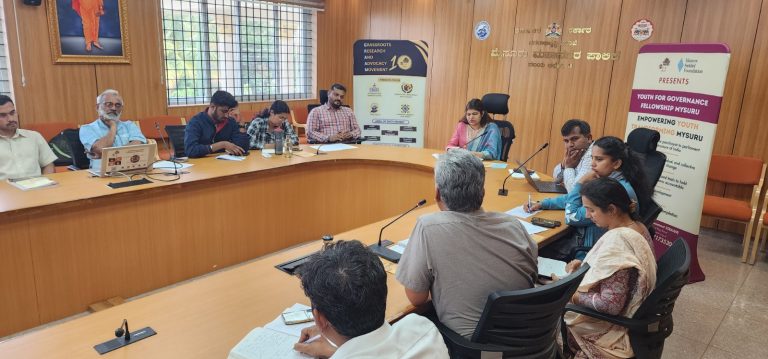
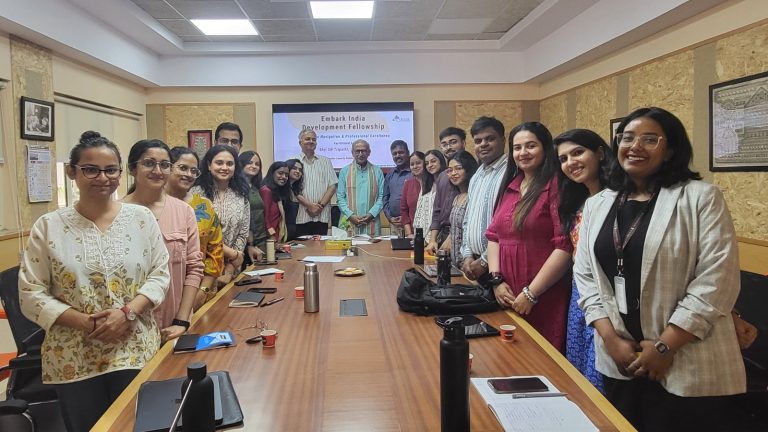
Our engagement as Youth for Governance Fellows with NITI Aayog and DMEO offered valuable insights into how governance functions beyond policy documents and classroom learning. What stood out most was the strong emphasis on data, evidence, and accountability. Discussions were not limited to what schemes were launched, but centred on whether they were achieving their intended objectives, reaching the right beneficiaries, and creating meaningful change. This approach highlighted how evaluation is used not as a fault-finding exercise, but as a tool for learning and continuous improvement.
We witnessed how DMEO uses dashboards, monitoring frameworks, and real-time data tools to assess the progress of government programmes. Initiatives such as the Aspirational Districts Programme demonstrated how data-driven monitoring can spotlight regional disparities and guide targeted interventions in underserved areas. The interaction between central ministries, state governments, and district-level administrations reflected the complexity of governance in a diverse country like India, and the importance of coordination across all levels.
From a learning perspective, this experience was both enriching and humbling. It reinforced the idea that policymaking is an ongoing process that requires regular review, adaptability, and openness to feedback. The collaborative nature of DMEO’s work, involving academic institutions, research bodies, and international organizations, further showed how evidence-based governance thrives on partnerships and shared knowledge.
Perhaps the most important takeaway was understanding how institutions like NITI Aayog and DMEO help bridge the gap between policy intent and people’s lived realities. By systematically monitoring outcomes and evaluating impact, policymakers are better equipped to respond to ground-level challenges and ensure that development remains people-centric and inclusive. For students and young professionals, this exposure underscored the relevance of data, research, and evaluation in achieving social justice and sustainable development.
In conclusion, NITI Aayog and DMEO together represent the evolving face of Indian governance, strategic, collaborative, and evidence-driven. Witnessing their work firsthand deepened our understanding of how policies are shaped, implemented, and refined to deliver real impact. This experience has not only strengthened our appreciation for outcome-based governance but has also inspired a deeper engagement with public policy, research, and community-oriented development in the future.
By
Akshatha, Y4G fellow, GRAAM