
–Ramya C, Embark India Development Fellow
Co-Authored and Mentored by Dr. Ananya Samajdar, Deputy Director of Research,GRAAM.
In FY 2022–23, India’s North Eastern Region (NER) received just 2.8% of the country’s total Corporate Social Responsibility (CSR) spending, ₹638.78 crore across eight states. In the same year, Maharashtra alone received over ₹5,000 crore. Even within the NER, this limited pool is unevenly distributed: Assam accounts for more than 70% of CSR inflows, leaving the remaining states to share a small fraction. On a per-capita basis, this gap is equally stark: Maharashtra received approximately ₹397 per person in CSR spending, compared to roughly ₹120 per person across the NER, a nearly three-fold disparity that holds even after accounting for population differences (Ministry of Corporate Affairs, 2023; Ministry of Health and Family Welfare, 2020; population projections for FY 2022–23).
These numbers are often cited to highlight the region’s underfunding. But they point to a deeper issue. The question is not only whether CSR reaches the North East in sufficient volume, it is also whether, when it does, it also aligns with what the region actually needs.
Over the past decade, CSR has become one of India’s largest pools of directed private development finance. Mandated under the Companies Act, 2013, eligible firms are required to spend 2% of their average net profits on social development. National CSR spending has crossed ₹1.8 lakh crore, with education and healthcare consistently receiving the largest share (PIB, 2024).
At the same time, the North East occupies a central place in India’s development vision. Policy frameworks, from the Union Budget’s Purvodaya initiative to the broader Viksit Bharat @2047 agenda, emphasise inclusive growth in the region. The NER is also ecologically significant, socially diverse, and developmentally uneven, with persistent gaps in livelihoods, infrastructure, and service delivery (NITI Aayog & MDoNER, 2024).
This creates a paradox. A region that is repeatedly identified as a national priority remains peripheral in one of the country’s most significant development financing streams.
Part of this gap is structural: CSR spending tends to follow the geography of corporate India. Large firms, and therefore large CSR budgets, are concentrated in industrialised states such as Maharashtra, Karnataka, and Gujarat. The North East, with relatively limited industrial presence, attracts far fewer CSR-contributing companies (CSDD & NEDF, 2024 ; Bharat CSR, 2025).
Within the region, the same pattern repeats itself. Assam, with a relatively stronger industrial base, captures the majority of CSR inflows, while smaller states receive minimal allocations.
But geography alone does not fully explain the problem. Even within the limited CSR that reaches the NER, there is a question of alignment.
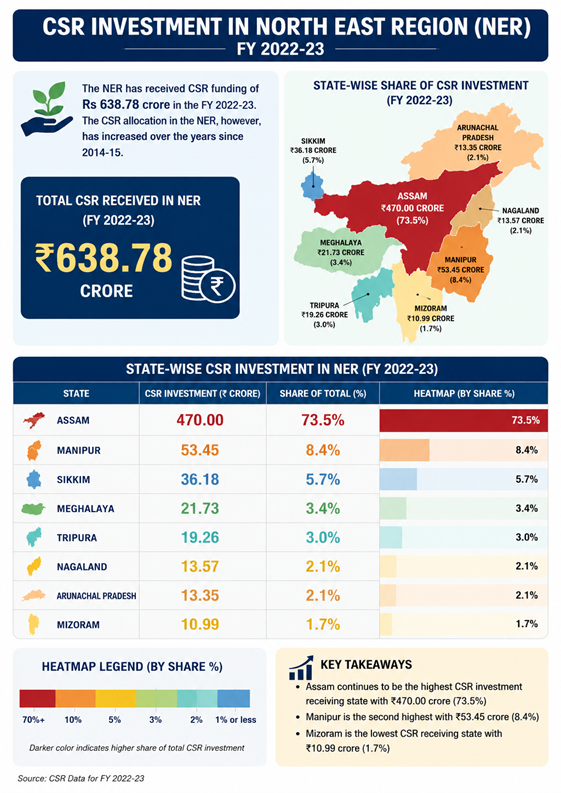
Image 1 : Infographic representing the CSR distribution within the NER States
CSR investments in the region mirror national trends, concentrating heavily on education and healthcare. These sectors are important, but they do not fully reflect the development profile of the North East. The region’s priorities, articulated through state plans and the UNDP–NITI Aayog NER District SDG Index (UNDP India & NITI Aayog, 2025), include environmental sustainability, livelihood support for tribal communities, gender empowerment, and cultural preservation. Yet these areas receive relatively limited CSR attention, and in some cases declining allocations (Poddar et al., 2025; CSDD & NEDF, 2024).
This mismatch is not incidental. CSR decisions are typically made at the firm level, shaped by operational convenience, reporting requirements, and reputational considerations. Companies often prioritise projects that are easier to implement and measure, such as infrastructure or short-term service delivery. By contrast, investments in livelihoods, ecology, or community systems tend to be longer-term, less visible, and harder to quantify.(Outlook Business Desk, 2026)
The result is a shift from need-driven allocation to activity-driven spending. Funds flow, but not necessarily to the sectors or districts where they could generate the greatest developmental impact. (CSDD & NEDF, 2024; Poddar et al., 2025)
A second, less visible issue lies in the absence of coordination. Unlike public expenditure, which follows structured planning processes, CSR operates as a decentralised system. Companies make allocation decisions with limited visibility into district-level development gaps or state priorities.
At the same time, governments have begun generating precisely this kind of data. Tools like the NER District SDG Index provide granular insights into development deficits across districts. However, there is no systematic mechanism to integrate this data into CSR decision-making.
This creates a disconnect. On one side, there is detailed evidence on where interventions are needed. On the other hand, there are corporate resources being deployed without consistently engaging with that evidence.
For companies, this also translates into higher transaction costs. Investing in remote or underdeveloped regions requires identifying credible partners, managing logistical challenges, and operating within the 5% administrative cap under CSR rules. In states with limited institutional capacity, these constraints are even more pronounced. As a result, companies often gravitate toward geographies where execution is simpler and risks are lower (Bharat CSR, 2025)
Taken together, these factors, corporate geography, thematic preferences, and coordination gaps, shape a system where CSR allocation is driven more by feasibility than by need.
There are, however, early signs of change. Several states have begun experimenting with platforms that actively connect CSR supply with development demand. Karnataka’s Akanksha platform and Odisha’s GO CARE portal align corporate CSR goals with identified development gaps. More recently, Mizoram launched its CSR Connect portal, supported by a dedicated CSR cell, to facilitate partnerships and attract targeted CSR investment.
These initiatives point to an important insight: the CSR gap is not only about intent, it is also about information and coordination. When companies have clearer visibility on where to invest, whom to partner with, and what outcomes to expect, investment decisions can become more strategic.
For the North East, this suggests a practical pathway forward. The region already has access to detailed development diagnostics, for instance, the NER District SDG Index 2023–24 (UNDP India & NITI Aayog, 2025) maps development deficits at the district level across all eight states, yet this evidence is rarely integrated into company-level CSR planning. The next step is to translate these into actionable pipelines, clearly defined projects, credible implementing partners, and outcome-linked frameworks that align corporate and public priorities.
At a broader level, there is also space for policy innovation. While the current CSR framework provides flexibility, it does little to address regional imbalances. Carefully designed incentives, particularly for investments in underserved regions or aspirational districts, could help rebalance flows without undermining corporate autonomy.Targeted incentives , such as a weighted deduction for CSR expenditure in aspirational districts under the government’s existing Aspirational Districts Programme, or a National CSR Impact Index recognising companies that invest in chronically underserved regions, could help reorient flows without mandating specific outcomes or undermining corporate discretion.
Ultimately, the challenge is not just about increasing CSR flows to the North East. It is about ensuring that these flows are aligned, intentional, and capable of supporting long-term development outcomes.
A decade after CSR became mandatory, India has built a substantial pool of private development finance. The next phase will depend on how effectively this capital is directed. For regions like the North-East, bridging the gap between where CSR goes and where it is needed most is essential, not only for regional equity, but for the credibility of CSR as a development instrument. Key research gaps remain: there is limited evidence on the effectiveness of CSR interventions in the NER relative to demonstrated need, and no systematic study linking district-level SDG deficits with actual CSR allocation patterns across states. Future research would examine whether coordination platforms like Mizoram’s CSR Connect meaningfully shift investment geography over time, and whether incentive-linked frameworks produce more need-aligned outcomes than the current discretionary model.
About the Author
Ramya C is a fellow with the Embark India Development Fellowship placed at the Department of Public Enterprises (DPE), where her work focuses on analysing CSR investment patterns and their alignment with regional development priorities in India’s North Eastern Region. Her research examines disparities in CSR allocation, links between CSR flows and SDG outcomes, and pathways for strengthening strategic, data-driven CSR planning under the vision of Viksit Bharat @2047. This blog was developed under the mentorship and guidance of Dr. Ananya Samajdar, Deputy Director – Research at Graam.
References
- Annual filings by companies on development CSR expenditure totals over ₹1,44,159 crores in last five FYs (2019–20 to 2023–24). (n.d.). Press Information Bureau. https://www.pib.gov.in/PressReleseDetailm.aspx?PRID=2226018®=3&lang=2
- Bharat CSR. (2025). Bharat CSR Performance Report FY 2023 – 2024. https://fulcrum.vision/wp-content/uploads/2025/06/Bharat-CSR-Performance-Report-2025-1.pdf
- CSDD, & NEDF. (2024). A decade of corporate social responsibility (CSR) in the North East Region (NER) of India (Table 6.1: CSR allocation in various sectors, 2018–19 to 2022–23).
- Government of India, Ministry of Finance. (2024). Economic survey 2023–24: CSR spending reaches ₹1.53 lakh crore (2014–2022).
- Government of India, Ministry of Finance. (2026). Union budget 2026–27 speech (Point 90: Purvodaya initiative).
- Ministry of Health and Family Welfare. (2020). Population projection by Gender, Social Groups and age-group, 2022. In Report of the Expert Group on Population Projection. https://www.education.gov.in/sites/upload_files/mhrd/files/statistics-new/Population_2223_0.pdf
- Mizoram launches CSR Connect portal. (n.d.). Department of Information & Public Relations, Government of Mizoram. https://dipr.mizoram.gov.in/post/chief-minister-inaugurates-csr-matchmaking-portal-mizoram-csr-connect
- Ministry of Corporate Affairs. (n.d.). National CSR portal: State-wise CSR expenditure data, FY 2022–23. https://www.csr.gov.in
- NITI Aayog, & Ministry of Development of North Eastern Region (MDoNER). (2025). SDG-NER report. https://niti.gov.in/sites/default/files/2025-07/SDG-NER-Report.pdf
- Odisha GO CARE CSR Portal. (n.d.). Government of Odisha. https://csr.odisha.gov.in/
- Outlook Business Desk. (2026, March 30). CSR funding set to hit ₹35000 crore by FY25, but startups still struggle for Long-Term capital. Outlook Business. https://www.outlookbusiness.com/circularity/csr-funding-set-to-hit-143-lakh-crore-by-fy25-but-startups-still-struggle-for-long-term-capital
- Poddar, A., Bagadeem, S., & Magry, M. A. (2025). Aligning corporate social responsibility with sustainable development goals in India across pandemic phases. Discover Sustainability, 6, 1355. https://doi.org/10.1007/s43621-025-02223-4
- UNDP India, & NITI Aayog. (2025). NER district SDG index and dashboard 2023–24. https://www.undp.org/india/publications/north-eastern-region-district-sdg-index-report-2023-24
- UNDP SDGCC. (2021). Akanksha, Karnataka’s SDG-aligned CSR matchmaking platform. https://sdgknowledgehub.undp.org.in/sdgcc/
- UNESCO, & ILO. (2014/2025). Mandatory corporate social responsibility (CSR) in India. https://www.unesco.org/en/dtc-financing-toolkit/mandatory-corporate-social-responsibility-csr-india



Ramya, this is a beautiful piece.
CSR funds remain at the discretion of corporates, and that autonomy is exactly where the trouble begins. Many companies still fail to deploy these funds on time, so resources end up wasted or hastily channelled at the last moment just to meet the compliance criteria. The intent gets lost in the rush to tick the box.
On the North East and regional allocation, better distribution is certainly possible, but the real question is where we stand on the policy end to ensure that distribution actually happens. A decade in, the deeper question still lies here: does simply mandating a percentage of profit as CSR truly serve the purpose? And what regulatory mechanism exists to check whether the funds are being utilised in the right spirit, and not merely spent?
With the mandate now firmly enforced, what we need is a clear policy map that addresses a few things:
How companies plan their initial CSR budgets?
How areas of focus are identified and prioritised?
How execution is monitored against actual regional need?
If the goal is genuine social upliftment, and regions like the North East remain infrastructurally underserved, then perhaps the more interesting question is this: can we borrow from the PPP model of commercialisation and reimagine a new design of the PPP model for the CSR sector, one where the government's development vision, often stalled for want of funds, is handed over to CSR to build those very public assets?
One company alone can only cover a drop in the sea. But the whole sea can be covered when funds are pooled, goals are shared, and partners collaborate, unlocking a far larger corpus that could be directed toward capital and infrastructure where it is needed most and thats what NE needs the most right now.
In this way, the wastage and leakage of CSR funds would stop, and as a nation, we would be channelling these funds into real development. Development need not wait only for tax revenues to be raised; the growth of a country should not rest on taxes alone, but on the shared responsibility of both the private and the public.
Just a long time thought running in my mind understanding the loopholes and how can be made it better. Feel free to disagree and correct me. Will be happy to learn and be inspired from your thoughts too.
This article reminds me of a challenge many humanitarian actors observed in 2023.
Two major crises unfolded almost simultaneously: the ethnic violence in Manipur (from May 2023 onwards) and Cyclone Biparjoy, which struck Gujarat in June 2023. While both required urgent humanitarian assistance, the response environment was markedly different.
In the humanitarian sector, I witnessed strong interest from companies and CSR teams to support cyclone response and recovery efforts in Gujarat. By contrast, mobilising support for Manipur's displaced communities was significantly more difficult, despite the violence displacing over 60,000 people and triggering a prolonged humanitarian crisis.
This is not to argue that Biparjoy did not deserve support. Rather, it highlights the concern raised in the article: development often follows visibility, corporate presence, ease of implementation, and existing institutional networks along with political situation rather than need alone.
The Manipur crisis offers an important example of why CSR and philanthropic investments need stronger mechanisms to identify and support underserved regions and complex emergencies, particularly in the North East. Otherwise, even when needs are acute, resources may continue to flow disproportionately toward geographies that are already better connected to corporate India.