Background
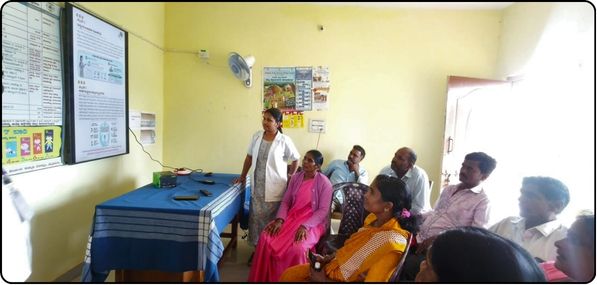
Under the Swasthya Swaraj Project, Digital Display Systems have been installed at Ayushman Arogya Kendras (AAKs) to strengthen Information, Education and Communication (IEC) activities and promote awareness on maternal and child health, immunisation, nutrition, non-communicable diseases, sanitation, preventive healthcare, and various government health programmes.
A Digital Display System was allocated to the Hulyalu Ayushman Arogya Kendra; however, it could not be installed because the Sub-Centre had been without a functional electricity connection for over five years. Consequently, the health facility was unable to utilise this important IEC resource, limiting opportunities to improve community awareness and health-seeking behaviour.
The Challenge
Despite repeated representations by the Community Health Officer (CHO) to the Gram Panchayat Development Officer (PDO), the electricity issue remained unresolved for several years. The absence of electricity affected not only the functioning of the health facility but also prevented the operationalisation of the Digital Display System, depriving the community of a valuable platform for accessing health information.
Convergence and Collective Action
- Determined to resolve the issue, the Community Health Officer, Mr. Harshith, once again engaged with the Gram Panchayat Development Officer.
- During the discussion, the PDO advised that an official request from the Health Department would facilitate the required administrative approval.
- Acting on this suggestion, the Community Health Officer approached the Taluk Health Officer (THO), who promptly issued an official communication to the Gavadagere Gram Panchayat requesting immediate restoration of the electricity connection.
- Following this, the Community Health Officer, supported by the Swasthya Swaraj Project’s Community Facilitator, maintained continuous follow-up with the Gram Panchayat.
- This sustained coordination between the Health Department, Gram Panchayat, and the Swasthya Swaraj Project created the momentum needed to resolve the long-pending issue.
Recognising the importance of strengthening health services within the village, the Gram Panchayat responded positively by approving and completing electrical repair works worth approximately ₹22,000, restoring electricity to the Ayushman Arogya Kendra after more than five years. The initiative reflected the value of convergence, institutional accountability, and shared commitment to improving community health infrastructure.
Outcome
The collaborative effort resulted in several significant outcomes:
- A five-year-old electricity issue was successfully resolved through coordinated institutional action.
- The Digital Display System became fully operational, enabling regular audio-visual health education for patients and community members.
- Community access to reliable information on key health issues and government health programmes was significantly improved.
- Convergence and collaboration between the Health Department, Gram Panchayat, and the Swasthya Swaraj Project were strengthened.
- The initiative demonstrated that persistent follow-up, effective coordination, and local leadership can successfully resolve long-standing infrastructure challenges without additional project investments.
Key Learning
The Hulyalu experience demonstrates that many persistent challenges within primary healthcare can be addressed through proactive leadership, convergence among government institutions, and sustained follow-up. The leadership of the Community Health Officer, timely intervention by the Taluk Health Officer, responsive support from the Gram Panchayat, and continuous facilitation by the Swasthya Swaraj Project collectively enabled the mobilisation of local resources and institutional action. The experience reinforces that strengthening health systems is not only about creating new resources but also about facilitating collaboration, accountability, and effective utilisation of existing government systems.
Conclusion
The Hulyalu Ayushman Arogya Kendra illustrates how convergence, community-centred facilitation, and institutional collaboration can transform a long-neglected infrastructure challenge into an opportunity to strengthen primary healthcare. By restoring electricity, the health facility became capable of delivering technology-enabled health education through the Digital Display System, enhancing community awareness and health-seeking behaviour. More importantly, the experience demonstrates the Swasthya Swaraj Project’s approach to systems strengthening—bringing together the Health Department, Gram Panchayat, and community stakeholders to build sustainable, responsive, and accountable primary healthcare services.