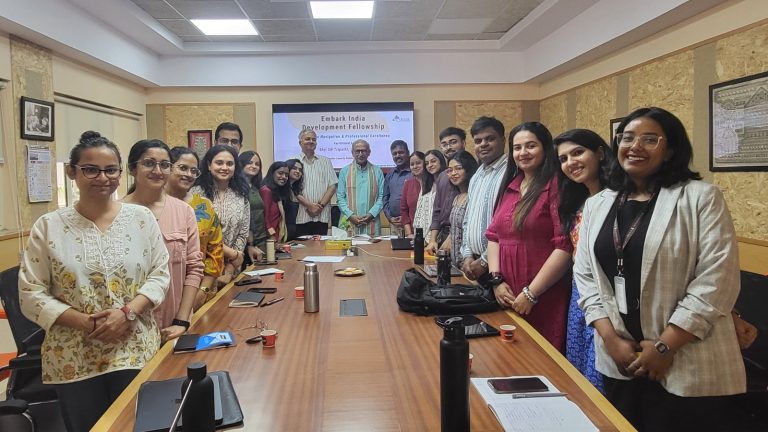
–Shalvi Suman, Embark India Development Fellow.
Mentored by Shri Anand Mohan (CEO, National CAMPA), Prof. Vivek Kumar (IIT Delhi) and Dr. Balu I (Senior Research Fellow, GRAAM).
In the dense forests of Dibang Valley, the Idu Mishmi tribe perceives tigers not as predators, but as biological brothers, making them a foundational branch of their lineage1. Meanwhile, in the rugged hills of Jawai, Rabari pastoralists coexist with leopards, regarding them as sacred guards of the village, protecting them from external threats and misfortune2. Beyond folklore, these portray the living blueprints of an indigenous conservation paradigm defined by the shared landscape ideology. For many indigenous people, the distinction between the human and natural world is often blurred. Some cultures depict human relatedness to nature as a type of kinship: parent–child relationship, sexual relatedness or procreation relatedness3,4,5. This can be seen in some farming societies in India where forests are seen as ancestors who unconditionally provide food, portraying the forest as a parent and the people as children of the forest. This profound bond between indigenous people and wildlife is a cornerstone of India’s civilizational ethos, representing a unique cultural heritage that has the potential to position India as a global leader in compassionate environmental conservation. However, the operationalisation of these ideals in the policy space often faces significant friction when met with the complexities of ground reality.
Human-Wildlife Shared Landscape
India’s remarkable wildlife conservation successes have inadvertently pushed the ecological carrying capacity of its protected areas, forcing 30–40% of tigers and elephants to venture beyond forest boundaries into human settlements for sustenance. India now supports nearly 75% of the global wild tiger population and 60% of Asian elephants6,7,8, all while grappling with the demands of the world’s largest human population. As a result, human-wildlife conflict cases in India are escalating each year; elephant-related encounters alone result in over 500 annual human deaths6, along with significant livelihood related damages such as livestock predation, crop raids and property damage. Due to the shrinking habitats and continued growth of both human and wildlife populations, this geographic overlap is becoming an inevitable reality that is only going to increase over time.
While indigenous communities possess ancestral wisdom for navigating these high-stake interactions with potentially damage-causing megafauna, contemporary forest governance mechanisms in India remain anchored in the colonial-era fortress conservation model which prioritizes spatial segregation, frequently viewing the presence of local communities as an inherent threat to biodiversity. The two dominant forest management acts, Wildlife Protection Act (WPA) and Forest Rights Act (FRA) frequently operate as binary opposites rather than integrated tools, creating policy friction that leaves both wildlife and people vulnerable.
Indigenous Conflict Mitigation Strategies
Addressing human-wildlife conflict requires a multifaceted strategy as it sits at the volatile intersection of ecological survival, economic security, and deeply ingrained cultural identities. Effective mitigation requires a holistic approach by facilitating a shift beyond purely technocratic measures toward interdisciplinary innovative approaches that harmonize administrative law with the ancestral wisdom of those who live on the front lines. The current conflict mitigation approaches rely heavily on reactive, post-facto measures, primarily in the form of financial compensation schemes which often cover only a fraction of the actual economic loss9. This, along with stringent documentation requirements and bureaucratic red tapes, further alienates victims6,10. Another very important aspect of this compensation efficacy issue is the cultural relationship of communities with specific megafauna such as elephants, tigers, and leopards, where victims feel that filing for complaint may upset the forest deity and hence bring forth severe misfortune. Ultimately, these economically centric mitigation measures overlook the emotional burden and cultural nuances, and they may fail to foster harmonious human–wildlife coexistence because they miss the opportunity to instill long-term conservation responsibility in local communities.
Indigenous Ecological Knowledge around wildlife including rituals, conflict prevention and mitigation measures, conflict-coping mechanisms, etc. showcase a long history of organically developed wildlife coexistence strategies.
For example:
- Tong used by Bodo in the Brahmaputra valley is a low-cost bamboo watch tower used as a safehouse and to protect crops from elephants and other herbivores during the harvest season.
- Biofencing used by farmers in Odisha and the Malenadu region is a fencing technique in which unpalatable species like chili, lemon, and agave create olfactory and physical barriers that mask the scent of crops and deter elephants and other herbivores.
- Bamboo penns used by Nyishi and Apatani tribes in Arunachal Pradesh is a reinforced bamboo structure to safeguard young livestock from smaller carnivores like clouded leopards.
- Thorny enclosures made out of dense, local cactus and thorny shrubs are used by the Rabari pastoralists in Jawai, Rajasthan to protect their livestock from leopards.
- Sacrificial fruit trees is a strategy used by the tharu community in Terai-Arc landscape where jackfruit and banana trees are planted on house peripheries, allowing elephants to feed there first so that the resulting noise serves as a natural early-warning system for residents.
These indigenous mitigation measures represent a sophisticated synergy between Traditional Ecological Knowledge and frugal engineering (jugaad), transforming a deep understanding of animal behavior into practical, low-cost non-lethal safety solutions.
Administrative Dilemma
From a governance point of view, managing high-conflict wildlife ranges can be extremely difficult and full of administrative dilemmas; ensuring human and wildlife safety is a tricky balance to maintain. The spatial segregation suggested in WPA can often be justified as a necessary protective measure, particularly for recent settlers or migrant populations in wildlife zones. Unlike indigenous communities, the newer residents lack a multi-generational history of coexistence required to navigate high-risk wildlife interactions safely. The absence of culturally-embedded wildlife interaction protocols makes spatial separation a functional necessity to prevent fatalities and retaliatory killing of wildlife.
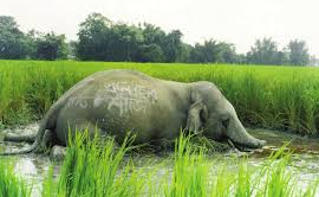 The tragic history of retaliatory wildlife killings, such as the 2001-2002 poisoning of elephants in Sonitpur, Assam, serves as a stark reminder of the high stakes involved in human-wildlife shared landscapes. The carcass of the national heritage animal, labelled as ‘Paddy Thief Laden’ represents the shortcomings of administrative conflict mitigation frameworks.
Silver Lining
As India marches toward its Viksit Bharat@2047 vision seeking a developed nation that is both modern and rooted in its civilizational ethos, a critical question emerges: ‘How do we reconcile technocratic wildlife management with the indigenous wisdom that has a history of protecting India’s biodiversity for centuries?’ Indigenous mitigation measures can be considered as one of the best practices for wildlife management. However, these practices are largely undocumented, creating a knowledge gap as intergenerational transmissions decline. Without a concerted effort to record these strategies, we risk losing centuries of ecological wisdom with the community’s elder knowledge keepers.
By bridging the ontological divide in Indian conservation governance, we can institutionalise indigenous strategies from folklore to formal state wildlife management protocols:
- Documentation and Digital Archiving of TEK: Creating robust digital repositories for TEK. Systematically recording these non-lethal, site-specific strategies ensures that this living library is preserved despite the threat of intergenerational knowledge loss. Viksit Bharat alignment: Digital Empowerment and Virasat
- Integrating TEK into Standard Operating Procedures (SOPs): Creating an SOP with a species specific list of indigenous conflict mitigation measures can help practitioners and conflict-affected communities with a directory of tried and tested indigenous measures that can be deployed as immediate, low-cost solutions or serve as a foundation for innovation with modern technology. Viksit bharat alignment: Sustainable Technology and Aatmanirbharta
- Incentivizing Coexistence over Compensation: State can foster a sustainable partnership with local communities by providing incentives for the adoption of indigenous mitigation measures. Viksit bharat alignment: Inclusive Growth and Antyodaya
Ultimately, looking beyond technocratic fencing and embracing these sustainable, non-lethal, and cost-effective conflict prevention and mitigation practices allows India to pioneer a global model of inclusive wildlife conservation.
About the Author:
Shalvi Suman is a fellow with the Embark India Development Fellowship, placed at National CAMPA, Ministry of Environment, Forest and Climate Change (MoEFCC), Government of India. Her research focuses on finding the scope for indigenous human-wildlife coexistence mechanisms in formal state wildlife conflict mitigation protocols.
References:
- Aiyadurai, A. (2016). ‘Tigers are our brothers’: Understanding human-nature relations in the Mishmi Hills, Northeast India. Conservation & Society, 14(4), 305–316. https://doi.org/10.4103/0972-4923.197614
- Tree, I. (2019, March 22). This Indian community welcomes leopards. National Geographic. https://www.nationalgeographic.com/animals/article/leopards-coexist-hindu-community-india
- Bird-David, N. (1990). The giving environment: Another perspective on the economic system of gatherer–hunters. Current Anthropology, 31(2), 189–196. https://doi.org/10.1086/203825
- Ingold, T. (1996). Hunting and gathering as ways of perceiving the environment. In R. Ellen & K. Fukui (Eds.), Redefining nature: Ecology, culture and domestication (pp. 117–156). Berg.
- Tanner, A. (1979). Bringing home animals: Religious ideology and mode of production of the Mistassini Cree hunters. St. Martin’s Press.
- Pandey, R. K., Mittal, D., George, AM., Sirola, G., Nigam, P., Nath, A., & Habib, B. (2026). Reframing human–elephant conflict in India through context-dependent coexistence strategies. Frontiers in Conservation Science, 7, Article 1762380. https://doi.org/10.3389/fcosc.2026.1762380
- Siddiqui, I., Basu, N., Bandyopadhyay, K., Koprowski, J. L., & Angandhula, V. (2026). Could prey support the recovery of a tiger population? Long-term prey density and carrying capacity assessment of a tiger reserve in India. Oryx, 1–9. https://doi.org/10.1017/S003060532510224X
- Qureshi, Q., Jhala, Y. V., Yadav, S. P., & Mallick, A. (Eds.). (2023). Status of tigers, co-predators and prey in India, 2022. National Tiger Conservation Authority, Government of India, and Wildlife Institute of India.
- Gulati, S., Karanth, K. K., Le, N. A., & Noack, F. (2021). Human casualties are the dominant cost of human-wildlife conflict in India. Proceedings of the National Academy of Sciences, 118(8), Article e1921338118. https://doi.org/10.1073/pnas.1921338118
- Kshettry, A., Bhave, N., Das, P., & Athreya, V. (2021). Mahakal blessed my crop: Community dynamics and religious beliefs influence efficacy of a wildlife compensation program. Frontiers in Conservation Science, 2, Article 727696. https://doi.org/10.3389/fcosc.2021.727696