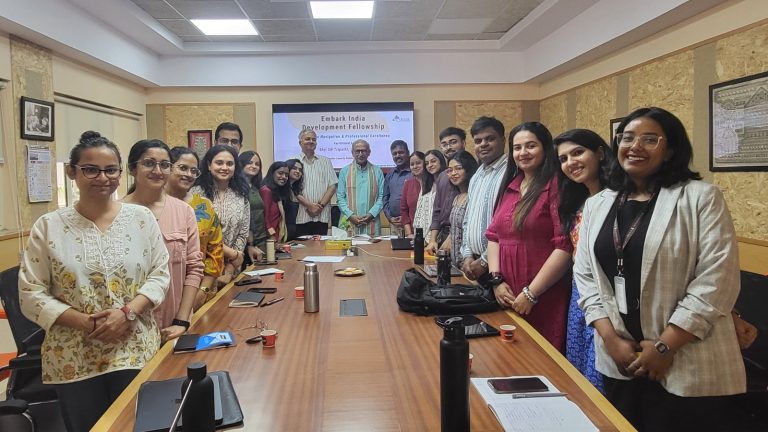
–Saundarya Shrotriya,Embark India Development Fellow
Co-Authored by:
- Dr. Ruchika (Research Fellow) | GRAAM
- Dr. Sanjay Jain (Associate Professor) | Nirma University
Guided / Mentored by:
- Shri Sandeep Kumar (Under Secretary) | Department of Empowerment of Persons with Disabilities, Ministry of Social Justice and Empowerment
Introduction
Mridula, a young woman from Yadgir, received a motorized tricycle through ADIP a few years ago. The device gave her the mobility to attend school, travel independently, and participate more actively in her community.
By 2026, Mridula had joined college and dreamed of taking part in sports and other activities alongside her peers. However, her aging tricycle could no longer keep up with her aspirations. Limited performance, and outdated features made it difficult for her to compete and engage on equal footing with others.
Just in time, the government announces the Divyang Sahara Yojana, designed to support the growing aspirations of thousands of Mridulas across India with the much needed evolution of the delivery system of Assistive Technology
As India moves towards Viksit Bharat @ 2047, it is crucial that the trillion-dollar potential of persons with disabilities is not limited by gaps in the assistive technology ecosystem [1]. This article explores how the Divyang Sahara Yojana can support this transition.
The Bigger Picture
According to the Ministry of Statistics and Programme Implementation, India’s population of persons with disabilities is estimated at approximately 55-90 million people [2]. Yet, India’s Assistive Technology (AT) penetration is critically low with only 5-10% of persons with disabilities and senior citizens estimated to have access to essential assistive technology due to policy, economic, service delivery, social, infrastructural, design, training and geographic barriers being some [3].
India’s assistive technology ecosystem has relevance across the 21 disability categories recognized under the Rights of Persons with Disabilities (RPwD) Act, 2016. While ALIMCO offers a wide range of assistive devices, coverage remains stronger for physical, sensory, and locomotor disabilities, with solutions for intellectual, psychosocial, and certain rare conditions still evolving.
Also, government schemes like ADIP and RVY have expanded access through camps and Pradhan Mantri Divyasha-Vayoshri Kendras (PMDVKs); the system remains largely periodic and welfare-driven.
This puts a long term restriction on their education, employment, and independent living, limiting social and economic participation of beneficiaries. With these schemes already in operation, the Government announced the Divyang Sahara Yojana (DSY) in the Union Budget 2026–27. It aims to ensure that persons with disabilities and senior citizens can easily access good-quality assistive devices on time. For this, support will be provided to ALIMCO to increase the production of such devices and improve technology through research and AI. The plan also includes strengthening PM Divyasha Kendras and setting up Assistive Technology Marts, which will function like modern stores where people can see, try, and buy assistive products according to their needs. [4].
Now this will be a paradigm shift in India’s ecosystem of assistive technology, driving both the social and economic vision of Viksit Bharat.
Assistive Technology Access As Of 2026
At the centre of India’s assistive technology delivery system is the Artificial Limbs Manufacturing Corporation of India (ALIMCO), a public sector unit under the Department of Empowerment of Persons with Disabilities (DEPwD), Ministry of Social Justice & Empowerment. ALIMCO is the country’s main manufacturer of assistive devices for people with different types of disabilities. [5].
Access to assistive technology is largely supported through government schemes. The Assistance to Persons with Disabilities for Purchase/Fitting of Aids/Appliances (ADIP Scheme), operational since 1981 which supports the procurement and distribution of assistive devices to eligible persons with disabilities through implementing agencies such as ALIMCO, NGOs, CRCs and state bodies. These agencies identify eligible beneficiaries through camps, headquarters, and the ARJUN portal (ADIP MIS web portal), then provide aids/appliances along with fitting and follow-up care [6]. Under ADIP-Sarva Siksha Abhiyan , assistive devices and learning kits are also provided to children with special needs [7].
Rashtriya Vayoshri Yojana (RVY) provides assistive devices to low-income senior citizens for age-related conditions such as reduced mobility, hearing loss, and vision impairment. Under both schemes, distribution largely takes place through camp-based or centre-based models coordinated by district administrations and ALIMCO, usually in two stages: assessment and distribution [8].
In addition, Pradhan Mantri Divyasha-Vayoshri Kendras (PMDVKs), operated by ALIMCO, function as one-stop centres for assessment, counselling, distribution, and post-distribution care, with around 102 Kendras currently operating nationwide.[9, 10].
Where Does The System Fall Short?
The current AT ecosystem serves the marginalized with basic assistive needs. However, does it have limitations to answer the question of “How do we enable Divyangjans to become economically productive?” This shift can become a quintessential boost to the ecosystem serving millions of PWDs, provided that the existing gaps associated with this transition are adequately addressed.
While the camps are episodic and temporary, many beneficiaries tend to get excluded. Either they missed the camp or never received information. Additionally, beneficiaries may face delays in accessing repair after a year or replacement services for assistive devices, often having to wait for the next camp or service visit. According to the International Labour Organization (2013), such delays can have a wider impact on the productivity, participation, and overall contribution of persons with disabilities to social and economic development [11].
Another barrier that does not quite seem to do justice to persons with disabilities, especially when they are active users of assistive technology, is the Tech ceiling. Assistive devices distributed in camps are low-cost and basic in design [12]. While a standard wheelchair and prosthetic may improve mobility, a more advanced device can create employment opportunities in multiple sectors and financial independence [13]. Corporate trust in hiring PWDs does not emerge from policy mandates or attitude-change campaigns, it emerges from visibility [14]. When employers see persons with disabilities performing effectively with the support of assistive technology, perceptions shift from disability to capability.
AT camps are designed to provide free devices to individuals identified as economically vulnerable, which is critical for ensuring access and inclusion. In this model, beneficiaries typically receive devices selected by assessors, with limited opportunity to compare products or choose what best fits their lifestyle and needs. While this approach effectively addresses immediate affordability barriers, on its own it may not be sufficient to ensure long-term access and ownership. As multiple research studies suggest that over time, this may lead to lower ownership, weaker connection with economic participation, and reduced long-term use or maintenance of devices [15, 16, 17].
Pathway To Viksit Bharat
India’s vision of Viksit Bharat 2047 hinges on inclusive growth that harnesses the potential of every citizen, including persons with disabilities. Development requires that PWDs transition from dependence to dignity, from welfare to empowerment, from limitation to contribution. Guided by the principle of “Sabka Saath, Sabka Vikas, Sabka Vishwas aur Sabka Prayas,“, the Divyang Sahara Yojana enables this transformation through several pathways [18]. Divyang Sahara Yojana aims to ensure people with disabilities get timely access to quality assistive devices. ALIMCO will be scaled up with better research and AI integration. New Assistive Technology Marts will also be set up alongside existing PM Divyasha Kendras, acting as modern showrooms where people with disabilities and senior citizens can see, try, and purchase assistive products with ease and dignity.
DSY will strengthen Pradhan Mantri Divyasha Vayoshri Kendras and establish AT Marts as permanent, accessible outlets. These can offer a wider range of devices, from standard essentials to advanced technologies such as motorized wheelchairs, smart hearing devices, and myoelectric prosthetics. Year-round access ensures no one is excluded by timing or location. This improves inclusion and sustained productivity, as devices and services are always within reach.
Pradhan Mantri Divyasha-Vayoshri Kendras also offer Assistive Technology Service Hubs, offering on-site assessment, customization, fabrication and maintenance services. Users like Mridula can maintain independence without long disruptions. This continuity of care preserves productivity and wellbeing over the device’s lifespan. [19]
By positioning ALIMCO as a national hub for innovation, DSY will spur domestic production and R&D (with AI integration) and support for startups/MSMEs will diversify suppliers. Where low demand has kept prices high and India depends on imports for advanced devices. Increased local production reduces import dependence and can lower costs.
Additionally, scaled up production of high-quality assistive devices would open new prospects. Access to better technology can improve mobility, communication, and individual independence. It can also strengthen workplaces by being one of its kind marts spreading awareness. Plus enable Divyangjans to participate more effectively in education, entrepreneurship, and formal employment [20].
The Big Idea
A critical reframing is needed in how India thinks about assistive technology investment. AT provisioning must be understood not as a welfare expenditure but as a high-return public investment. Research consistently shows that every rupee invested in assistive technology yields measurable returns – through increased workforce participation, greater educational attainment, and reduced dependency on caregivers and social support systems. When a person with a disability gains mobility, communication, or functional independence through appropriate AT, they become more employable, more productive, and more likely to contribute to formal economic activity. The ROI of AT is therefore both fiscal and social: it reduces long-term government expenditure on care and rehabilitation, while simultaneously expanding the tax base and human capital available to the economy. Viewed through this lens, Divyanga Sahara Yojana is not another welfare benefaction – it is a strategic investment.
Beyond individual outcomes, a stronger assistive technology ecosystem can generate significant long-term socio-economic benefits for India. Investing in AT generates economic benefits by increasing workforce participation, reducing dependency, creating jobs, and strengthening domestic industry. With DSY, India is more ready than ever to build this mature ecosystem.
Conclusion
Critically, DSY does not abandon camps or existing welfare schemes. Government camps will continue identifying vulnerable PWDs and providing free devices through ADIP and RVY. DSY adds to this foundation by creating permanent touchpoints of support where PWDs can choose, return, repair, upgrade, replace, and get professional guidance throughout their lives.
For Mridula, DSY changes everything. She has access to a nearby service center where she can explore options, access repair and maintenance, and upgrade to advanced technology when she can afford it. Her mobility is no longer dependent on timing; it is a right she can exercise year-round.
But it is just one story. Multiply her experience across India–millions of PWDs and senior citizens. Multiply the employment, the education, the participation, the contribution. This is the promise of Divyang Sahara Yojana.
The journey toward Viksit Bharat 2047 will not be measured by GDP alone. It will be measured by lives transformed. The Divyang Sahara Yojana is that commitment made tangible.
About The Author
Saundarya Shrotriya is a Fellow with the Embark India Development Fellowship, placed at Department of Empowerment of Persons with Disabilities. Ministry of Social Justice and Empowerment, Government of India. Her research explores the readiness and receptiveness of the ambitious Divyang Sahara Yojana. This blog was developed under the fellowship with mentorship from Shri Sandeep Kumar (Under Secretary, DEPwD, MOSJE), Dr. Ruchika (Research Fellow, GRAAM) and Dr. Sanjay Jain (Associate Professor, Nirma University)
References
- Press Trust of India. (2024, January 31). India’s disability sector can contribute USD 1 trillion to the economy by 2047: Indian-American industry leader. NDTV.
- Ministry of Statistics and Programme Implementation. (n.d.). Chapter 4: Dimension of disability in India [PDF]. Government of India.
- Badhal, S., Vashist, A., Singh, R., Tushar, & Hans, K. (2025). Challenges and barriers in assistive technology and the scale for their assessment: A global and Indian perspective. Journal of the Epidemiology Foundation of India, 3(1 Suppl), 8–16.
- Press Information Bureau. (2025). Press release (PRID 2221393). Government of India.
- Artificial Limbs Manufacturing Corporation of India. (n.d.). ALIMCO.
- Department of Empowerment of Persons with Disabilities. (2024). Scheme of assistance to persons with disabilities for purchase/fitting of aids and appliances (ADIP scheme) [PDF]. Ministry of Social Justice and Empowerment, Government of India.
- Ministry of Education. (n.d.). Sarva Shiksha Abhiyan framework for implementation [PDF]. Government of India.
- Artificial Limbs Manufacturing Corporation of India. (n.d.). Rashtriya Vayoshri Yojana [PDF].
- Press Information Bureau. (2025, July, 14). Union Minister of State Shri B. L. Verma to preside over the inauguration of 75th Pradhan Mantri Divyasha Kendra (PMDK) at Badaun, Uttar Pradesh.
- Artificial Limbs Manufacturing Corporation of India. (n.d.). ALIMCO Centers.
- International Labour Organization. (2013). Inclusion of persons with disabilities in India: Challenges and opportunities [PDF].
- Department of Empowerment of Persons with Disabilities. (2024, September 26). Scheme of assistance to persons with disabilities for purchase/fitting of aids/appliances (ADIP scheme) [PDF]. Ministry of Social Justice and Empowerment, Government of India.
- Alanazi, A., et al. (2024). Assistive Technology and Employment Opportunities for People with Disabilities: A Systematic Review and Meta-analysis. Emerald Publishing.
- Nagtegaal, R., de Winter, P., Keesler, J., & colleagues. (2023). Why do employers (fail to) hire people with disabilities? A systematic review of capabilities, opportunities and motivations. Journal of Occupational Rehabilitation, 33(2), 329–340.
- Legro, M. W., et al. (2004). Satisfaction with prostheses and assistive devices: Evidence for improvement with activity-specific devices. Archives of Physical Medicine and Rehabilitation, 85(7), 1111-1119.
- Allport, G. W. (1954). The Nature of Prejudice. Addison-Wesley. (Classic contact hypothesis – prejudice reduces through direct contact and demonstrated competence)
- Ariely, D. (2008). Predictably Irrational: The Hidden Forces That Shape Our Decisions. Harper. (Discusses psychological effects of payment and ownership)
- Press Information Bureau. (2025). Press release (PRID 2237298). Government of India.
- Nussbaum, M. C. (2011). Creating Capabilities: The Human Development Approach. Harvard University Press. (Discusses agency, capabilities, and empowerment in development)
- Gitlow, L. (2014). Technology use by older adults and barriers to using technology. International Journal of Technology and Aging, 1(1), 44–58.