– Anushree Rai, Embark India Development Fellow
Guided / Mentored by
- Dr. Chandrika Shetty (Lead- Governance and Democratisation, Partnership Development, GRAAM)
- Mr Rajendra Kumar (Section Officer) | Department of Youth Affairs, Ministry of Youth Affairs and Sports, Government of India
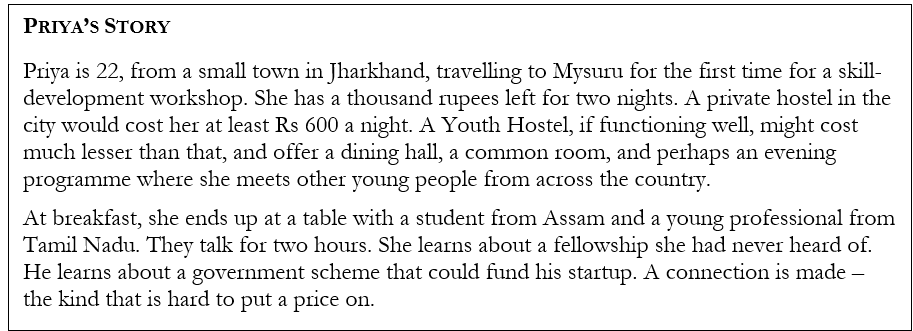
Imagine arriving in a new city – backpack on your shoulders, eyes wide, and a budget that barely covers lunch at a restaurant. You need a clean, safe place to sleep, but more than that, you need somewhere to meet other young people like yourself, share stories – or just feel a little less alone in a big, unfamiliar place. That is the idea behind India’s Youth Hostels. Youth Hostels not only provide affordable accommodation, but also a network of spaces designed to be homes away from home for the youth of the country.
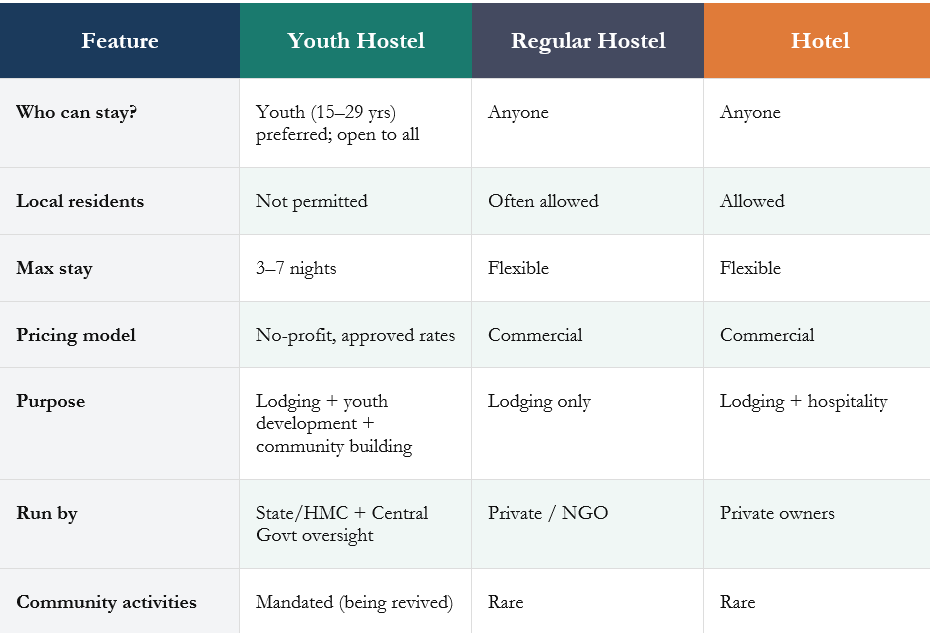
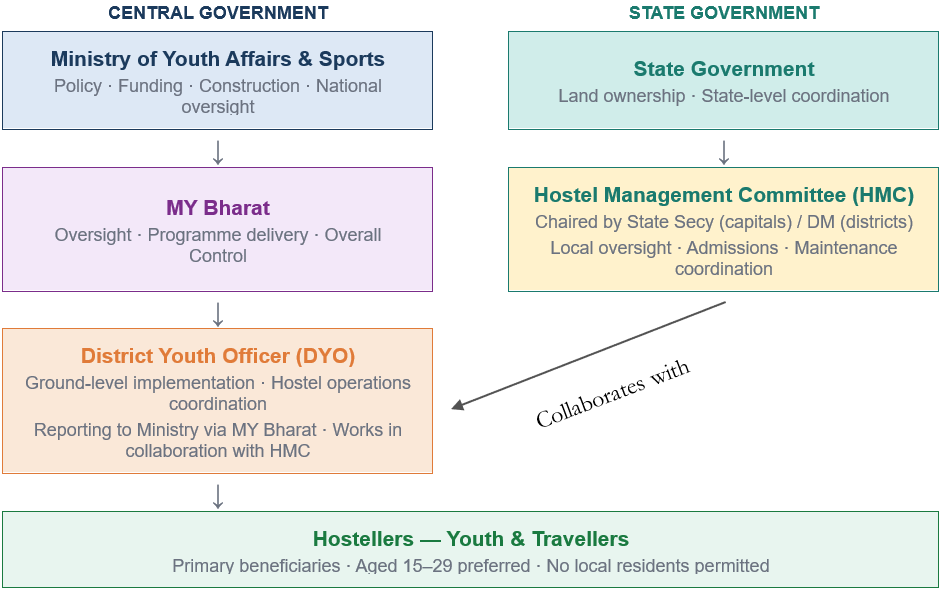
But India’s government-run Youth Hostels are not the same as budget hotels or private hostels. A Youth Hostel under the Department of Youth Affairs, Ministry of Youth Affairs and Sports, is a joint venture between the Central and State Governments. The land belongs to the State, the construction is funded by the Centre, and day-to-day operations are managed by a Hostel Management Committee (HMC). The tariff rates are set by the HMC on a no-profit, no-loss basis (Ministry of Youth Affairs and Sports, n.d.).
But here is what really sets them apart (Ministry of Youth Affairs and Sports, 2014):
- Youth (15-29 years) get priority, but the hostels are open to people of all ages
- Local residents cannot stay – these spaces are reserved exclusively for travellers
- Stays are capped at 3 nights (extendable to 7 at the manager’s discretion)
- The mandate goes beyond lodging — cultural exchange, youth development, and community programmes are at the core of their purpose
India has 85 Youth Hostels spread across states and Union Territories – from the mountains of Himachal Pradesh to the coasts of Kerala. They were envisioned as a nationwide youth infrastructure network, and the geographic ambition behind them is genuinely impressive. Here is a snapshot of where things stand:

Of the 85 hostels, 11 have been transferred to other agencies – to SAI for sportspersons, and to MY Bharat for broader youth development activities. Of the remaining, only 49 are currently functional. However, efforts are being made to make the non-functional hostels functional with an objective to reach efficient utilisation (Ministry of Youth Affairs and Sports , 2025). Sixteen hostels have earned ISO 9001:2015 quality certification, which is a genuine sign of what is possible when standards are applied and enforced.
The governance structure of Youth Hostels involves multiple tiers of government and local administration. Understanding how they are run helps explain both their strengths and where they have room to grow.
The Indian Institute of Public Administration (IIPA) conducted a comprehensive evaluation of Youth Hostels across six states in 2020. On a 3-point scale (1 = Poor, 2 = Average, 3 = Good), no state crossed the average mark – but the data is useful precisely because it gives us a clear baseline and a roadmap for targeted improvement (Indian Institute of Public Administration, 2020).
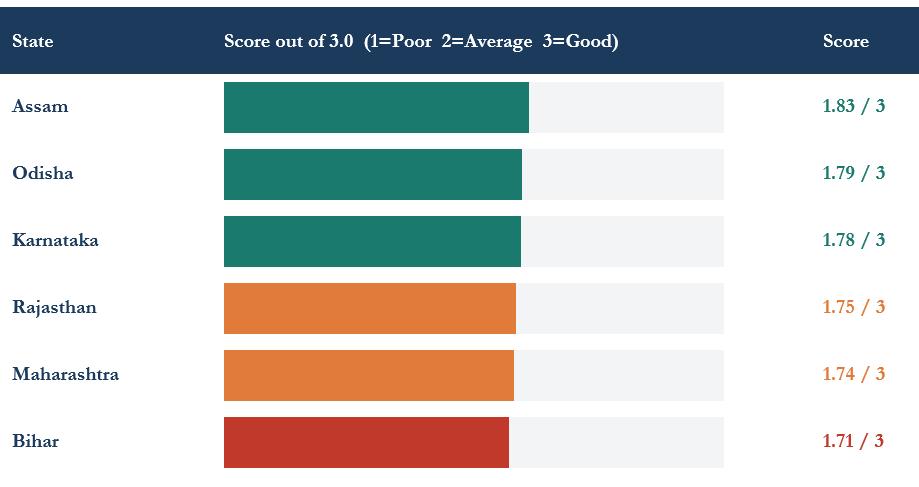
Assam was the best performer at 1.83, and Bihar scored lowest at 1.71, with an overall average of 1.75 across the six states. Infrastructure quality, hygiene, dining facilities, and access to safe drinking water were flagged as areas needing attention. The evaluation by the Parliamentary Standing Committee in 2026 further noted inadequate monitoring and accountability mechanisms. These findings are not a source of discouragement – they are a clear, actionable starting point.
The presence of a Youth Hostel in Delhi, being the national capital, would not only benefit youth travellers immensely, but would also send a strong signal of commitment to the original vision of the scheme (Parliament of India, 2016). The Budget for the current Financial Year (2026-27) also presents a real opportunity for revival.
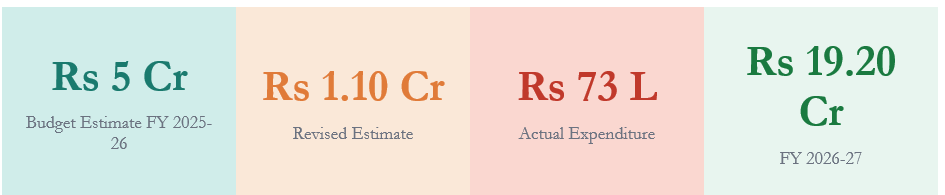
For FY 2025-26, the budget was initially set at Rs 5 crores, later revised to Rs 1.10 crores, with actual expenditure at just Rs 73 lakhs (Parliament of India, 2016). The underutilisation was due to changes in the fund mechanism. For FY 2026-27, however, the projected allocation rises sharply to Rs 19.20 crores. This increase is earmarked not just for renovation, but for new initiatives – career counselling centres, digital skill-training workshops, and MY Bharat registration desks. The intent to shift from overnight lodging to round-the-clock youth hubs is clear and welcome.
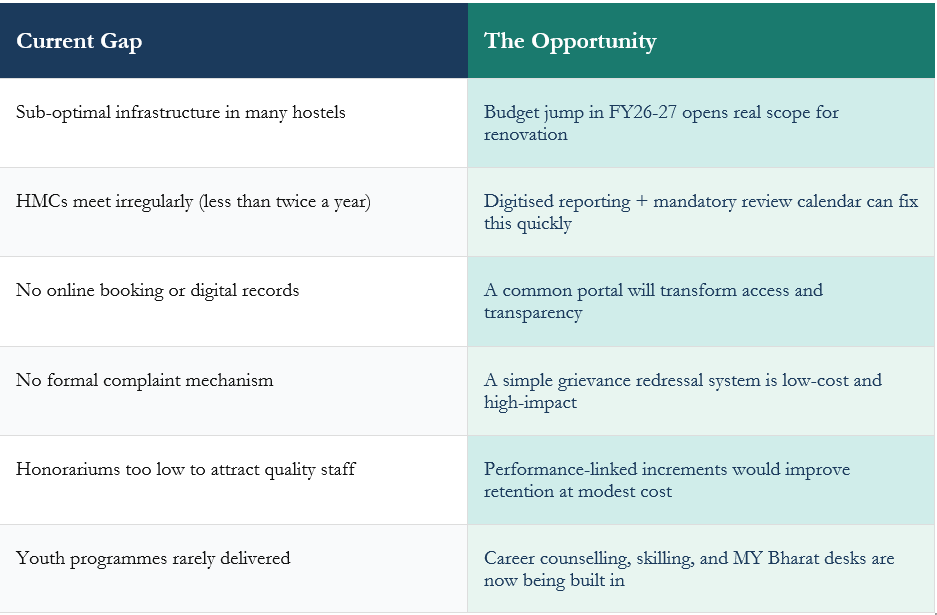
Here is a direct look at where Youth Hostels currently fall short — and the opportunity embedded in each gap:
It would be easy to frame Youth Hostels purely as an affordable accommodation solution. But that misses the point entirely. For a young woman travelling alone, a Youth Hostel is not just more affordable than a hotel – it is also safer. There is a Warden on-site, a management committee with accountability, and rules that create a supervised, transient community. The proposal to build dedicated Youth Hostels for women deserves to be prioritised. For a young person from a marginalised background, a Youth Hostel is often the only place where they can access a dining hall, a common room, and a peer community, without feeling out of place or out of budget. And for every young traveller, a Youth Hostel is a chance encounter waiting to happen, someone from a state you have never visited, a meal you have never tried, a perspective you did not have before. That is the deeper value: not the rupees saved on accommodation, but the connections made and the horizons broadened.
The Ministry’s vision for revamped Youth Hostels includes some genuinely exciting possibilities that go well beyond overnight lodging:
- Career counselling sessions and digital skill workshops during daytime hours
- High-speed Wi-Fi and co-working spaces for students and remote workers
- MY Bharat registration desks to connect youth to government programmes
- Online booking platforms for easier, transparent access
- Psychosocial support and peer community programmes
- Dedicated women-only facilities for safer, more inclusive travel
The original architects of this scheme understood something important: young people need more than just shelter. They need exposure, connection, and community. In a country as vast and diverse as India, the ability to travel affordably and safely is not a luxury – it is an enabler of social mobility, cultural integration, and personal growth.
The problems with Youth Hostels today are real, but they are not fundamental. They are problems of implementation, not of concept. The governance structure is complex, but functional. The infrastructure is ageing, but repairable. The honorariums are low, but adjustable. The HMC meetings are infrequent, but can be mandated. Every single gap in this scheme has a known, addressable solution. What precedes genuine optimism is the FY26-27 budget projection, a nearly 17x increase from actual expenditure. Paired with plans for career counselling, digital upskilling, and community programming, it suggests the Ministry is ready to move from passive custodian to active developer. Efforts are being made to make the system more comprehensive, easy to access as well as smooth.
The Youth Hostel scheme has all the ingredients of a transformative public institution: a nationwide footprint, a mandate rooted in inclusion, and a target demographic that is diverse and inclusive. The task ahead is not to reinvent the wheel – it is to finally give it enough road to run on.
References
- Ministry of Youth Affairs and Sports. (n.d.). Youth Hostel Scheme. Retrieved from https://yas.gov.in/sites/default/files/Youth%20Hostel%20Scheme_0-converted.pdf
- Ministry of Youth Affairs and Sports. (2014). Youth Hostel Manual.
- Ministry of Youth Affairs and Sports . (2025). Annual Report 2024-25.
- Indian Institute of Public Administration. (2020). Evaluation Study Report of Central Sector Scheme of Rashtriya Yuva Sashaktikaran Karyakram (RYSK). Ministry of Youth Affairs and Sports.
- Parliament of India. (2016). Report No. 378. Rajya Sabha – Department-Related Parliamentary Standing Committee on Education, Women, Children, Youth and Sports.
About the Author
Anushree Rai, Embark India Development Fellow