
Improving Policy Design Through Time Use Surveys: Opportunities and Pathways for India
– Meera Anil, Embark India Development Fellow
Co-authors
- Dr. Jitendra Singh Tomar (Deputy Director General, Agriculture Statistics Headquarters, National Statistics Office, Field Operations Division, Ministry of Statistics and Programme Implementation, Government of India)
- Shri. Santosh Kumar Gupta (Director, National Statistical Systems Training Academy, Ministry of Statistics and Programme Implementation, Government of India)
Guided / Mentored by
- Shri R. Rajesh, ADG, CDD, MoSPI (Ministry of Statistics and Programme Implementation, Government of India)
- Shri Vivek Srivastava, Director, NSSTA (National Statistical Systems Training Academy, Ministry of Statistics an d Programme Implementation, Government of India)
- Dr. Samudra Sen, Assistant Professor & Program Director (MBA), RV University
- Ms. Pushpa C. O, Research Fellow, GRAAM
Why Measuring Time Matters?
In a small village in Rajasthan, a woman wakes up before dawn, walks two kilometers to collect firewood, returns to cook, cleans the household, and begins her day before 8 AM. Her contribution has long been invisible to conventional socio-economic studies, including the Periodic Labor Force Survey. Yet, her time, how it is spent, burdened, and potentially freed, holds the key to some of India’s most pressing development questions. This is precisely the promise that India’s Time Use Survey (TUS) has begun to fulfill.
In a two-room flat in Keralam, a 16-year-old sits hunched over his phone well past midnight, not texting his friends, not reading, but scrolling through Instagram reels, one after another, in an endless loop, and can’t even recall what he watched two minutes before. Understanding how India’s youth allocate their time is no longer an academic curiosity; instead, it is a governance stewardship. India now has its own survey and statistical tools to answer these developmental questions with rigor and accuracy.
For any country, how its citizens spend their time fundamentally shapes its economic growth and human development, because it is their daily choices and activities that ultimately drive the nation forward. Bharat is now among the few nations alongside Australia, Japan, the Republic of Korea, New Zealand, the USA, and China, that conduct a national Time Use Survey to systematically analyze how their people allocate their days.
Time is a universal resource and it matters and that, perhaps, is the key to many of the solutions. Yet when analysts discuss youth or women, they often speak in the language of enrolment ratios and employment rates, numbers that say little about how a teenager actually spends a Tuesday afternoon, or what holds a woman back from joining the labor force. Time Use data bridges this gap precisely by enabling the design of policies that are not just statistically informed but grounded in the lived rhythms of Indian life.
What are Time Use Surveys, and what do they capture?
India’s Time Use Survey (TUS), conducted by the National Statistics Office (NSO) under the Ministry of Statistics and Programme Implementation (MoSPI), was carried out nationwide (excluding the Andaman and Nicobar Islands) from January to December in both 2019 and 2024, covering persons aged 6 years and above with household sample sizes of 138,799 and 139,487, respectively, making it one of the most powerful and the rarest statistical instruments ever deployed by the country. It attempts to measure how much time its citizens spend on both paid and unpaid activities. The data is accessible through the Microdata portal, and it meticulously tracks how people allocate every hour of their 24-hour day, covering paid work, unpaid care, leisure, learning, socialization, and everything in between. The data follows the International Classification of Activities for Time-Use Statistics (ICATUS), aligning India’s methodology with global standards and enabling meaningful cross-country comparison.
Unlike conventional socio-economic surveys that capture employment or income at a point in time, TUS records the full texture of daily life, every activity, its duration, and whether it was paid or unpaid, and this makes it uniquely suited to revealing the gendered division of labor, the hidden burden of domestic work, the care economy and the way structural changes reshape daily routines. Countries like South Korea, Finland, and Senegal have demonstrated that Time Use Surveys, when properly integrated into governance systems, can reshape how governments design welfare programs, evaluate gender equity, and measure human development.[3][5] Similarly, India has a rare opportunity, and a corresponding responsibility, to do the same especially with the availability of two survey rounds, which can enable a dynamic, comparative analysis that no other instrument in India’s statistical toolkit can match.
Key Findings and Policy Opportunities for India
India’s growing commitment to evidence-based policy making finds a powerful expression in its Time Use Surveys. Globally, institutions like the UN Statistics Division, Data2X, and the UNDP Human Development Reports have consistently recognized time use data as essential to measuring SDG indicators, particularly SDG 5.4.1 (proportion of time spent on unpaid domestic and care work by sex, age, and location).
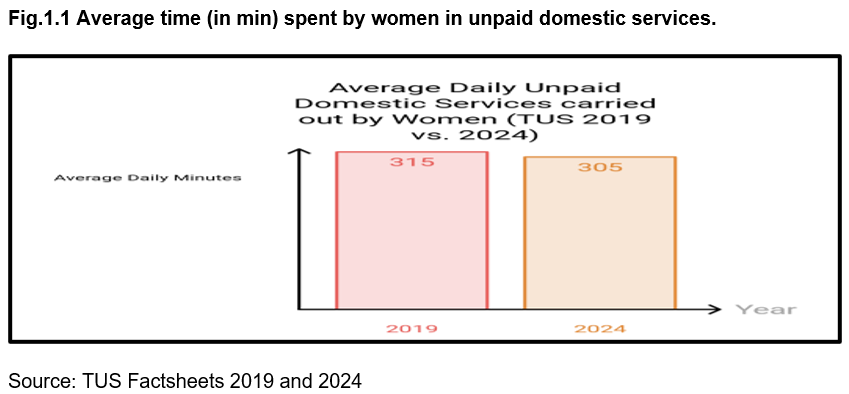
There is a growing potential to develop systematic institutional mechanisms that can effectively translate TUS findings into an evidence-based policy design, program evaluation, and budget allocation in India. According to the TUS Fact sheets, women aged 15-59 spent an average of 315 minutes per day on unpaid domestic services in 2019; this fell only marginally to 305 minutes in 2024.[6]
The Survey enables policymakers to ask sharper questions and proceed with inferential analysis: Is the time saved being redirected toward productive, income-generating, or educational activities? These are evaluation questions that can and should inform the design of many programs like Pradhan Mantri Ujjwala Yojana (PMUY), the Digital India initiative, and education policies etc.
Similarly, with digital access expanding rapidly among youth, TUS data opens a window into analyzing whether increased connectivity is translating into productive learning or passive consumption. This is exactly the kind of evidence needed to refine digital literacy programs and the Yuva pillar of Viksit Bharat@2047. This also underscores the need to systematically integrate TUS data into policy making processes to better inform design, targeting, and evaluation.
Time utilization intersects with nearly every development sector, creating important intersectoral linkages that policymakers and the Government of India can leverage for more integrated national planning. The TUS datasets offer valuable insights that can help refine policies more effectively across energy, education, digital connectivity, gender, public health, and so on.
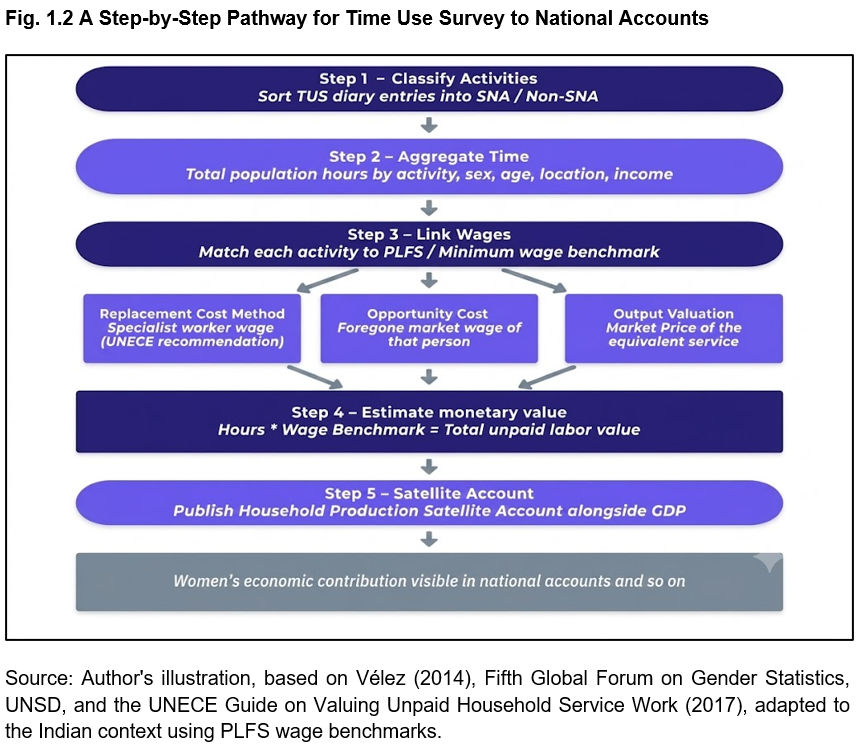
The pathway below is an attempt to illustrate how Time Use Survey data can be systematically translated into national accounts, moving from data collection and dissemination to data evaluation.
Global Lessons, Indian Opportunity
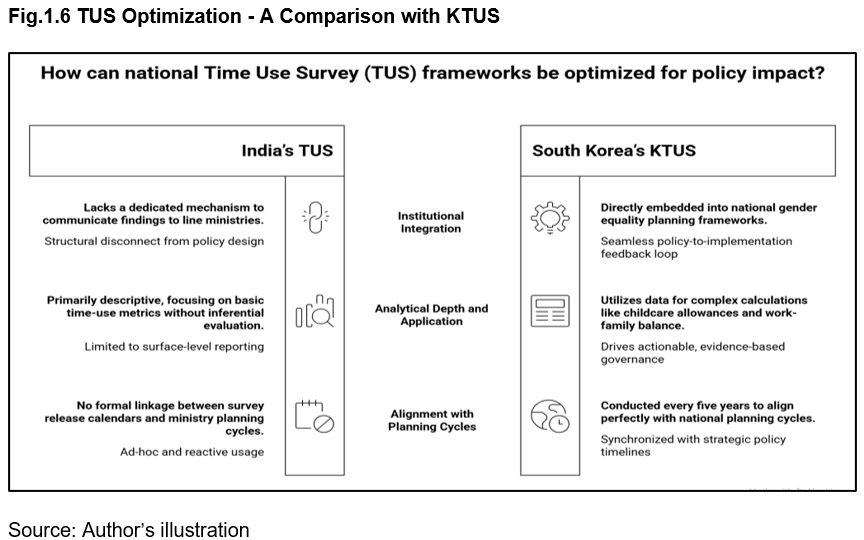
The international experience offers a clear and achievable road map for India. The Time Use Survey conducted by South Korea (KTUS), every five years since 1999, has been directly embedded in its national gender equality planning frameworks. The country’s 3rd Gender Equality Basic Plan, for instance, explicitly used KTUS data on unpaid work among dual-earner couples to set policy directions around work-family balance and childcare support. Local governments even used TUS derived calculations to determine the size of allowances paid to grandparents providing childcare, which is a direct, tangible link from survey to citizen benefits.[14]
In India, many researchers and academic institutions have begun analyzing TUS data, and its findings are increasingly informing policy discussions, particularly on women’s unpaid work and the valuation of care. MoSPI is now well-positioned to formalize and strengthen this linkage, ensuring that TUS insights consistently reach the policy table of the line ministries.
Finland and Uruguay have gone further in using TUS data to calculate the monetary value of unpaid work as a share of GDP, using this evidence to make the case for better care infrastructure and parental leave policies. In Finland, such accounting exercises revealed that unpaid work could add approximately 40% to GDP if formally counted.[10] India’s TUS gives statistical visibility to unpaid household and care work, making them a crucial building block for the System of National Accounts (SNA) 2025’s goal of capturing women’s contribution and non-market activity within national accounts. Yes, India has the data and institutional capacity to undertake such analyses.
The 2025-2030 vision of MoSPI explicitly recognizes the importance of linking official statistics to policy outcomes. There are also broader initiatives under Viksit Bharat@2047 that could benefit from time use evidence tracking the Yuva (Youth) and Mahilayen (Women) pillars, which requires exactly the kind of granular, activity-based data that TUS provides. The required institutional infrastructure already exists: the microdata portal is operational, and the National Statistical Systems Training Academy (NSSTA) holds the capacity-building mandate. What remains to be built is the institutional linkage between data production and policy use.
In order to strengthen the dialogue between data producers and data users, MoSPI has already carried out several data user conferences, seminars, and stakeholder meetings, enabling deeper insights into the significance and applications of TUS data for socio-economic policy. This momentum provides a strong foundation for translating TUS data into action.
The illustration below maps the outcomes of these ministerial initiatives in advancing evidence-based decision-making.
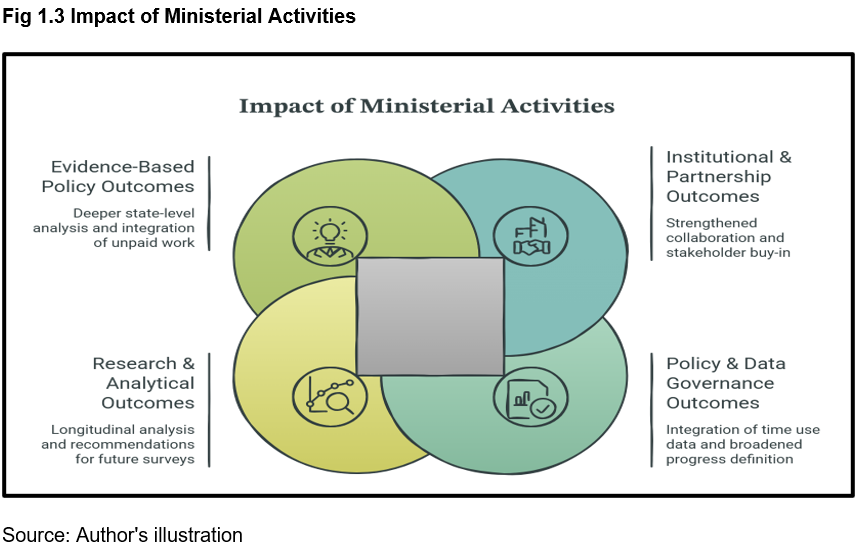
These engagements point toward four connected outcomes, mapped above: stronger evidence-based policy design, deeper institutional partnerships, greater analytical and research depth, and improved data governance.
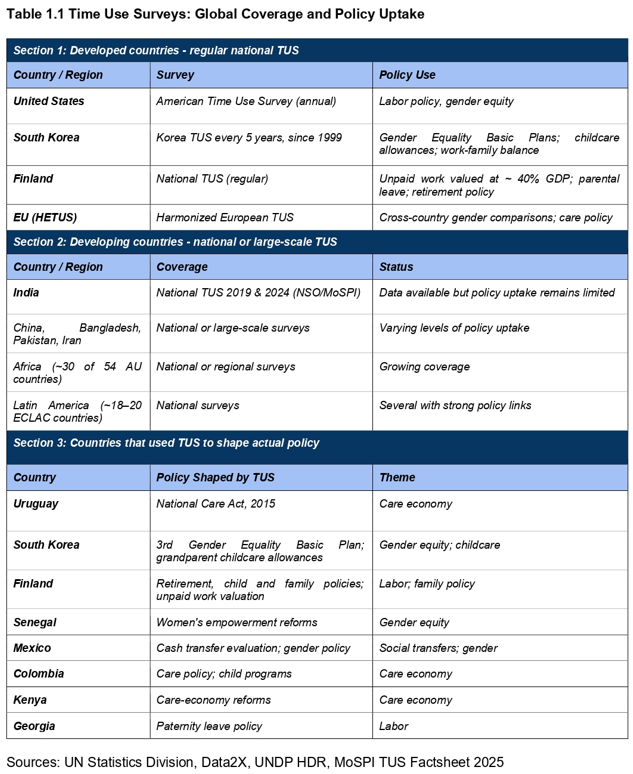
The table below provides a comparative overview of the Time Use Surveys across countries, capturing the coverage, periodicity, status, policy use, and theme.
Way Forward: Making TUS Work for Policy
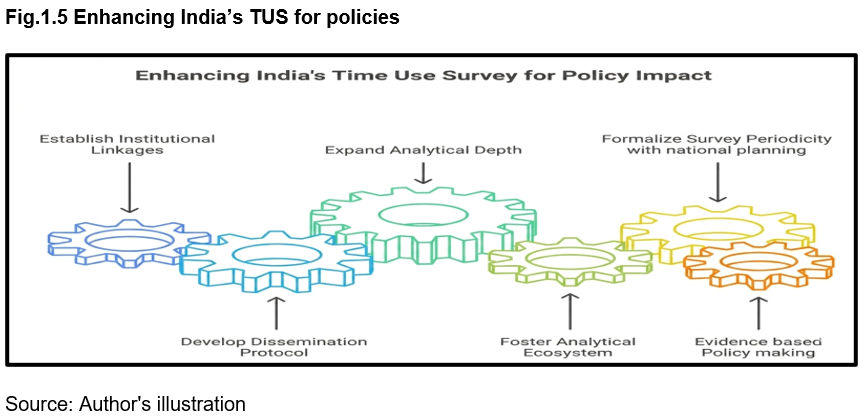
Translating India’s TUS data into policy impact may require movement on three fronts: building institutional and intersectoral linkages, expanding analytical depth beyond descriptive reporting, and formalizing survey periodicity in alignment with policy cycles.
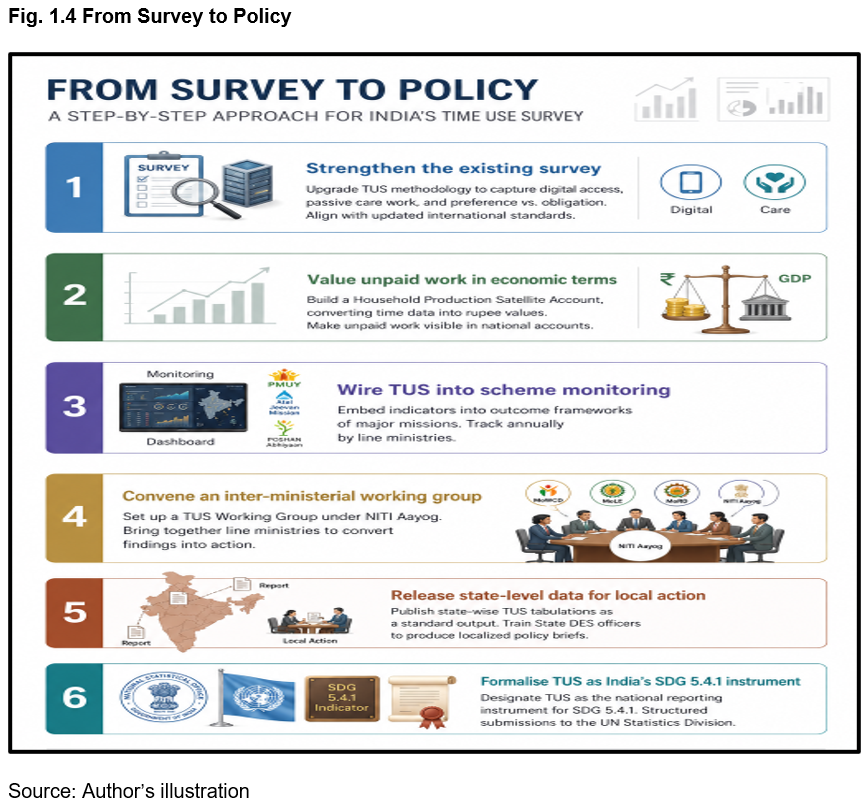
Most urgently, the institutional and intersectoral linkages need to be created. MoSPI, ideally through NSSTA and its training and capacity-building mandate, may lead the effort to develop accessible, ministry-specific briefs from TUS findings, translating granular data on various aspects into actionable inputs for line departments. A structured dissemination protocol similar to how the Periodic Labor Force Survey (PLFS) feeds into employment policy should be developed for TUS as well.
The Figure below illustrates a step- by -step approach for translating TUS data into policy design.
Second, the analytical depth may be expanded beyond descriptive reporting. India needs investment in applied research that links TUS data with program outcomes: evaluating whether a scheme is actually freeing rural women’s time, or assessing whether digital access among youth correlates with productive or passive time use. MoSPI, along with NSSTA, can help build this analytical ecosystem through fellowships, research grants, and academic partnerships, with its existing research internship program serving as a ready vehicle for seeding exactly this kind of applied, policy-linked analysis.
Looking ahead, the survey periodicity and alignment with policy cycles may be formalized. A five-year TUS cycle, clearly synchronized with national planning frameworks, may ensure that TUS data is not merely reactive (documenting what happened) but anticipatory, enabling evidence-based design of the next wave of programs.
The Figure below outlines the key steps needed to enhance India’s TUS for effective policy use.
The following figure offers a comparative view of India’s TUS Framework alongside South Korea’s KTUS, highlighting gaps and opportunities for alignment.
From Data to Decisions
India stands at an important statistical inflection point now. As mentioned, India is among the select few nations, both developed and developing, that conduct the National TUS to analyze how people allocate their time to various daily activities. With two nationally representative Time Use Surveys available, India has the raw material to answer some of its most consequential development questions about women’s time poverty, youth’s digital habits, unpaid labor, the real impact of clean energy programs, infrastructure and time saving, and the hidden economy of unpaid care.
What needs to follow now is the institutional infrastructure to actually use this evidence in decision-making. As India moves toward its Viksit Bharat@2047 goals, the gap between data production and policy action is not just a statistical matter; it is a governance cost. What the data is waiting for is not a better survey. It is a decision. A decision by line ministries to treat TUS findings as inputs to program design, and not just as mere footnotes in academic papers. A decision by NITI Aayog to make unpaid work visible in the national accounting ledger. To recapitulate, the question is no longer whether India has the evidence. What remains – and what is well within reach – is the institutional will to translate this evidence into action.
Key Takeaways
- India’s Time Use Survey (2019 and 2024) provides a unique, granular evidence base that can directly inform governance decisions.
- India is among a select group of nations with two national TUS rounds; the microdata portal and the institutional capacity at MoSPI and NSSTA could lead to the next phase of evidence-based decision making.
- Countries like South Korea, Finland, and Senegal have demonstrated that TUS data, properly embedded in governance systems, can drive concrete policy changes.
- India’s most urgent opportunity lies in linking TUS insights to its flagship programs, building ministry-specific dissemination protocols, and aligning the TUS cycle with national planning frameworks.
About the Author
Meera Anil is an Economist and Embark India Development Fellow (2025–2026), deployed at the National Statistical Systems Training Academy (NSSTA), Ministry of Statistics and Programme Implementation (MoSPI). Her fellowship research examines how energy access and digital connectivity have reshaped time use patterns among rural women and youth in India, using the Time Use Surveys of 2019 and 2024.
Co-authors
Dr. Jitendra Singh Tomar (Deputy Director General, Agriculture Statistics Headquarters, National Statistics Office, Field Operations Division, Ministry of Statistics and Programme Implementation, Government of India)
Shri. Santosh Kumar Gupta (Director, National Statistical Systems Training Academy, Ministry of Statistics and Programme Implementation, Government of India)
Acknowledgement
With gratitude to GRAAM (Grassroots Research and Advocacy Movement) and the National Statistical Systems Training Academy (NSSTA), Ministry of Statistics and Programme Implementation (MoSPI), for the many conversations that shaped this piece. I am especially thankful to my mentors: Shri R. Rajesh, Dr. Jitendra Singh Tomar, Shri Santosh Kumar Gupta, Shri Vivek Srivastava, Ms. Pushpa C. O, and Dr. Samudra Sen for their valuable insights and guidance. The views expressed here, however, are personal.
Reference
- Asian Development Bank. (2025). It is about time: Measurement, challenges, and policies for Asia. https://www.adb.org/sites/default/files/publication/1134396/measurement-challenges-policies-asia.pdf
- Centre for Global Social Policy. (2025). Role of time use data in policymaking in South Korea. https://cgsp-cpsm.ca/article/role-of-time-use-data-in-policymaking-in-south-korea/
- Data2X. (n.d.). Using data to address the unpaid work burden: A case study of Finland. https://data2x.org/resource-center/using-data-to-address-the-unpaid-work-burden-a-case-study-of-finland/
- Hirway, I. (2020, November). The ‘Time Use Survey’ as an opportunity lost. The Hindu. https://www.thehindu.com/opinion/op-ed/the-time-use-survey-as-an-opportunity-lost/article33145986.ece
- Jun, J., & Eun, K.-S. (2025). Role of time use data in policymaking in South Korea. Data2X. https://data2x.org/wp-content/uploads/2025/02/South-Korea-TUCS-WR-250225.pdf
- Ministry of Statistics and Programme Implementation. (2025). Time Use Survey 2024: Fact sheet. Government of India. https://www.mospi.gov.in/sites/default/files/publication_reports/TUS_Factsheet_25022025.pdf
- Ministry of Statistics and Programme Implementation. (n.d.). National Data Archive (NADA) [Microdata portal]. Government of India. Retrieved April 20, 2026, from https://microdata.gov.in/NADA/index.php/home
- National Statistical Office. (2020). Time use in India–2019 [Report of the Time Use Survey]. Ministry of Statistics and Programme Implementation, Government of India. https://www.mospi.gov.in/sites/default/files/publication_reports/Report%20of%20the%20Time%20Use%20Survey-Final.pdf
- Open Data Watch. (2025). Time use data shape better policies. https://opendatawatch.com/publications/time-use-data-shape-better-policies/
- Pääkkönen, H. (2005). Leisure participation and time-use surveys: Finland. In G. Cushman, A. J. Veal, & J. Zuzanek (Eds.), Free time and leisure participation: International perspectives. CABI Publishing. https://www.researchgate.net/publication/353873269_Leisure_participation_and_time-use_surveys_Finland
- Press Information Bureau. (2020, September 29). Time Use Survey in India 2019 [Press release]. Ministry of Statistics and Programme Implementation, Government of India. https://www.pib.gov.in/PressReleasePage.aspx?PRID=2169833
- Press Information Bureau. (2025, September 22). Data User’s Conference on the Time Use Survey (TUS), 2024 [Press release]. Ministry of Statistics and Programme Implementation, Government of India. https://www.pib.gov.in/PressReleasePage.aspx?PRID=2169833
- Statistics Finland. (n.d.). Time use survey [Statistics documentation]. https://stat.fi/en/statistics/documentation/akay
- Statistics Korea. (n.d.). Korean Time Use Survey. National Data Agency, Republic of Korea. Retrieved April 25, 2026, from https://mods.go.kr/board.es?mid=a20111060000&bid=11762
- United Nations Development Programme. (n.d.). How to strengthen the usefulness of time use surveys for policymaking. Human Development Reports. https://hdr.undp.org/content/how-strengthen-usefulness-time-use-surveys-policymaking



Very insightful