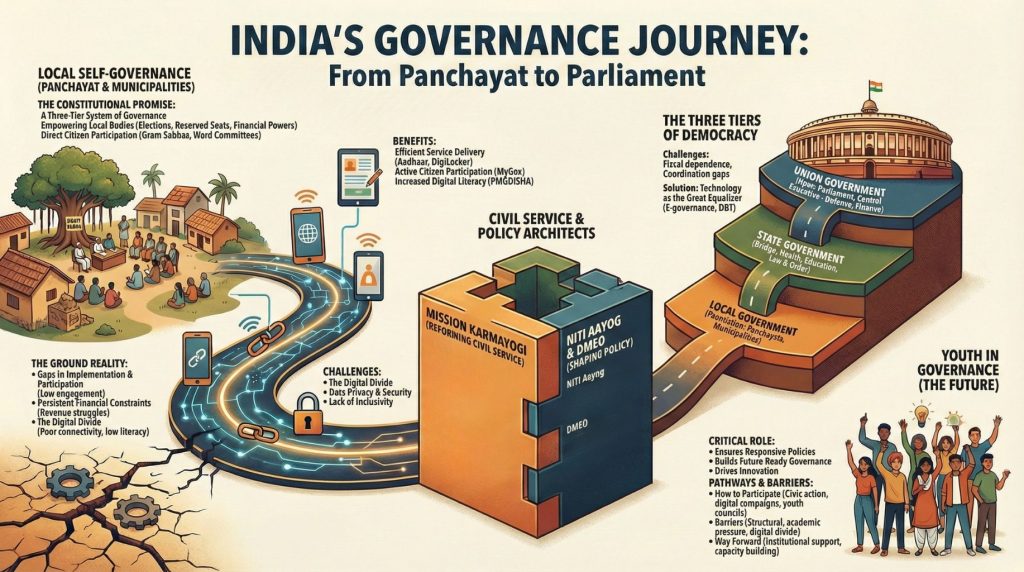
Imagine a local village council having the financial independence and administrative power to transform its own community without waiting for outside approval. Across India’s 2.55 lakh Gram Panchayats, this vision represents the future of grassroots democracy. Recently, G. Mallikarjuna Swamy and Mr. Alok Virendra Tiwari from GRAAM participated in a national consultation convened by NITI Aayog to address how local governance units can achieve true self-reliance.
While Gram Panchayats serve as the primary link between citizens and the state, many face significant operational hurdles. They often grapple with limited planning capacity, insufficient infrastructure, and a heavy reliance on central grants. In fact, local revenue currently accounts for less than 6% of total Panchayat income.
To bridge these gaps, G. Mallikarjuna Swamy and Mr. Alok Virendra Tiwari shared field-tested insights across vital areas: managing rapidly growing peri-urban regions, addressing staff and infrastructure shortages, expanding local revenue streams, and strengthening State Institutes of Rural Development and Panchayati Raj (SIRDPRs) through improved competency assessment processes.
By synthesizing these ground-level realities into clear recommendations for the Ministry of Panchayati Raj, Government of India, the consultation marked an essential step toward creating fiscally independent, capable, and accountable local governments.
Key Takeaway & Impact
Policy Influence: Ground-level research and field-based insights were integrated directly into national governance frameworks alongside NITI Aayog.
Fiscal Self-Reliance: Practical strategies were formulated to help Gram Panchayats boost local revenue generation and transition into fully functional units of self-governance.
Join the Conversation
How can local communities play a more active role in supporting their Gram Panchayats? Share your thoughts below!