
– Hrithika Goswami, Grassroots Research and Advocacy Movement
– Ramanjali Ramesh, Grassroots Research and Advocacy Movement
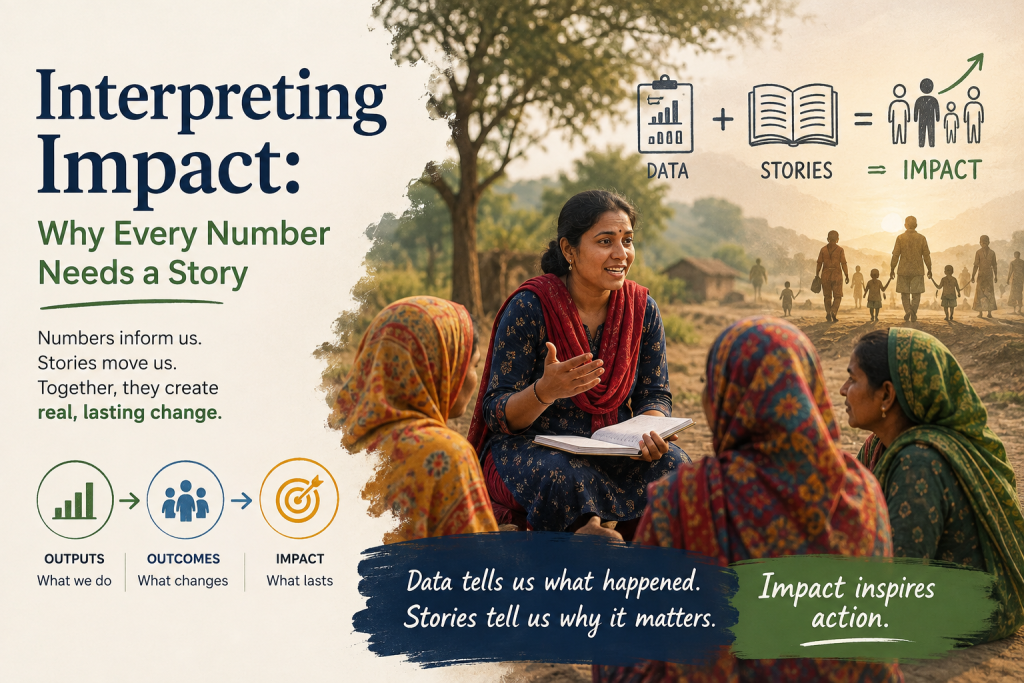
In the world of social impact work, there is a rather unaddressed pain point- the interpretation of impact. Yes, interpreting impact. Different stakeholders interpret impact differently – some interpret outputs as impact while others often read outcomes as impact and in this misinterpretation, we lose the essence of real social impact. Take some programs and schemes: they more often than not equate impact with scale-participation numbers, beneficiary counts. Corporates, on the other hand, tend to halt at outcomes based on their engagement with a project. Non-profits are left in the middle, juggling both – grounding these numbers in ground realities, and hunting for examples that can translate national schemes and corporate interventions into the language of real impact.
A study conducting a detailed literature synthesis of social impact measurement defined impact as “the result of a deliberate intervention by an individual, community, or organization with the objective of causing a positive effect on social, environmental, and economic well-being” (Feor, L. et al, 2023). Impact is zoomed-out. It’s not what you did today – it’s what changes because of it. Take a 5-year project: it’ll give you outcomes, both short-term and long-term, along the way. But the impact itself may not be visible for a decade or more, depending on the intervention and other factors.
What is most interesting is program planning and evaluation frameworks such as Theory of Change (TOCs) and logical frameworks clearly lay out an intervention’s Outputs, Outcomes, and Impact and yet in due course of time we often forget to refer to this holy grail. Limitations such as impact showcasing in a shorter course of time, reporting to secondary stakeholders, and looking for more tangible outcomes to renew project cycles, etc. make us lose focus less on the impact.
In the pickle of impact interpretation, civil society organizations emerge as the ambassadors of social impact with their unique vantage point- a strong grassroots connection that other stakeholders of development do not possess. As such, the responsibility falls on them: to tell on-ground stories, to report impact, “whether they be intended or unintended, anticipated or unanticipated, positive or negative” (Johnston, K. et al, 2025) and to co-orient others on what impact really is. And this is achieved best through one thing – responsible impact storytelling.
Beyond Metrics: How Storytelling Turns Impact into Collective Action
Evaluation frameworks tell us what to be changed. Storytelling explains why it mattered, how it happened, and why others should care. A successful collaboration between government, corporate partners, and civil society is rarely sustained by data alone.
This is particularly important in cross-sector partnerships, where each stakeholder views impact through a different lens. Governments seek scalable solutions that align with policy priorities. Corporate partners look for measurable outcomes, credibility, and responsible investments. Civil society organisations prioritise lived experiences, inclusion, and community ownership. Storytelling serves as a common language that bridges these perspectives, translating different forms of value into a shared understanding of impact.
Stories Build Trust Before They Build Scale
Every successful collaboration begins with trust. Long before another district adopts an innovation or another company decides to invest, stakeholders ask a simple question: “Has this worked somewhere else?” The answer is rarely found in a spreadsheet. It is found in stories supported by evidence.
Consider a village health committee that successfully improved maternal health outcomes. The evaluation may report increased institutional deliveries or improved service utilisation. The story of impact reveals the journey : how local women negotiated with health workers, how governance structures evolved, and how despite all shortcomings, the discourse for systems change was sown.
Findings from interventions validate progress, but storytelling validates the impact by communicating it effectively to diverse stakeholders. It provides context, captures lived experiences, and translates evidence into narratives that are believable, relatable, and actionable. In doing so, storytelling helps diverse audiences understand not just what changed, but why it matters and how those learnings can be adapted or replicated in other contexts.
For policymakers, stories reduce uncertainty. For corporate CSR teams, they demonstrate responsible stewardship of investments. For communities, they create recognition, ownership, and the scope of replicability.
Grassroots Organisations Are the Torchbearers of Impact Storytelling
Grassroots organisations are the torchbearers of impact storytelling, working closest to communities, they witness change as it unfolds, and their stories reflect authentic, bottom-up perspectives rooted in lived realities rather than external observation. But too often, development work stays confined to donor reports, internal documentation, or annual reports, and valuable innovations never enter wider policy conversations. Communication should not be the final stage of a project; it needs to be embedded throughout implementation, documenting community voices alongside quantitative indicators, decisions and adaptations and not just successes, local innovations that show how policy works in practice, and stories that capture both progress and remaining challenges. By creating this space, grassroots organisations enable more truthful, inclusive, and credible reporting of change and in doing so, communities stop being simply subjects of communication and become contributors to the knowledge being created. The most powerful impact stories, after all, are not written about communities, they are built with them.
Visibility Is Not Promotion, It Is Public Infrastructure
Many organisations hesitate to invest in communication because they associate visibility with marketing. But when a project is consistently documented through policy briefs, practitioner blogs, LinkedIn thought leadership, community stories, podcasts, research summaries, and media engagement, institutional credibility increases, collaborators gain confidence because evidence becomes accessible, and successful practices enter broader development discourse instead of staying locked away as isolated organisational knowledge. Visibility therefore serves an important governance function, enabling transparency, accountability, peer learning, and informed decision-making. In today’s digital ecosystem, a well-documented project can reach policymakers, CSR leaders, researchers, and practitioners far beyond its original geography.
Using Social Media to Foster Accountability and Trust
Rather than asking “How many likes did this receive?”, Organizations should ask whether the content helped stakeholders keep sight of the impact, whether it amplified community voices and lived experiences, and whether it fostered transparency and built trust. The better measure is whether it sparked meaningful dialogue, partnerships, or policy conversations, and whether it encouraged others to learn from or adapt the approach. Communication success, then, isn’t just about reach, it’s about accountability, trust, informed decision-making, and meaningful action. That shift in what we measure is what turns social media from a broadcast tool into infrastructure for genuine accountability.
The Way Forward
The tools for better impact storytelling aren’t hidden, they’re already in your hands. Don’t go searching for impact elsewhere when it’s already mapped out in the frameworks you designed. Leverage the power of social media the way it’s meant to be used, “ek teer se lakhon nishaan” one well-told story, one platform, reaching policymakers, corporates, communities, youth and peers all at once. And most importantly, recognise that impact storytelling isn’t just a communications exercise, it’s a mechanism for systems change. Every story shared responsibly nudges a government toward better policy, a corporate partner toward deeper investment, and a community toward greater ownership of its own progress. The frameworks exist. The platforms exist. What’s needed now is the will to use them consistently, credibly, and unapologetically.
References:
- Boeck, H., Bourguignon, B., Habib, S., & Bahra, M. (2025). Evaluating the impact of storytelling elements on social media stakeholder engagement: An AI-driven approach. Data & Policy, 7. https://doi.org/10.1017/dap.2025.10029
- Davidson, B. (2017). Storytelling and evidence-based policy: Lessons from the grey literature. Palgrave Communications, 3(1), 1–10. https://doi.org/10.1057/palcomms.2017.93
- Feor, L., Clarke, A., & Dougherty, I. (2023). Social impact measurement: A systematic literature review and future research directions. World, 4(4), 816–837. https://doi.org/10.3390/world4040051
- Hendricks, A. (2024). Types of stakeholders and their roles: A quick reference guide – simply stakeholders. In Simply Stakeholders. https://simplystakeholders.com/types-of-stakeholders-and-their-roles/
- Johnston, K. A., Hurst, B., & Lane, A. B. (2025). Co-orientation on social impact: The role of perspectives. Public Relations Review, 51(3), 102589. https://doi.org/10.1016/j.pubrev.2025.102589
- Powell, A., & Ditkoff, S. (2016). Collaborating to accelerate social impact a research study are funder collaboratives valuable? https://www.bridgespan.org/getmedia/3bec9088-712d-4e06-9bd7-fdcfdc10db57/bridgespan-2019-value-of-philanthropic-collaboration-research-study.pdf
- Thompson, R. (2024). Community-driven change: Demonstrating impact in Africa and India. In Bridgespan. https://www.bridgespan.org/insights/community-driven-change-africa-and-india/report-community-driven-change-africa-and-india





Congratulations