
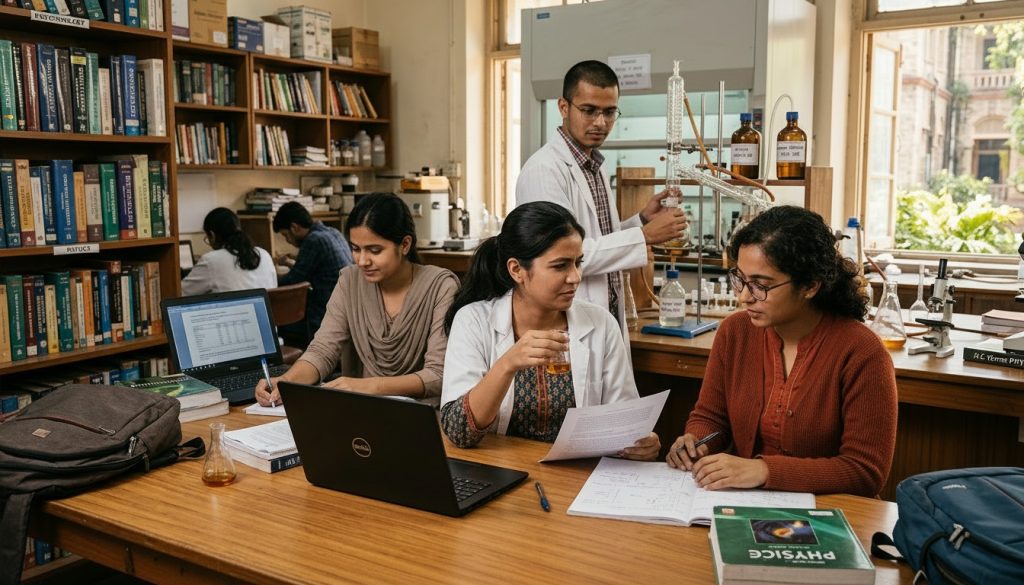
– Prakyath Shetty, Embark India Development Fellow
Co-Authored by: Dr. Inv. Shivakiran S. Makam (Director-Strategy, Collaboration and Operations) | Section Infin8 Foundation, Dr. Ananya Samajdar (Deputy Director of Research) and Dr. Sanjeev Kenchaigol (Research Fellow) | GRAAM
Guided / Mentored by: Ms. Preksha Thej (Program Manager) and Dr Nida Faruqui (Programme Lead) | Office of the Principal Scientific Adviser to Government of India
The Opportunity: Unlocking Research and Innovation at Scale
In 2022, an alarming trend in Indian research became visible: the retraction rate for papers published by Indian authors reached 3.5 per 1,000 papers more than double the rate from 2012 .The severity of India’s research integrity crisis became globally apparent in 2023, as the nation recorded 2,737 retractions, placing it third in worldwide rankings behind only China and the United States (Retraction Watch, 2023). Yet this statistic captures only half the problem facing India’s Higher Education especially the Tier 2 and Tier 3 universities.
The other half is visible in a different kind of absence: the near-total lack of meaningful innovation and startup activity emerging from institutions serving 35 million students. While India’s startup ecosystem has grown dramatically, most activity originates from Tier 1 institutions and metropolitan centers. Tier 2 and Tier 3 universities contribute almost minimally. Faculty publish between 0.3 and 0.5 papers per year on average (compared to 1.2 to 1.8 at Tier 1)(EY-FICCI, 2022), More fundamentally, students at Tier 2 and Tier 3 institutions have limited opportunities to develop critical thinking, analytical reasoning, problem-solving, and collaborative working skills that research and innovation require. As the British Council notes, students have ‘little opportunity to develop a wider range of transversal skills’ essential for research and innovation engagement (British Council, 2014).
This blog examines how the National Education Policy 2020 (NEP 2020) and the National Innovation and Startup Policy 2019 (NIP 2019) have laid a strong foundation, and explores the opportunities to build on these frameworks to further elevate research quality and innovation capacity at Tier 2 and Tier 3 institutions.
Understanding India’s Higher Education Landscape
India’s higher education sector is one of the world’s largest by enrollment, yet it is profoundly stratified. India has over 42,000 higher education institutions, but research capacity, innovation infrastructure, and expertise are concentrated at the top. A small number of institutions, the IITs, NITs, central universities, and elite private universities, concentrate most of India’s research infrastructure, funding, faculty expertise, and industry partnerships.
The remaining 80 percent are predominantly teaching-focused colleges. According to the British Council’s 2014 analysis, approximately 90 percent of India’s undergraduates study at affiliated colleges with limited curricular autonomy, minimal research infrastructure, and faculty stretched across heavy administration duties. Many operate under severe budget constraints.
The scale of institutional constraints is significant. The British Council documented that 30 to 40 percent of faculty positions across Indian higher education remain vacant. Faculty at Tier 2 and Tier 3 institutions face enormous teaching loads 18 to 22 hours per week leaving almost no time for research, mentoring, or innovation engagement that NEP 2020 and NIP 2019 envision.
The EY-FICCI report “Higher Education in India: Vision 2047” (2022) quantifies the capacity gap. India’s research and development spending is 0.7 percent of GDP, compared to 2.1 percent in the United States and 2.8 percent in China. Most critically, India has only 216 researchers per million population, versus 4,300 in the United States. This research capacity is not distributed evenly. Additionally, the innovation ecosystem startup formation, funding, mentoring, industry partnerships is similarly concentrated in Tier 1 institutions and urban centers. Tier 2 and Tier 3 colleges barely participate.
The Capacity Gap: Where Policy Meets Reality
The problem is dual and systemic. Tier 2 and Tier 3 universities serving 35 million students produce less than 20 percent of India’s research output and contribute almost in single digits to the startup and innovation ecosystem. This is very likely not because faculty are less capable or motivated, but because of structural constraints affecting both research and innovation capacity: absence of good governance, relevant infrastructure, insufficient faculty expertise and training, inadequate resources, and misaligned institutional incentives.
The retraction rate of India’s overall higher education has jumped from 1.5 per 1,000 papers in 2012 to 3.5 per 1,000 in 2022, suggesting widespread quality and ethics problems. A senior IISC researcher quoted in The Hindu (August 2025) stated: “In Tier 2 and Tier 3 institutions, the drop in research quality isn’t linear, it’s exponential. Many are publishing in predatory venues.” Additionally, The Hindu reported (May 2025) that graduates from Tier 2 and Tier 3 colleges lack research exposure and problem-solving skills, leaving them locked out of core technical positions.
On the innovation side, startup and entrepreneurship ecosystems remain concentrated in Tier 1 institutions. Tier 2 and Tier 3 colleges report minimal incubation activities or startup mentorship programs, despite NIP 2019 policy mandates for innovation support. While India has produced over 100 unicorns, virtually none originated from Tier 2 or Tier 3 universities. Most originated from Tier 1 institutions. Tier 2 and Tier 3 colleges have limited track records of student startups, faculty entrepreneurship, or technology transfer. Faculty rarely mentor entrepreneurs. Students graduate with low participation in innovation competitions or incubation programs.
Why does this dual gap matter? India’s ambitions to compete globally and address domestic challenges in healthcare, agriculture, and energy require participation from geographically distributed institutions. If innovation and research remain confined to Tier 1 institutions, India will struggle to develop regional solutions and create employment through innovation in tier-2 and tier-3 cities.
Current Policy Framework: NEP 2020 and NIP 2019
India has released two major policy frameworks to address research and innovation: NEP 2020 and NIP 2019 (Ministry of Education, 2020; MHRD, 2019). NEP 2020 mandates research as a core function across institutions, undergraduate research engagement, innovation incubators, and entrepreneurship education (Ministry of Education, 2020). NIP 2019 provides operational guidance on governance, infrastructure, faculty support, IP management, and innovation ecosystems (MHRD, 2019).
Both policies are thoughtfully designed and visionary in their ambition. To realise their full potential at Tier 2 and Tier 3 institutions, complementary support is needed across institutional capacities, research governance structures, faculty expertise, curriculum autonomy, dedicated innovation budgets, and industry partnership areas where these colleges are still building strength. While reasonable for Tier 1 institutions, these assumptions are very difficult to fulfil for the majority of Tier 2 and Tier 3 colleges. As a result, implementation at many of these institutions is still in early stages of maturity, For example an innovation cell may exist in structure, but is often yet to be fully funded, staffed, and integrated into day-to-day institutional functioning. This points to a meaningful insight for the road ahead: the policies’ advanced capacity-building goals can be realised most effectively when supported by parallel strengthening of foundational governance and infrastructure at the institutional level.
The core problem: policy prescribes advanced capacity-building to institutions that lack foundational governance and infrastructure.
Key Capacity Areas for Development
The Research and Innovation Governance Infrastructure Gap
The first fundamental challenge is that Tier 2 and Tier 3 institutions lack documented, shared standards for what constitutes quality research or how innovation initiatives should be managed. This absence affects both the research produced and students’ learning about research and entrepreneurship processes.
In well-functioning research institutions, there are understood standards about what constitutes rigorous methodology, adequate evidence, ethical conduct, and appropriate peer review(British Council, 2014) . Faculty learn these standards through training and apply them to their own work and colleagues. Students are exposed to these standards through coursework and research experiences.
In many Tier 2 and Tier 3 colleges, by contrast, research quality is assumed rather than defined. Faculty proceed from their own training and intuition. There is often no formal internal peer review, no documentation of quality criteria, and no institutional mechanism for evaluating research ethics before publication. Under pressure from NIRF rankings measuring quantity rather than quality, faculty may publish in low-cost, low-review journals. Some are legitimate but under-resourced; others are explicitly “predatory,” designed to extract fees without peer review. When these papers are later retracted, the institution suffers reputational damage. But by then, the metric has been achieved.
Similarly, for innovation, institutions lack governance structures for evaluating startup ideas, mentoring entrepreneurs, or managing incubation activities. Without documentation of what makes a viable startup or innovation opportunity, institutions cannot meaningfully support entrepreneurship; they can only host it.
The Faculty Capacity Gap
The second major challenge is that faculty lack capacity to conduct quality research, mentor students in research, or guide innovation and entrepreneurship. The root cause is workload and training.
Most faculty spend 18 to 22 hours per week teaching. Add grading, lecture preparation, administrative meetings, and student consultations, and there is almost no time for research, research supervision, or entrepreneurship mentoring. The EY-FICCI report notes that only 2.5 percent of Indian colleges run PhD programs, while most Tier 2 and Tier 3 faculty have master’s degrees, not PhDs. While not inherently problematic, this means fewer faculty have first-hand experience with rigorous research design and peer review systems.
Additionally, faculty vacancy rates of 30 to 40 percent mean that present faculty often carry double or triple loads. One faculty member covers course teaching that should spread across two or three people. Under these conditions, the expectation that faculty will mentor startups, sit on innovation committees, or develop entrepreneurship curricula is impossible.
The Institutional Incentive Misalignment Gap
A third challenge is fundamental misalignment between what policies prescribe and what institutional incentive structures reward. This affects both research and innovation capacity.
NEP 2020 and NIP 2019 envision faculty mentoring startups and developing entrepreneurship curricula. Yet in most Tier 2 and Tier 3 colleges, faculty performance evaluations still weigh teaching hours as primary. If a faculty member reduces teaching to spend time on entrepreneurship mentoring, their teaching hours drop, potentially threatening affiliation status or institutional revenue. For many administrators, the logic is clear: teaching hours must remain at current levels for institutional survival. Innovation, while valued in policy, cannot be prioritised if it threatens institutional viability. While NIP 2019 urges institutions to count research and entrepreneurship as legitimate, institutional systems measuring and rewarding performance have not caught up. A faculty member whose research reduces teaching evaluations is unlikely to be promoted.
This creates an impossible situation. Policies tell faculty to do research and innovation. Institutional incentives tell them to maximize teaching. They respond rationally: prioritize teaching and, if they publish or engage in innovation, do it quickly regardless of quality.
The Infrastructure and Partnership Gaps
Fourth and fifth challenges are the absence of infrastructure for both research and innovation, and near-complete absence of industry-academia partnerships. Research requires laboratories, equipment, journals, and technical support. Innovation requires incubation spaces, mentoring networks, and industry connections.
While OECD countries derive 31% of tertiary education funding from private sources (OECD, 2018), India’s research remains heavily government-dependent. India’s R&D expenditure is 0.7% of GDP versus 2.1% in the USA and 2.8% in China (EY-FICCI, 2022). Industry engagement is limited: large corporations prefer establishing their own research facilities rather than funding existing institutions, particularly at Tier 2 and Tier 3 colleges (British Council, 2014). Faculty at Tier 2/3 institutions operate with near-zero private research budgets because industry will not invest without demonstrated institutional credibility (The Hindu, 2025). Until these institutions establish research governance and quality standards, private sector funding will remain inaccessible.
Path Forward:
First, the research quality and innovation capacity crisis in Tier 2 and Tier 3 universities reflects systemic governance gaps, faculty capacity shortages, infrastructure deficits, and misaligned institutional incentives affecting both research and innovation simultaneously that make quality work extremely difficult even for well-intentioned faculty.
Second, current policies (NEP 2020 and NIP 2019) are well-designed for institutions with governance maturity, faculty expertise, and resources. These conditions are not present across most Tier 2 and Tier 3 institutions. Implementing sophisticated policies without first building foundational capacity is unrealistic.
Third, a diagnostic maturity assessment approach offers a more realistic pathway. By measuring institutional capacity honestly and designing interventions at the right maturity level, institutions can build quality incrementally rather than pretending to implement advanced policies they cannot realistically achieve.
Fourth, solutions must address both research and innovation together, not as separate problems. They share root causes and require integrated capacity-building.
Scaling Research and Innovation: A Regional Opportunity
India’s ambitions to become a knowledge and innovation-driven economy cannot be realised if quality research and meaningful innovation remain confined to 20 percent of institutions. Tier 2 and Tier 3 universities, serving 35 million students and connected to regional economies, must participate meaningfully in both research and innovation. Current policy frameworks can evolve further to place greater emphasis on the foundational capacity needs that influence implementation at these institutions.
NEP 2020 and NIP 2019 are thoughtfully designed and forward-looking, and their effective realisation at Tier 2 and Tier 3 institutions can be accelerated by aligning support with the conditions these colleges are still building. What is needed is a diagnostic approach that measures institutional maturity honestly, acknowledges real constraints, and designs realistic, sequenced capacity-building in both research and innovation. The question ahead is not “why won’t Tier 2 and Tier 3 institutions comply with policy?” It is “what foundational capacities do they need to build first, and how do we help them build those realistically?” That question opens a different and more promising pathway forward.
About the Author
Prakyath Shetty is a Fellow at Office of Principal Scientific Adviser, Government of India. His research is a study on “Realigning Institutionals’ Academic & Administrative Governance to promote Faculty-Led Research & Innovation”.
This blog was produced under the GRAAM Embark India Fellowship 2025–26, mentored by Ms.Preksha Thej (Program Manager) and Dr Nida Faruqui (Programme Lead) Office of Principal Scientific Adviser – GoI, Dr. Inv. Shivakiran S. Makam, Director-Strategy, Collaboration and Operations (Section Infin8 Foundation), Dr. Ananya Samajdar (Deputy Director–Research) and Dr. Sanjeev Kenchaigol(Research Fellow) – GRAAM.
References
- AISHE. (n.d.). AISHE Final Report. All India Survey on Higher Education. https://aishe.gov.in/aishe-final-report/
- Arnhold, Nina, Sangeeta Dey, Sangeeta Goyal, Kurt Larsen, and Namrata Tognatta. (n.d.). India Higher Education Report: Revitalizing Higher Education for Growth and Innovation. World Bank.
- British Council. (2014). Understanding India: The Future of Higher Education. https://www.britishcouncil.in
- EY and FICCI. (2022). Higher Education in India: Vision 2047. Ministry of Education, Government of India. https://www.ey.com/content/dam/ey-unified-site/ey-com/en-in/insights/education/documents/ey-higher-education-in-india-vision-2047.pdf
- LinkedIn. “Manthan PSA Post.” https://www.linkedin.com/posts/manthanpsa_riseutthan-researchforall-scienceforsociety-activity-7365962021382615040-h1Vb/
- Ministry of Education, Government of India. (2020). About National Education Policy. https://www.education.gov.in/en/nep/about-nep
- Ministry of Education, Government of India. (2020). National Education Policy 2020. https://www.education.gov.in/en/nep
- Ministry of Human Resource Development. (2019). National Innovation and Startup Policy 2019 for Students and Faculty. Government of India. https://www.mic.gov.in/assets/doc/startup_policy_2019.pdf
- OECD. (n.d.). Higher Education. https://www.oecd.org/en/topics/higher-education.html
- Office of the Principal Scientific Adviser. (n.d.). Manthan. Strategic Alliances Division, Government of India. https://www.psa.gov.in/manthan
- Section Infin8 Foundation. (n.d.). Incubation Centers in Karnataka: Expert Business Planning and Marketing Support. https://sectioninfin8.org/national-initiative.html
- The Hindu. (2025, August). “As India’s retractions surge, NIRF rankings only now begin penalising tainted research.” Education Section.
- The Hindu. (2025, May). “Why engineering graduates from tier-2, tier-3 colleges struggle: The skill gap that few talk about.” Education Section.
- Times of India. (2025, March). “Mission Utthan Launched in Mangaluru.” Mangaluru News. https://timesofindia.indiatimes.com/city/mangaluru/mission-utthan-launched-in-mangaluru/articleshow/118072739.cms
- University Grants Commission. (n.d.). Guidelines for Establishment of Research & Development Cell In Higher Education Institutions. https://www.ugc.gov.in/KeyInitiative?ID=Ox9NUJ/7LE8xivPCZ476jg==





Insightful
💯