
–Shagun Katiyar, Embark India Development Fellow
Co-Authored by Dr. Balu I (Senior Research Fellow) and Dr. Ganesh Prasad (Consultant, Abdul Nazir Sub State Institute of Rural Development and Panchayat Raj).
What makes a village truly developed? Is it one scheme, one department, one budget line, or is it the coordination of many working together toward the same goal?
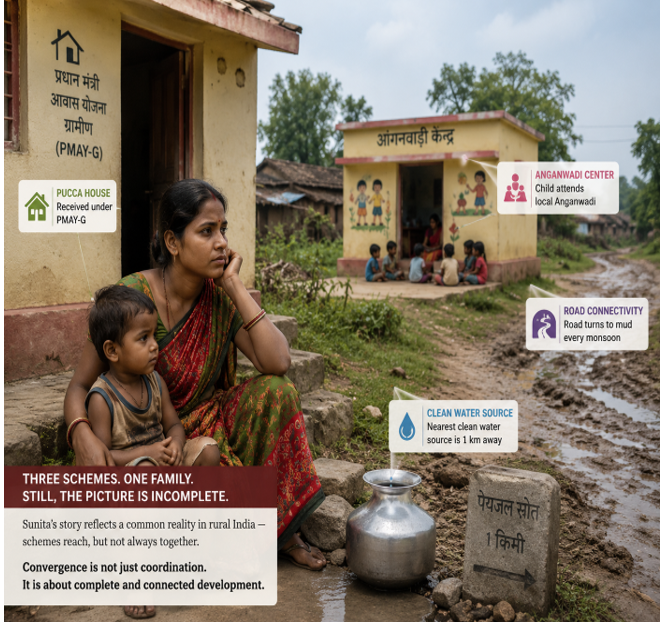
Meet Sunita, a young mother in a rural part of India. Her family received a pucca house under Pradhan Mantri Awas Yojana (PMAY-G), but the nearest clean water source is a kilometer away. Her child attends an Anganwadi, but the road to it turns to mud in every monsoon.
On paper, three government schemes have reached her family, but the reality is incomplete.
“Sunita’s story is not an exception. It is the rule for 68.8 percent of Indians who live in rural areas, where policy must translate into tangible change at the last mile — and too often, it does not.”
The Challenge: More Schemes, Less Coherence
Fiscal commitments to rural development have been substantial. Union budget allocations for rural development grew from ₹87,765 crore in 2016–17 to ₹273,108 crore in 2026–27, representing a rise of over 211 percent in a decade.
India, over the years, has developed a world-class rural portfolio, disbursing over ₹2 lakh crore annually through key initiatives such as MGNREGA, DAY-NRLM, NSAP, PMAY-G, PMGSY, and PMKSY. Each scheme addresses a real dimension of rural development, such as housing, employment, roads, water, livelihood, and social protection.
Yet this number carries one significant question: if rural budgets have more than tripled, why do outcomes remain uneven across states, districts, and Gram Panchayats?
The answer lies not in the scale of investment but in how it is organized. Despite being a deeply interconnected system, the rural economy has long been approached through fragmented departmental silos.
PMAY-G tracks houses completed. Jal Jeevan Mission tracks tap connections installed. PMGSY counts kilometers of road laid. Each number is real. Each is a genuine achievement. But when departments only measure what they own, the gap is in measuring what the household actually experiences.
A family may have a house without water. A road may reach a village where children still lack nutrition. A Block Development Officer in Gorakhpur, UP, cannot tell you today whether the family that received a PMAY-G house also has a functioning tap connection because that information lives in an entirely separate system, maintained by a separate department and reported to a separate ministry.
“India’s rural development challenge is no longer expansion alone. It is synchronization.”
What Convergence Actually Means
This coordination has a name, and that is “convergence.”
At its core, convergence is the intentional alignment of programmatic goals, financial resources, human capital, and implementation structures across schemes and departments. It is not merely administrative efficiency. It is a governance approach aimed at equitable prosperity, especially at the last mile, where policy must translate into tangible change in people’s lives.
“Convergence is India’s Social Gati Shakti – the governance multiplier that ensures 1 + 1 equals 11, not 2.”
Convergence in Action: Anganwadi Story
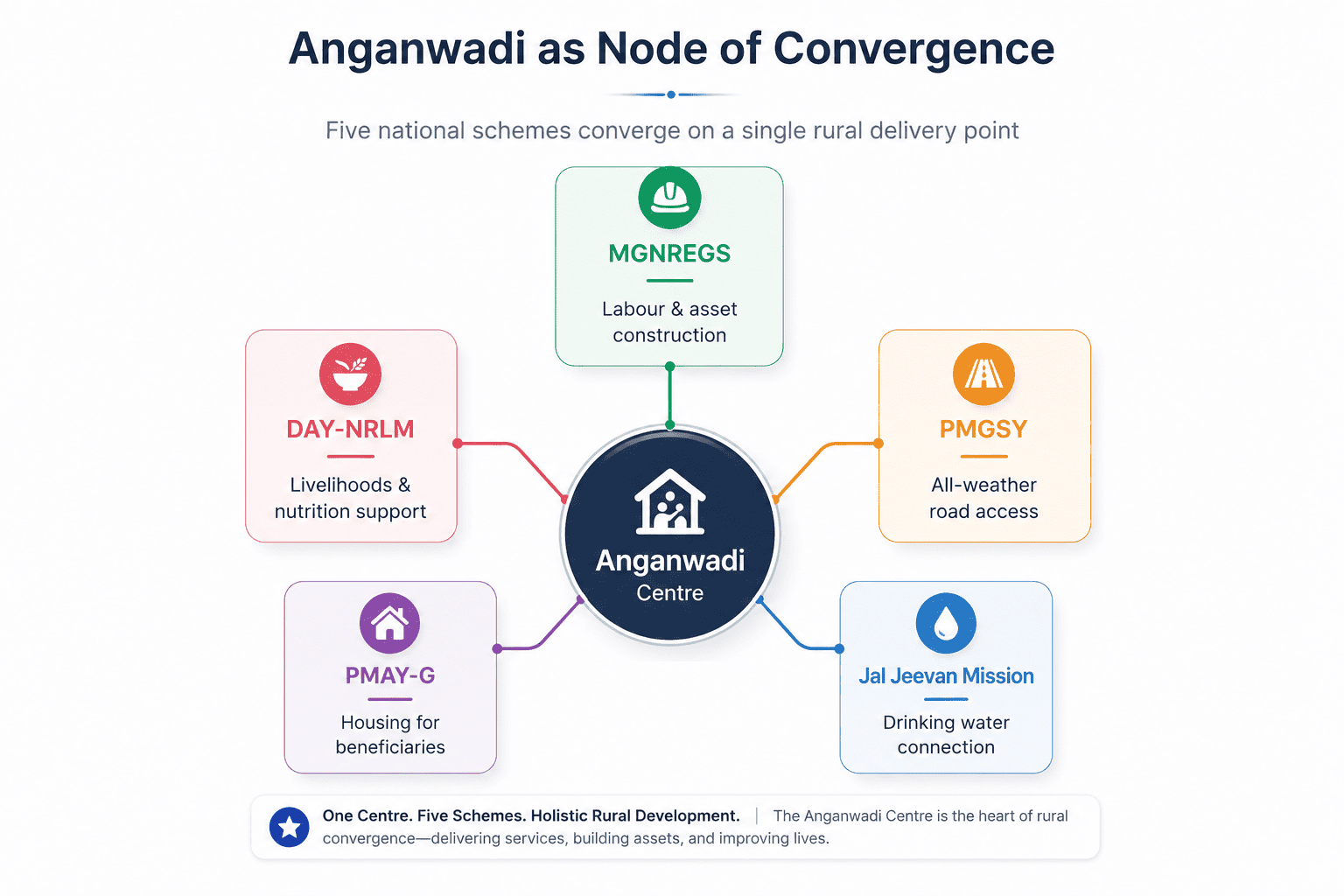
Consider the Anganwadi center, a familiar fixture in rural India, yet one that quietly sits at the intersection of multiple departments and schemes. An Anganwadi is not just a childcare space; it is a stage for coordinated developmental activity.
The construction of the Anganwadi center can be undertaken using labor and funds from the MGNREGS, ensuring local employment while creating durable community assets. All-weather connectivity to the center is enabled through the Pradhan Mantri Gram Sadak Yojana (PMGSY).
Accessible drinking water is secured under the Jal Jeevan Mission, and housing support for beneficiaries’ families is provided through the Pradhan Mantri Awas Yojana–Gramin (PMAY-G). Nutritional outcomes are further supported through livelihood and nutrition-sensitive interventions under the Deendayal Antyodaya Yojana – National Rural Livelihoods Mission (DAY-NRLM). That is convergence in action.
The Anganwadi is not merely a building. It is a node of convergence where the efforts of various ministries and departments come together to deliver a single, unified outcome for one family.
The numbers behind this example are real. As part of MGNREGA convergence, 81,447 Anganwadi centers were constructed in 2016-17, and during the 15th Finance Commission cycle, 50,000 Anganwadi centers are being constructed, of which 10,000 AWCs per year are being constructed in convergence with MGNREGS. As of early 2025, the Jal Jeevan Mission has delivered tap water connections to 79.74% of rural households, a landmark achievement. Yet that figure also means roughly one in five rural families still carries water by hand. PMAY-G has sanctioned housing for 268,480 landless beneficiaries. Progress is real. But the gaps between schemes mean Sunita’s family can still fall through the cracks.
“Development outcomes are delivered through coordinated systems, not standalone schemes. This is the core principle that must now move from aspiration to architecture.”
What the Evidence Points to: Coordination
Nobel laureate Amartya Sen argued that poverty is not merely a lack of income but an absence of capabilities, the freedom to live with dignity, access to opportunity, and leading a secure life. These capabilities are interconnected. A house without water, a school without roads, or a livelihood without market access delivers only partial transformation.
This is the central logic of convergence. As Abhijit Banerjee and Esther Duflo show in Poor Economics, isolated interventions rarely change lives unless supported by complementary systems. Rural transformation does not come from a single scheme, but from the simultaneous alignment of housing, water, roads, livelihoods, and institutional support.
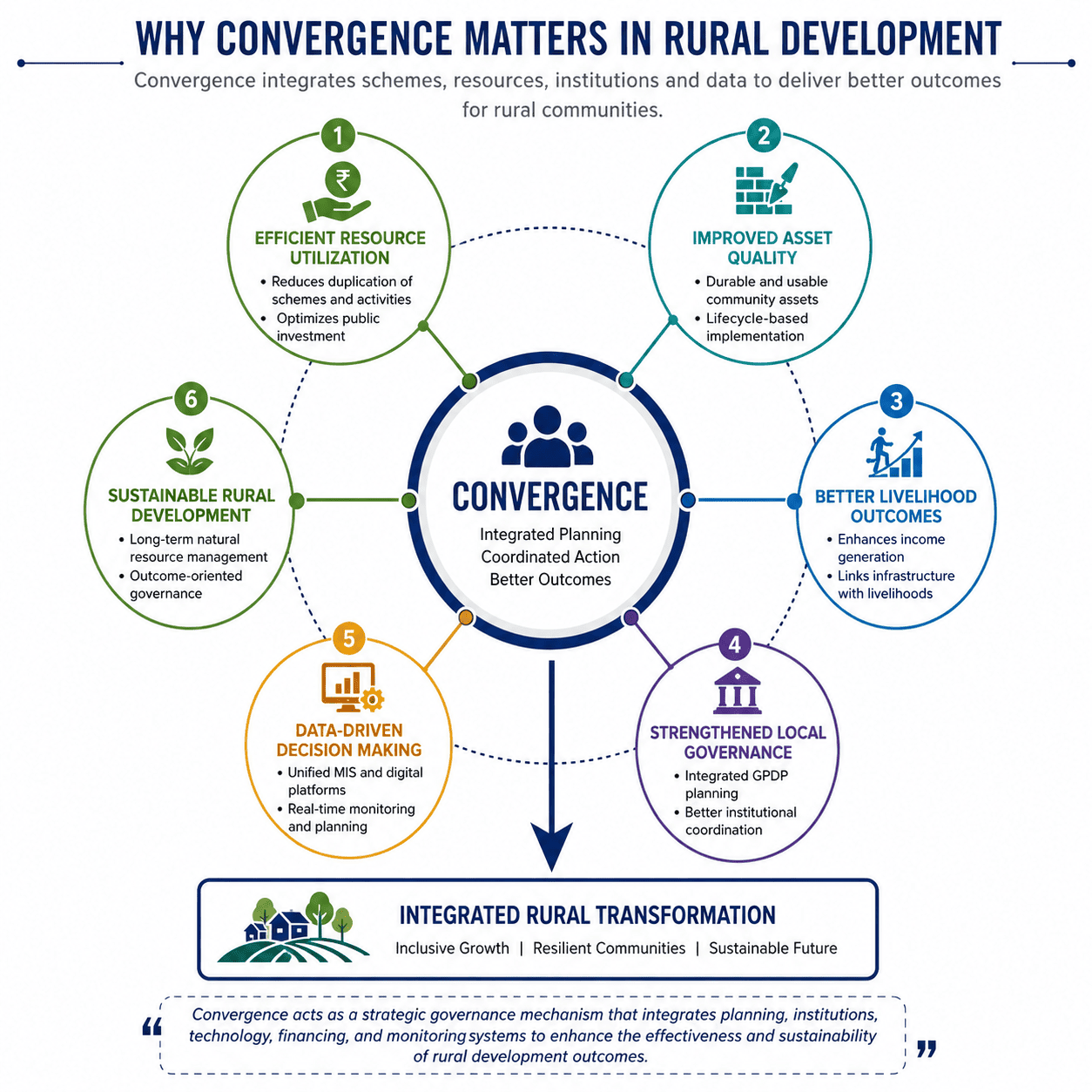
Development economics reinforces the same idea. The Solow-Swan framework suggests that investments generate higher returns when supported by complementary infrastructure and services. A road is more valuable when it connects livelihoods to markets. A house becomes transformative when combined with water, electricity, and income security. In this sense, convergence is not merely administrative coordination; it is the creation of developmental complementarities where each public investment strengthens the impact of every other investment.
Convergence has a history.
But convergence itself is not a new concept. The Ministry of Rural Development has emphasized convergence for over two decades. MGNREGA’s operational guidelines (2005) explicitly envisioned the co-deployment of multiple schemes at the Gram Panchayat level. Successive convergence guidelines in 2013 and 2016 operationalized this further. The recently enacted Viksit Bharat – Guarantee for Rozgar and Ajeevika Mission (Gramin) Act, 2025 (VB-G RAM G), with a fiscal outlay of ₹95,692 crore, makes convergence a statutory mandate under Schedule 1, clause 6, rather than just a guiding principle.
Progress is visible. According to the Ministry of Rural Development, 45.53% of works completed in 2025-26 were under convergence, a figure that has grown year on year. Gram Panchayats are increasingly planning for co-deployment of schemes rather than treating them as separate pipelines.
And in the developmental trajectory envisioned under the VB-G RAM G Act, 2025, rural development will assume a new face in the old coil. The goal is to establish a unified infrastructure stack that will help reduce asset duplication. By integrating a unified registry, we eliminate the “silo tax,” the hidden cost of redundant paperwork and fragmented data. With Viksit Bharat Panchayat plans, we are shifting to saturation-based planning. This means we don’t just “allocate” funds; we “saturate” a village with every necessary intervention simultaneously, ensuring no household is left behind by a gap between two departments.
And yet, why does more than half of all rural work still happen in isolation? The answer is simple and important.
“And yet, why does more than half of all rural work still happen in isolation? Aspiration without measurement is not accountable. Two decades of policy intent have produced guidelines — but not a scorecard.”
The Convergence Effective Index: From Principle to Architecture
But despite the effectiveness of convergence, there is a lack of effort in capturing it. Ministry records show how much convergence occurs, but not how effectively coordinated investment improves lives.
The absence of a “convergence variable” in fragmented architectures means that critical questions remain unanswered: Does a village with aligned investments in livelihoods, infrastructure, and basic services perform better than one with fragmented delivery? Does convergence generate additive or truly multiplicative gains?
This is precisely the gap the Convergence Effectiveness Index (CEI) is designed to fill. The CEI could function as a weighted composite index combining indicators across institutional coordination, scheme integration, planning convergence, technology interoperability, and household-level outcomes.
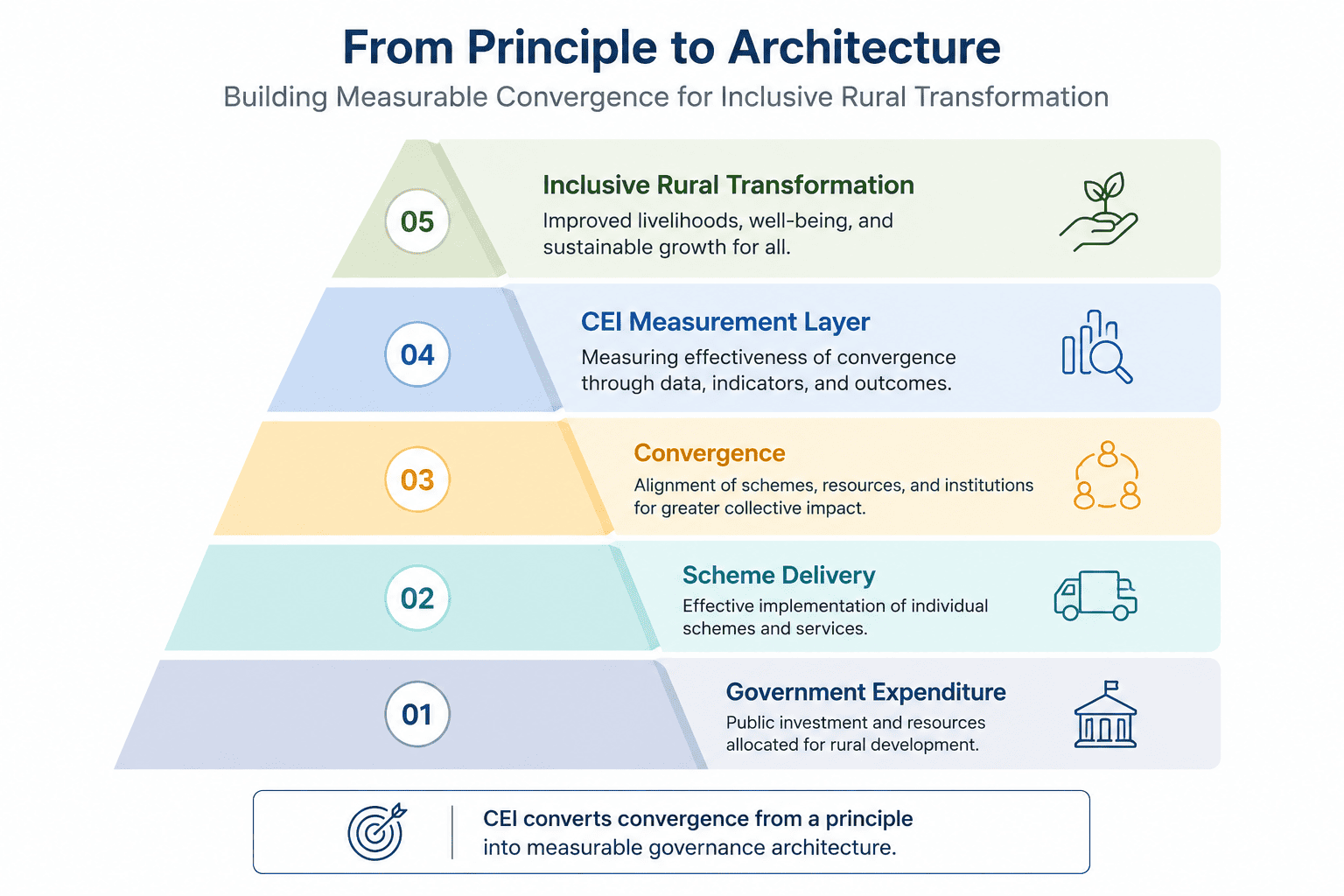
It is the missing institutional bridge between expenditure and development outcomes. It is the governance architecture India needs to complete the journey from scheme delivery to household transformation.
In doing so, it would transform convergence from a guiding principle into a governable, comparable, and accountable metric, enabling India to ensure that its substantial rural investments translate not into parallel efforts, but into a cohesive engine of inclusive growth.
At its core, the CEI answers a simple question: do villages where schemes converge perform better than those where they do not?
The CEI would function as a standardized analytical and evaluation tool to assess the depth, quality, and outcomes of convergence across rural development schemes at the Gram Panchayat level. Its purpose is not to confirm that schemes were co-deployed, which is a matter of administrative compliance, but to answer a more challenging question: Did they actually work in concert to improve lives?
What CEI measures:
Most existing monitoring systems measure inputs and outputs. CEI attempts to measure interactions and outcomes. A well-designed CEI would evaluate convergence across five dimensions: scheme integration, planning integration, institutional coordination, technology integration, and outcome linkages, together capturing the full life cycle of convergence from intent to impact.
When we measure houses built, we know PMAY-G. But we do not know whether the household also has water, whether the road connects them to the market, or whether their livelihood has strengthened. CEI answers the harder question: Did combined investments actually improve lives?
Updated annually and tied to planning and performance review cycles, it would produce a composite score that shifts the focus of governance from inputs to interactions.
The Multiplier Effect: Why Convergence Is Not Just Addition
The central hypothesis underlying the CEI is that converged investments generate multiplicative rather than additive developmental returns. This is not merely a philosophical assertion; it follows directly from the economics of complementarity.
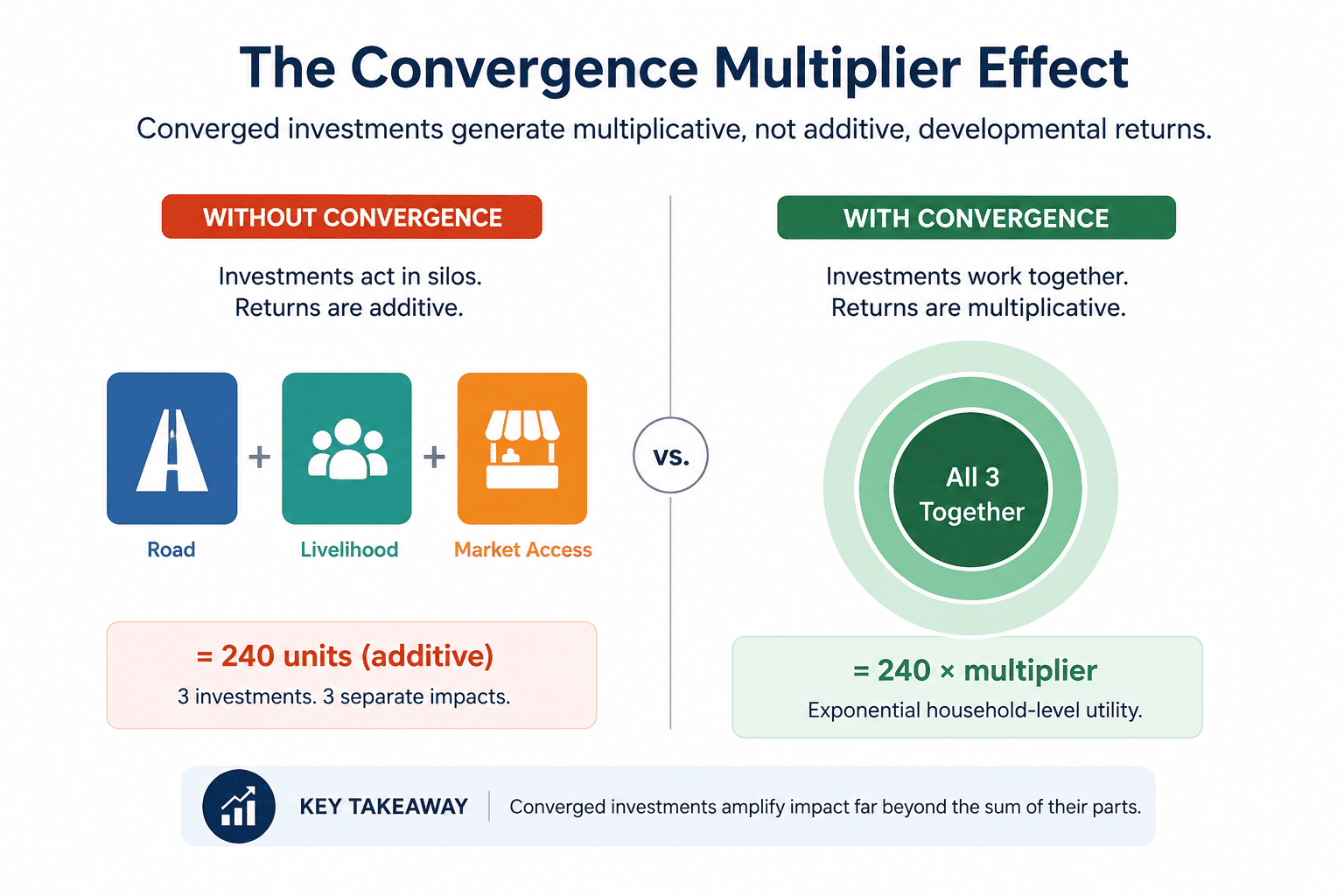 A road alone has value. A livelihood program alone has value. But a road combined with a livelihood program, market linkage, functioning water access, and a stable home creates exponential utility, because each investment raises the returns to every other investment. When a household has all of these simultaneously, the interaction effect dwarfs the sum of the parts.
How CEI Transforms Rural Governance
Implemented consistently, the CEI would reshape rural governance in three fundamental ways:
It redefines success. Collaboration between departments becomes a measurable outcome, not a procedural expectation. Coordination becomes something worth doing because it is something that gets counted.
It guides investment. By identifying Gram Panchayats where convergence delivers better outcomes per rupee, it gives planners a sharper lens, not just on how much to spend but on where alignment matters most.
It closes the accountability gap. For the first time, policymakers would have a shared framework to evaluate not just expenditure but whether combined efforts actually reached people and where they fell short.
“The CEI transforms convergence from a governing principle into a governable, comparable, accountable metric.”
Conclusion: The architecture India needs for 2047
Rural India is not the hinterland; it is the heartbeat.
As Mahatma Gandhi ji rightly said, “If the villages perish, India will perish too.” As per the 2011 Census, nearly 68.8 percent of our population and over 72.4 percent of our workforce reside in rural areas. Any roadmap to the Viksit Bharat goal of 2047 must run directly through our villages, not around them.
As India approaches Viksit Bharat 2047, the strategic question is no longer whether we have enough schemes. India now has more schemes, greater fiscal allocations, and stronger institutional capacity than ever before in its development journey. But the developmental debate is whether that multiplication is actually happening and to what degree, in how many villages, and with what consistency, something we currently cannot answer with evidence. It is a gap in the system that costs real families real opportunities every year.
The Convergence Effectiveness Index would give us that answer and fill the gap. It would transform convergence from a governing principle into a measurable reality, ensuring that every rupee spent, every asset built, and every livelihood supported contributes not in isolation but as part of a coherent, intentional system oriented toward inclusive and sustainable development for all.
And when that architecture is in place, the answer to Sunita’s story will no longer be incomplete. Her house, her road, her water, and her livelihood will have been planned together, not as parallel pipelines from separate departments, but as a unified commitment from a state that has learned to govern as a system.
“The true measure of development is not how much we deliver, but how well those efforts come together to improve lives.”
About the Author
Shagun Katiyar is an Embark India Development Fellow, currently attached to the Ministry of Rural Development (MoRD), Government of India, for six months. Her work focuses on strengthening institutional coordination, data-driven planning, and outcome-oriented rural transformation through frameworks such as the Convergence Effectiveness Index (CEI). With a background in public policy and governance, her research interests lie at the intersection of rural development, sustainability, public systems, and governance innovation. This blog was developed under the guidance and mentorship of senior officials of the Ministry of Rural Development, and also with the mentors Dr. Balu I (Senior Research Fellow) and Dr. Ganesh Prasad (Consultant, Abdul Nazir Sub State Institute of Rural Development and Panchayat Raj). The views expressed are personal.
References
- Banerjee, A., & Duflo, E. (2011). Poor economics: A radical rethinking of the way to fight global poverty. PublicAffairs.
- Comptroller and Auditor General of India. (n.d.). Performance audit reports on rural development schemes. Government of India.
- Development Monitoring and Evaluation Office. (n.d.). Evaluation studies on rural development programs. NITI Aayog, Government of India.
- Government of India. (2011). Census of India 2011. Office of the Registrar General & Census Commissioner.
- Government of India. (2025). Viksit Bharat – Guarantee for Rozgar and Ajeevika Mission (Gramin) Act, 2025. Ministry of Law and Justice.
- Ministry of Finance. (2026). Union budget 2026–27. Government of India.
- Ministry of Rural Development. (2005). Mahatma Gandhi National Rural Employment Guarantee Act (MGNREGA): Operational guidelines. Government of India.
- Ministry of Rural Development. (2016). Guidelines for convergence of MGNREGA with other schemes (2013, revised 2016). Government of India.
- Ministry of Rural Development. (2025a). Annual report 2024–25. Government of India.
- Press Information Bureau. (2017). Construction of Anganwadi centres under MGNREGA (2015–16; 2016–17). Government of India.
- Press Information Bureau. (2025a). Jal Jeevan Mission: Status of rural household tap water connections. Government of India.
- Press Information Bureau. (2025b). Pradhan Mantri Awas Yojana – Gramin: Progress and beneficiary coverage. Government of India.
- Sen, A. (1999). Development as freedom. Oxford University Press.



Such an beautiful way of explaining such a complicated concept and making it easy to understand!