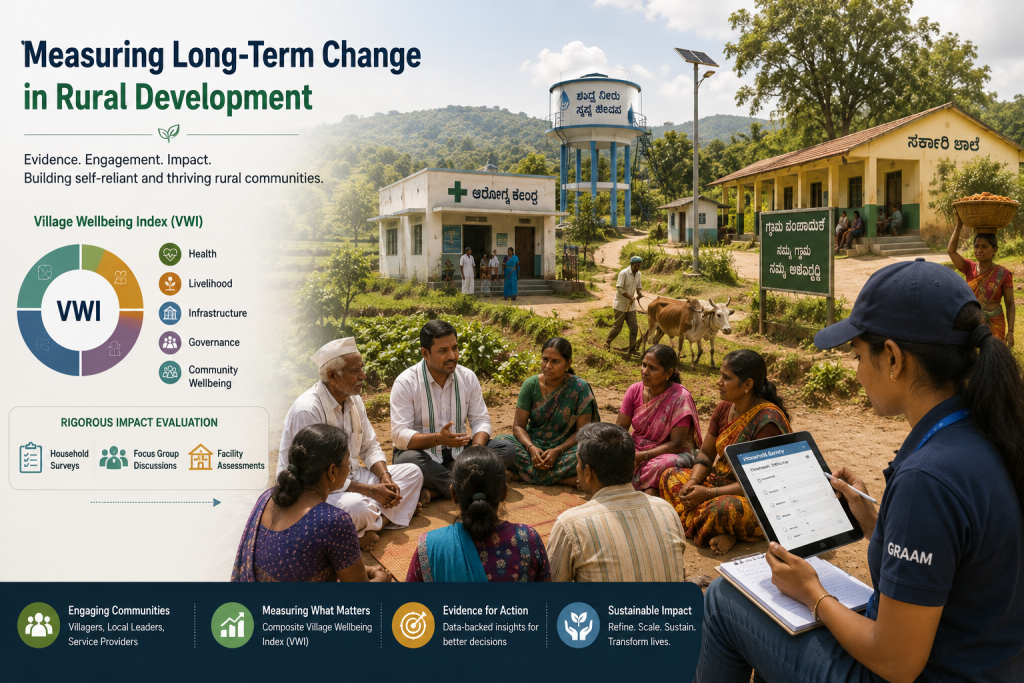
True rural development goes far beyond short-term fixes; it requires sustained investment in community self-reliance and local infrastructure. Across targeted rural landscapes in Karnataka, the Integrated Village Development Programme (IVDP) works to create lasting improvement across multiple facets of daily village life.
To evaluate how these comprehensive interventions translate into long-term community growth, the organization has launched Phase 2 of its impact assessment. Building directly upon a established Theory of Change and robust monitoring frameworks, the assessment shifts the focus from initial planning to measuring direct outcomes on the ground.
Using a rigorous mixed-methods research strategy, the evaluation team combines extensive household surveys, focus group discussions, and facility assessments across project locations. A core highlight of this evaluation is the creation of a Composite Village Wellbeing Index (VWI). This analytical tool, combined with treatment-comparison analysis, enables researchers to measure multidimensional wellbeing and determine the exact impact of the project’s activities.
By engaging directly with villagers, local leadership, and service providers, the team gathers essential data on rural healthcare, livelihood stability, and local governance. The final outputs will deliver data-backed insights and clear recommendations, providing the TVS Social Health and Education Trust (SST) with the evidence needed to refine, scale, and sustain impactful village development programs.
Join the Conversation
What indicators best capture true progress in rural community development? Share your thoughts and join the discussion below!