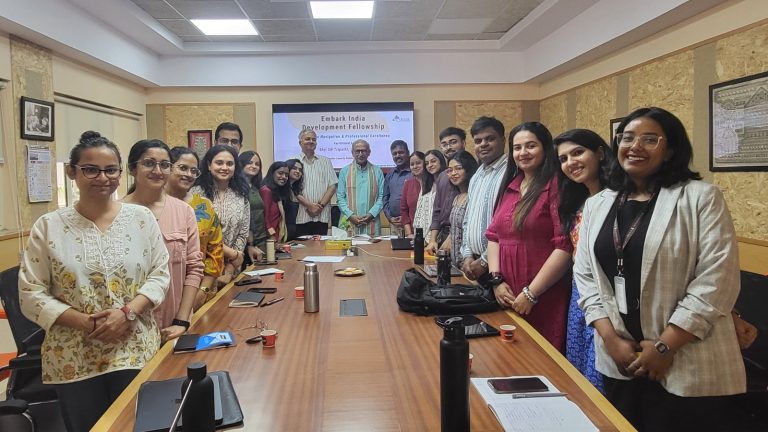
-Kimberley Monteiro, Embark India Development Fellow
Mentored by:
- Dr. A. Raghu (Advisor [Ay.], Ministry of Ayush)
- Dr. Ruchika DP (GRAAM)
- Dr. Sakshi Vermani Rishi (Associate Professor, MaNaS, Rishihood University)
The Mental Health Crisis and Prevention Opportunity
Across India today, it is increasingly common to see community wellness activities, lifestyle counselling, school initiatives, and growing public participation in wellbeing activities. Yet even as awareness around mental wellbeing expands, mental health concerns such as stress, anxiety, burnout, loneliness, and depression continue to affect large sections of the population. For many people, experiences such as stress, loneliness, emotional exhaustion or sleep difficulties may emerge quietly within everyday life long before they are recognised as concerns requiring support. Findings from the National Mental Health Survey (NMHS) 2015-16 estimated that nearly 15% of Indian adults require active intervention for one or more mental health concerns, while treatment gaps remain high across several conditions,[1][2].
This changing landscape raises an important question: if these wellness spaces already reach millions of people, what role might they play in strengthening preventive and promotive mental healthcare in India?
As discussions around mental wellbeing increasingly move beyond hospital-based care, there is growing interest in how community-based wellness approaches, lifestyle-oriented health systems, and public mental healthcare services can work together. This article explores existing strengths within Ayush systems, current challenges in integration, and possible pathways for building more connected preventive and promotive mental healthcare approaches.
Policy Context and Existing System Strengths
Mental health is increasingly recognized not only as a healthcare concern, but also as a social and developmental issue. The World Health Organization (WHO) has estimated that mental health conditions could contribute to economic losses of nearly USD 1.03 trillion in India between 2012 and 2030[3].
In response, India’s public health systems have gradually expanded community-oriented approaches through the National Mental Health Programme (NMHP), including district-level services under the District Mental Health Programme (DMHP). Alongside this, the Ministry of Ayush has strengthened wellness-oriented public health activities through the National Ayush Mission (NAM), Ayushman Arogya Mandirs, school-based Yoga programmes, community outreach initiatives, and co-located healthcare services.
Importantly, Ayush systems already engage with preventive and promotive aspects of wellbeing in multiple ways[4,5]. Ayurveda places emphasis on daily routines (Dinacharya), behavioural practices (Sadvritta), dietary patterns (Doshas), and sleep regulation (Nidra)[5]. Yoga and Naturopathy often focus on movement practices, breathing exercises, meditation, relaxation, and lifestyle modification[6,7]. Unani traditions similarly emphasise health promotion through factors such as diet, sleep, physical activity, and psychological balance[8]. Homeopathy services are also integrated across several public healthcare settings, highlighting the broader pluralistic landscape through which Ayush approaches are delivered[9].
Yet these spaces are rarely discussed as part of the larger mental health conversation. Mental healthcare discussions frequently focus on individuals once distress becomes more visible or severe. But where do people go before a crisis occurs? Where do they go when they are stressed, emotionally exhausted, lonely, or struggling to cope, but are not yet seeking formal psychiatric care?
These existing strengths of Ayush are especially relevant in the context of preventive and promotive mental health because emotional wellbeing is often shaped long before individuals seek formal psychiatric care. Stress, burnout, loneliness, sleep difficulties, and emotional strain are increasingly recognised as being influenced by broader social, community, and environmental contexts that shape wellbeing and mental health outcomes[10,11,12]. In this context, community-based Ayush platforms can offer opportunities for early support, lifestyle guidance, stress management, health awareness and conversations around emotional wellbeing at a population level.
In many communities, traditional healthcare systems may continue to possess cultural familiarity and community acceptance. Existing family and community networks, along with frontline workers, could provide opportunities for strengthening wellbeing conversations, early support, and referral pathways where appropriate[13.14].
What Might Preventive and Promotive Mental Health Look Like Within Ayush?
When conversations around mental health happen, they often begin after distress becomes visible. But what if some of the foundations of mental wellbeing are shaped much earlier, through sleep, routine, food, movement, relationships, and everyday behaviours?
Preventive and promotive approaches within Ayush can therefore extend beyond symptom reduction alone. Across systems, several elements already exist that may support emotional wellbeing:
- Behavioural and routine practices: Ayurveda emphasises Dinacharya (daily routines) and Sadvritta (behavioural conduct), while broader Ayush approaches often encourage self-care, healthy habits, and balanced daily living.
- Mind-body approaches: Yoga and Naturopathy include movement practices, breathing exercises, meditation, relaxation techniques, stress management, and practices that support emotional regulation and wellbeing.
- Diet and lifestyle approaches: Ayurveda and Unani traditions emphasise relationships between food, sleep, physical activity, and lifestyle balance as important components of maintaining health and wellbeing.
- Preventive and rejuvenative approaches: Siddha traditions include broader preventive and rejuvenative concepts such as maintaining balance and wellbeing through lifestyle-oriented practices and health maintenance approaches.
- Community approaches: wellness camps, school activities, outreach initiatives, Ayush platforms, and community engagement activities create spaces for connectedness, health awareness, and early wellbeing conversations.
The Core Challenge: A Gap Between Wellness and Mental Healthcare
Despite growing visibility of Ayush-based wellness approaches, stronger operational linkages between community wellness activities and formal mental healthcare systems are still evolving. Public health programmes under the National Ayush Mission (NAM) already reach diverse population groups through initiatives such as AYURVIDYA (school-based health and wellbeing activities), SUPRAJA (maternal and child wellbeing initiatives), Ayush Health and Wellness Centres, VAYO MITRA initiatives for older adults, community outreach and wellness camps, Information Education and Communication (IEC) activities, and co-located Ayush services within public healthcare settings[9].
Many of these programmes already serve population groups in whom mental wellbeing may be highly relevant, including children and adolescents, older adults, mothers, and individuals with chronic health conditions. These activities could create opportunities for supporting wellbeing through lifestyle counselling, Yoga activities, self-care approaches, and health promotion efforts. However, preventive and promotive mental health itself does not yet appear to emerge consistently as an explicit programme objective, measurable outcome, or structured service pathway. While several of these initiatives currently operate at limited scales, they may still offer opportunities for strengthening within existing systems. Rather than creating separate mental health programmes, existing platforms could gradually integrate preventive and promotive mental health elements through emotional wellbeing objectives, behavioural support, resilience-building, and clearer referral pathways.
If someone attending a school-based wellbeing activity, older-adult wellness initiative, or community Ayush programme experiences persistent stress, loneliness, emotional strain, sleep difficulties, or early signs of distress, who notices? Who decides when additional support may be needed? And where does that individual go next?
Key Challenges and Emerging Questions in Integration
1.When Wellness and Mental Healthcare Continue to Operate in Parallel
Preventive and promotive approaches may work best when individuals can move more easily between wellness activities, counselling services, and formal care systems. Questions therefore emerge around how such transitions may occur in practice[10,15].
2.Are Existing Programmes Designed to Think About Mental Wellbeing?
Many of the building blocks already seem to be present. Public health programmes under NAM already reach schools, older adults, communities, and primary healthcare settings[9]. Yet many of these programmes are designed around broader priorities such as school health, ageing, maternal health, or non-communicable diseases.
This raises an important question: where does mental wellbeing sit within these systems, and how might existing activities engage with it more explicitly?[9]
3.What Happens When Good Ideas Reach Real-World Settings?
Perhaps another challenge appears at the level of implementation itself. Existing training and orientation efforts for frontline workers and Ayush practitioners may vary in the extent to which mental wellbeing promotion, psychosocial support, and referral pathways are addressed across settings.
Questions also remain around how implementation success would be measured in practice. Would programmes be measured only through service delivery, or also through wellbeing outcomes and earlier help-seeking?
These questions may become especially important because preventive and promotive approaches operate within deeply personal spaces involving wellbeing, trust, relationships, and community life.[10,11]
Pathways for Integration
For many individuals, schools, workplaces, neighbourhood wellness activities, and community spaces may become the first places where conversations around stress, burnout, emotional strain, or wellbeing begin.
If the challenge is not simply the absence of programmes but the way they currently connect and operate, then the next steps may involve strengthening both programme design and implementation pathways. Such approaches may also build on existing programme structures rather than requiring entirely new systems.
Possible pathways for strengthening preventive and promotive mental health may include:
- Embedding mental wellbeing objectives into existing Ayush platforms: Existing school and community wellbeing programmes may further strengthen their mental wellbeing components through structured indicators related to stress, sleep quality, emotional wellbeing, peer relationships, coping, resilience, and help-seeking behaviours where appropriate.
- Strengthening cross-disciplinary capacity and coordination: Existing training and orientation efforts for frontline workers and Ayush practitioners may be further strengthened through greater emphasis on mental wellbeing promotion, psychosocial support, intersectoral coordination, and clearer referral linkages across systems.
- Strengthening mental wellbeing within reproductive and family health settings: Emotional wellbeing often intersects with adolescence, reproductive health, pregnancy, caregiving, and family wellbeing. Additional skilling of Ayush practitioners and community personnel may strengthen wellbeing support and referral pathways.
- Developing stepped referral pathways: Community wellness activities may function as entry points for wellbeing conversations such as awareness programmes and community workshops with clearly defined pathways connecting individuals to counselling services, District Mental Health Programme services, or specialist care when needed.
- Strengthening mental health literacy and IEC: Awareness activities could move beyond general wellness promotion to include introspective stress recognition, help-seeking behaviour, behavioural activation, stigma reduction, and emotional wellbeing literacy.
- Generating implementation evidence: Pilot models could explore how preventive and promotive Ayush-based approaches function across diverse settings such as rural, urban, tribal, and resource-constrained settings to understand their acceptability and feasibility while monitoring outcomes such as wellbeing, resilience, and earlier help-seeking behaviour.
Key Takeaways
- Mental health concerns continue to represent a major public health challenge in India, highlighting the need for stronger preventive and promotive approaches.
- Ayush systems already possess important strengths through lifestyle-oriented practices, community platforms, and public health outreach reaching diverse populations.
- While existing programmes may support emotional wellbeing indirectly, mental wellbeing does not yet consistently emerge as an explicit programme objective or structured service pathway.
- Strengthening early identification, referral pathways, frontline capacity, and implementation learning may help support wellbeing before distress reaches the level of crisis.
The Road Ahead for Preventive and Promotive Mental Health
India already possesses community wellness networks, culturally familiar preventive practices, and expanding public mental healthcare systems. The larger question may therefore be not whether systems exist, but whether mental wellbeing enters these systems early enough.
Stress, loneliness, emotional exhaustion, sleep difficulties, and coping challenges often emerge much earlier in everyday life, yet stigma, awareness, and social norms may continue to shape help-seeking behaviours.
The challenge ahead may extend beyond integrating Ayush and mental healthcare systems. It may involve rethinking where mental healthcare begins by strengthening wellbeing and support long before a crisis emerges.
About the Author
(Fellow, Embark India Development Fellowship placed at Ministry of Ayush, Government of India)
Kimberley is a mental health professional with experience in youth and community mental health programmes. Her current work focuses on preventive and promotive mental health approaches and pathways for integration within Ayush and public health systems.
Citations:
[1]Gururaj et al., 2016
[2]Murthy, 2017
[3]World Health Organization, 2023
[4]Salian & Jain, 2024
[5]Sen et al., 2023
[6]Sharma & Suneja, 2025
[7]Tiwari, 2016
[8]Saleem et al., 2015
[9]Ministry of Ayush, 2021
[10]World Health Organization, 2022
[11]World Health Organization, 2025
[12]American Psychological Association, 2019
[13]National Health Systems Resource Centre (NHSRC), 2011
[14]National Health Systems Resource Centre (NHSRC), 2022
[15]Ministry of Health and Family Welfare, n.d.
References
- American Psychological Association. (2019). The risks of social isolation. Monitor on Psychology, 50(5). https://www.apa.org/monitor/2019/05/ce-corner-isolation
- Gururaj, G., Varghese, M., Benegal, V., Rao, G. N., Pathak, K., Singh, L. K., et al. (2016). National Mental Health Survey of India, 2015–16: Prevalence, patterns and outcomes. National Institute of Mental Health and Neurosciences (NIMHANS). https://indianmhs.nimhans.ac.in/phase1/Docs/Report2.pdf
- Ministry of Ayush, Government of India. (2021). National Ayush Mission operational guidelines 2021–2026. https://nam.ayush.gov.in/
- Ministry of Health and Family Welfare, Government of India. (n.d.). National Mental Health Programme (NMHP).https://nhm.gov.in/index1.php?lang=1&level=2&lid=359&sublinkid=1043
- Murthy, R. S. (2017). National Mental Health Survey of India 2015–2016. Indian Journal of Psychiatry, 59(1), 21–26. https://doi.org/10.4103/psychiatry.IndianJPsychiatry_102_17
- National Health Systems Resource Centre. (2011). Status and role of AYUSH and local health traditions under NRHM. https://nhsrcindia.org/sites/default/files/2021-07/Status%20and%20Role%20of%20AYUSH%20and%20Local%20Health%20Traditions%20under%20NRHM.pdf
- National Health Systems Resource Centre. (2022). MNS care training manual for multi-purpose workers at health and wellness centres. https://nhsrcindia.org/sites/default/files/2022-05/MNS%20care%20Training%20manual%20for%20MPW%20at%20HWC%20%28english%29.pdf
- Saleem, S., Saleem, S., Mujeeb, K., Khan, M. I., & Sherani, F. S. (2015). Implication of Asbab-e-Sitta Zarooriyah in prevention of lifestyle diseases: A review. International Journal of Advanced Research, 3(10), 407–412. https://www.journalijar.com/article/6357/implication-of-asbab-e-sitta-zarooriyah-in-prevention-of-lifestyle-diseases-a-review/
- Salian, S., & Jain, S. (2024). Ayurvedic approaches to mental health: A review of current evidence and future directions. African Journal of Biomedical Research, 27(3S), 3909–3918. https://doi.org/10.53555/AJBR.v27i3S.3075
- Sen, A. K., Sen, S., Malviya, R. K., Jain, S. K., & Kirar, P. K. (2023). Exploring the role of Ayurveda in mental health: A comprehensive review. Journal of Ayurveda and Integrated Medical Sciences, 8(5), 72–75. https://doi.org/10.21760/jaims.8.5.12
- Sharma, V., & Suneja, B. (2025). From tradition to transformation: Ancient wisdom for modern minds: A systematic review of the impact of Ayurveda, Yoga, and meditation on mental health. International Journal of Indian Psychology, 13(3), 1664–1674. https://doi.org/10.25215/1303.153
- Tiwari, G. K. (2016). Yoga and mental health: An underexplored relationship. International Journal of Indian Psychology, 4(8). https://doi.org/10.25215/0476.002
- World Health Organization. (2023). Mental health in India. https://www.who.int/india/health-topics/mental-health
- World Health Organization. (2025). Social determinants of health. https://www.who.int/news-room/fact-sheets/detail/social-determinants-of-health
- World Health Organization. (2022). World mental health report: Transforming mental health for all. https://www.who.int/publications/i/item/9789240049338