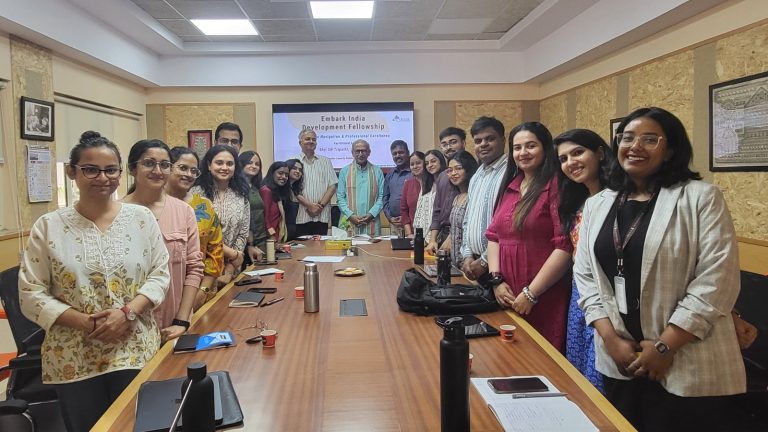
– Sanskriti Agrawal, Embark India Development Fellow
Co-authored by Dr. Balu I (Senior Research Fellow, GRAAM), and Mr. Kiran Rajashekariah (Senior Advisor, ESG and Sustainability) and was mentored by Mr. S. Govindraj, Commissioner, Office of the Chief Commissioner for Persons with Disabilities (CCPD), Ministry of Social Justice and Empowerment, Government of India.
Fifteen years ago, a census enumerator knocked on Apoorv Kulkarni’s door and never asked the disability question. His explanation: “Your house looks nice, you seem like a nice family, we didn’t think there would be anything like that here.” Apoorv, now 36, has lived with severely compromised vision since childhood. He was nearly erased from the data before anyone thought to look.
This was not an isolated lapse. It is embedded in the larger frame of disability enumeration in India: shaped by how enumerators are trained, how disability is socially perceived, and how measurement tools are designed. If India cannot count its disabled population accurately, it cannot design policies to serve them.
The Scale of the Gap
The 2011 Census recorded 2.68 crore persons with disabilities, or 2.21% of India’s population. The WHO estimates global disability prevalence at 16%, which applied to India, suggests a figure closer to 21 crore. Nearly eight times the official number.
The divergence is methodological. The WHO counts disability across a spectrum of functional limitation, including moderate and invisible conditions: mental health, chronic illness, and psychosocial disabilities that national censuses have historically excluded. The 2011 Census relied on eight fixed categories and a binary yes/no question. The RPwD Act draws a sharper distinction: impairment is a health condition; disability arises when that impairment meets a barrier, whether attitudinal, physical, economic, or institutional. The most foundational barrier is informational. When the state does not know a person exists, every other barrier becomes permanent by default. A Census that captures only impairment, without accounting for the barriers that convert it into disability, does not just undercount. It becomes a barrier itself.
The consequences fall hardest on those already least visible: persons in rural areas, women with disabilities, and those whose conditions carry the deepest stigma.
A Strong Law on a Weak Statistical Base
India’s legal framework has grown considerably. The RPwD Act, 2016 expanded recognised disability categories from 7 to 21; covering physical, cognitive, sensory, and psychosocial conditions. India has also ratified the UNCRPD. Accurate disability data is essential for tracking SDG commitments: SDG 4 (inclusive education), SDG 8 (decent work), SDG 10 (reduced inequalities), and SDG 11 (inclusive cities).
Yet this progressive legal architecture rests on a deeply uncertain statistical base. The RPwD Act envisions holistic inclusion. Section 19 recognises the right of persons with disabilities to live independently and participate fully in the community, while Section 39 mandates awareness and sensitisation measures to advance inclusion and protect disability rights. Section 75 empowers the Chief Commissioner to monitor implementation of these safeguards, yet such rights remain aspirational when large sections of the disabled population remain invisible to the system. Together, they sketch a system of rights with no mechanism to reach the people those rights belong to. A state that cannot locate its disabled population cannot meet even their most basic needs, namely income, healthcare, certification, let alone the conditions of participation, dignity, and self-determination the law promises.
When expectations are low, planning is narrow, and budgets follow. Disability welfare receives less than 0.025% of the Union Budget(Union Budget 2025-26). Even that goes largely unspent. SIPDA – The Scheme for Implementation of Persons with Disabilities Act, the central fund for accessibility and inclusion programmes used only 27% of its allocated funds in 2022-23 (Parliamentary Standing Committee on Social Justice and Empowerment, 2022), not because the need is absent, but because without accurate data on where persons with disabilities live, allocated money has nowhere to go.
Implementation is further challenged by stark state-level variation. Tamil Nadu and Kerala have built relatively robust welfare delivery systems: Kerala’s district-level disability cells and Tamil Nadu’s disaggregated beneficiary tracking are models of administrative intent, even where data quality remains imperfect. Rajasthan and Uttarakhand struggle with basic certification infrastructure, and medical boards (the gatekeepers to disability identification) meet infrequently or not at all in many districts. What the data cannot see in one state may be even less visible in another.
Existing Mechanisms and Where They Fall Short
Several instruments exist to identify and support persons with disabilities. Each is constrained by the identification gap that precedes it: a design problem, a data problem, and, in many cases, a combined delivery problem.
The UDID Portal was designed as a centralised registry giving persons with disabilities a portable identity for accessing welfare schemes. Cards have been issued to roughly half of the 2.68 crore persons counted in 2011, with over 11 lakh applications pending (Lok Sabha Unstarred Question No. 2444, 2024). The portal is online-only, requires Aadhaar linkage, and was found lacking screen reader compatibility and regional language support in a 2021 accessibility audit. A design failure that places it beyond the reach of those who need it most. Because the denominator itself is undercounted, actual coverage of the true disabled population is far lower than these figures suggest.
The ADIP scheme facilitates access to assistive devices (wheelchairs, hearing aids, Braille equipment), but awareness is low and reach is uneven, particularly in rural India. Where the data does not exist, outreach cannot follow.
The Disability Pension Scheme provides monthly support to below-poverty-line households with disabled members. With a beneficiary cap of 8.81 lakh and a central contribution of Rs. 300 per month, it functions less as a safety net and more as a narrowly targeted transfer. The gap is not only financial, it is structural. The scheme cannot reach people the data has not identified. State-level variation compounds this. Haryana (Rs. 3,200), Andhra Pradesh (Rs. 3,000), Delhi and Maharashtra (Rs. 2,500), and Kerala (Rs. 1,600) provide considerably higher support, while several others remain near the central floor. Research shows that in Uttarakhand and Madhya Pradesh, over a quarter of households with a disabled member are pushed below the poverty line by disability-related costs. Where pension support is lowest, the burden is highest, and the data to identify who needs help is the weakest.
Why the Data Fails: A Legacy Problem
India’s disability data failure is not recent; it is historic. The 1872 Census recorded only 67,000 people as having an “infirmity” out of 18 crore, a figure so implausible that colonial officials themselves questioned it. The 2011 Census improved little: eight categories, a binary question, no room for cognitive, psychosocial, or neurodevelopmental conditions. The RPwD Act recognised 21 categories in 2016, five years after the Census tool had been finalised.
Invisible conditions are the most undercounted. The National Mental Health Survey documented a treatment gap exceeding 80% for common mental disorders: conditions affecting daily functioning that would not appear in a Census built around visible physical impairment (National Mental Health Survey, 2015-16). A person with severe depression, an adolescent with autism, an adult with an intellectual disability remains invisible to a tool not designed to ask about them. This invisibility is sharpest in rural India, where 85% of the population lives, far from any diagnostic infrastructure.
Institutional fragmentation makes reform difficult. ORGI handles enumeration; DEPwD implements the RPwD Act. No single authority owns the problem end-to-end, and without a shared mandate, reform stalls between ministries.
The Washington Group Short Set has been available for over two decades: a six-question framework validated by the UN Statistical Commission and used in over 100 countries. It was designed to work across diverse cultural and linguistic contexts, to measure functional limitation rather than medical diagnosis, and to be administered by non-specialist enumerators. A direct fit with the RPwD Act’s own functional understanding of disability. India has not adopted it in any Census round.
The Enumerator Problem
Apoorv’s experience had a parallel in Delhi. Priya Varadan, who has cerebral palsy, was not asked the disability question. The enumerator decided on sight it was unnecessary. Only when Priya pushed back was she recorded.
The quality of disability data depends almost entirely on whether the question is asked, how it is phrased, and who is asked. India’s 2011 Census deployed approximately 27 lakh enumerators, most of them primary school teachers, whose training amounted to a brief handbook section with no guidance on disability types, stigma, or proxy reporting risks. Proxy reporting (where a family member answers on behalf of the person with disability) was nearly universal, and consistently distorted results for conditions affecting communication, cognition, or mental health. Enumerators were measured on form completion, not accuracy. The data reflects the biases of the process that produced it.
When Identification Still Is Not Enough
Even when a person is identified and registered, support is thin, and registration itself is a barrier. The UDID portal’s digital-only design excludes the rural poor and those without Aadhaar. Before reaching the portal, applicants must obtain a disability certificate from a government medical board, bodies whose meeting frequency varies sharply by district, creating the primary bottleneck. The entire DEPwD budget for 2024-25 stood at Rs. 1,225.05 crore, covering pensions, assistive devices, and the UDID system combined: roughly Rs. 55 per person applied to the WHO-estimated disabled population.
Health coverage is similarly thin. A recent NCPEDP survey found that over 80% of persons with disabilities lack any health insurance due to high premiums, exclusion of disability-related treatments, and denial of coverage.
The economic costs extend well beyond welfare. According to the ILO, persons with disabilities face significantly lower labour force participation rates, and their exclusion from the workforce represents a measurable drag on productivity. Inaccessible infrastructure (public transport, digital services, physical spaces) imposes compounding costs on disabled individuals and their families, pushing households deeper into poverty. Disability is not a welfare issue at its edges; it is a mainstream economic policy failure at its core.
Stigma, Intersectionality, and What the Data Cannot See
For many families, disclosing disability to a government official is not a neutral act. Conditions like mental illness, autism, leprosy, and intellectual disabilities carry deep stigma. Families conceal them not out of defiance, but out of fear of social judgment. This is particularly acute for women with disabilities, who may be hidden within households in ways that make even self-reporting impossible.
The exclusion compounds across intersecting lines. A Dalit or Adivasi woman with a psychosocial disability in a remote district faces multiple, mutually reinforcing invisibilities: her condition is stigmatised, her household may lack the literacy to navigate certification, medical boards may rarely visit her village, and structural disadvantage limits her administrative access at every turn. The literacy gap tells its own story: approximately 55% for persons with disabilities against 74% for the general population, and as low as 45% for women with disabilities. (Census 2011) All axes of exclusion, caste, tribe, gender, poverty, geography, compound each other. The data captures none of it, and that failure is in itself part of the problem.
What Needs to Change: Census 2027 as a Turning Point
The forthcoming Census, delayed since 2021 by COVID-19, boundary freezing for delimitation, and the 2024 General Election, is expected to conclude by February 2027. It will be the first Census conducted after the RPwD Act came into force. Union Minister Ramdas Athawale has called it “A historic national opportunity to recognise all 21 categories of disabilities.” That opportunity is real. But intent without implementation changes nothing.
The path forward requires action on five fronts:
- Redesign the disability module. Align the questionnaire with all 21 RPwD categories and adopt the Washington Group Short Set: six questions, cross-culturally validated, used in 100+ countries, designed for non-specialist enumerators. A 2026 Parliamentary Standing Committee recommendation has already called for ORGI and DEPwD to jointly ensure Census 2027 captures all 21 categories. Moving away from binary, stigmatising questioning is not cosmetic; it determines what conditions the system is even capable of seeing.
- Invest substantively in enumerator training, with dedicated modules on disability types, direct engagement with persons with disabilities, and proxy reporting risks. Kerala’s 2015 Disability Census deployed trained health professionals rather than generalist enumerators and recorded a prevalence of 3.20%,(Chanda & Sekher, 2023) more than double the national figure. Better data collection, not higher burden. The clearest available benchmark of what training investment produces.
- Connect the data ecosystem. UDID, state disability registers, NSAP records, and Census enumeration function as parallel systems that rarely speak to each other. Digital enumeration tools, AI-assisted error detection, GIS-based household mapping, and integrated disability registries offer real opportunities to improve identification and reduce duplication, provided they are accompanied by safeguards for privacy, accessibility, and exclusion prevention. Technology must not itself become a barrier for those least connected.
- Formalise civil society participation. Organisations working directly with disabled communities are well-placed to pre-map households before enumeration, accompany enumerators in the field (piloted informally in Karnataka and Tamil Nadu), and validate results afterwards, much as social audits function under VB-GRAMG. Global disability policy is unambiguous: “Nothing About Us Without Us.” A formal MOU between ORGI and disability-focused civil society would institutionalise this. It works: Andhra Pradesh’s SADAREM system received over 57,000 applications in two days; Odisha ran a 30-day door-to-door survey linking children with disabilities directly to UDID registration.
- Mainstream disability in economic policy analysis. Its consistent absence from instruments like the Economic Survey signals how far integration of disability into core policy thinking still has to travel. A more accurate Census count is the necessary first step; without it, no downstream reform has a reliable base.
Conclusion
India’s official disability count reflects the limitations of the tools used to measure it, not the true size of the population living with disability. The gap between 2.21% (Census 2011) and 16% (WHO estimate) is not a statistical footnote. It has direct consequences for welfare allocation, infrastructure design, and rights implementation, compounding from national budgets down to whether an individual can access a pension or a wheelchair.
The budget tells the same story. The first Union Budget shaped by Census 2011 data allocated Rs. 471 crore to the disability sector. By 2026-27, that figure stands at Rs. 1,669.72 crore. If India’s true disabled population is eight times the official count, a proportionate allocation would demand a commensurate increase. The budget has not even quadrupled. What the Census could not see, the budget could not plan for. The two gaps are not coincidental. They are structurally connected.
The causes are layered and mutually reinforcing: a Census instrument that predates the RPwD Act, undertrained enumerators, proxy reporting, social stigma, fragmented data systems, and a historic failure to recognise how exclusion compounds across gender, caste, tribal identity, poverty, and geography. The result is a system that most consistently fails those it should most accurately capture: persons with cognitive, psychosocial, and neurodevelopmental conditions who carry the deepest stigma and the least institutional visibility.
Census 2027 is a genuine, time-bound opportunity to break this cycle. The tools exist. The state-level evidence exists. The legal mandate exists. What has blocked reform for this long points to institutional fragmentation, the absence of a shared data mandate between ORGI and DEPwD, and the persistent treatment of disability as a welfare silo rather than a cross-cutting governance concern. Closing that gap requires more than redesigning a questionnaire. It requires the institutional will to ask every person on the other side of the door.
About the Author
Sanskriti Agrawal is a GRAAM Embark India Development Fellow placed at the Office of the Chief Commissioner for Persons with Disabilities (CCPD), Ministry of Social Justice and Empowerment, Government of India. Her research evaluates social inclusion, economic visibility of Persons with Disabilities (PwDs), disability-responsive public budgeting and CSR initiatives to support PwDs.
REFERENCES
- Bajeli-Datt, K. (2026, March 17). Census 2027 will provide improved data on people with disabilities in the country: Ramdas Athawale. The New Indian Express.
https://www.newindianexpress.com/nation/2026/Mar/17/census-2027-will-provide-improved-data-on-people-with-disabilities-in-the-country-ramdas-athawale - Chanda, S., & Sekher, T. V. (2023). Identification of disability for inclusive development: Lessons from disability census of Kerala, India. SAGE Open, 13(3). https://doi.org/10.1177/21582440231190817
- Government of India. (2011). Census of India 2011: Primary census abstract on disability. Office of the Registrar General and Census Commissioner.
- Government of India. (2011). Enumeration manual: Census of India 2011. Office of the Registrar General and Census Commissioner.
- Government of India. (2024). Lok Sabha unstarred question no. 2444: Indira Gandhi National Disability Pension Scheme (answered 10 December 2024). Ministry of Rural Development.
- Government of India. (2025). Expenditure budget 2024–25: Statement of budget estimates, Ministry of Social Justice and Empowerment. Union Budget Documents.
- Institute of South Asian Studies. (2024). India’s delayed census: Why it matters. National University of Singapore. https://www.isas.nus.edu.sg/papers/indias-delayed-census-why-it-matters/
- National Centre for Promotion of Employment for Disabled People. (2026). Beyond the visible: A handbook on disability inclusion for parliamentarians. NCPEDP.
- Nipman Foundation. (2021). Digital accessibility audit: Government of India portals. https://nipmanfoundation.org
- Parliamentary Standing Committee on Social Justice and Empowerment. (2022). Report on implementation of the Rights of Persons with Disabilities Act, 2016. Lok Sabha Secretariat, Government of India.
- The Hans India. (2026, March). SADAREM sees record rush as 57,000 apply in two days. https://www.thehansindia.com/andhra-pradesh/sadarem-sees-record-rush-as-57000-apply-in-two-days-1059953
- Times of India. (2026, March). Census 2027 offers historic opportunity to record data on disabilities: Athawale. https://timesofindia.indiatimes.com/india/census-2027-offers-historic-opportunity-to-record-data-on-disabilities-athawale/articleshow/129636958.cms
- Washington Group on Disability Statistics. (2020). Methodology: The Washington Group short set on functioning. United Nations Statistics Division. https://www.washingtongroup-disability.com
- World Health Organization. (2011). World report on disability. WHO Press. https://iris.who.int/bitstream/handle/10665/44575/9789240685215_eng.pdf
- Yadav, J., Tripathi, N., Yadav, S., Bhardwaj, P., Gupta, R., Yadav, K., & Deo, S. V. S. (2023). Measuring the financial impact of disabilities in India. PLOS ONE, 18(10), e0292592. https://doi.org/10.1371/journal.pone.0292592