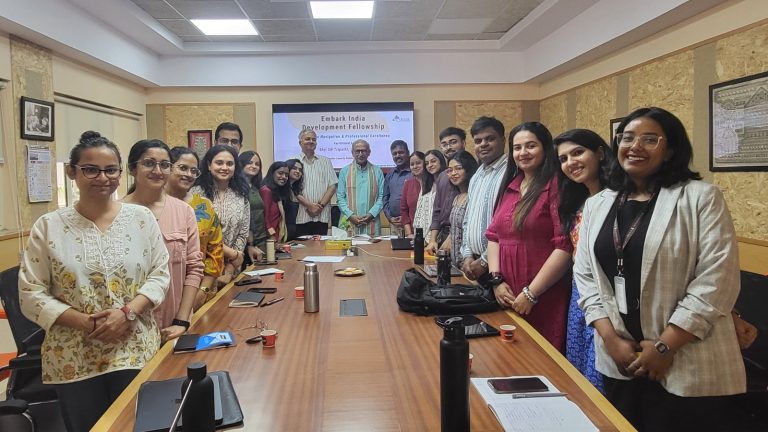
– Gowri Prasad K, Embark India Development Fellow.
Co-Authored by Dr. Chandrika Shetty, Lead Governance & Democratisation, Partnership Development, GRAAM
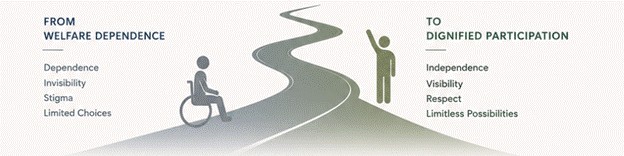
Disability inclusion is not a peripheral issue in the country’s development; rather, it serves as a foundational stone for India’s growth trajectory, aligning with Viksit Bharat @2047 and underscoring the principles of productivity, inclusivity, and capacity building. For a decade or so, India’s disability sector has been largely discussed through the lens of welfare. Often, our policy conversations revolve around subsidies, concessions, pensions, institutional care, and scholarships. Even though these measures are very necessary, without meaning to, the person with disabilities often continues to be viewed largely through the lens of welfare, where essentially, they tend to be treated as recipients of the state’s assistance rather than active participants in the economic sphere.
But India’s persons with disabilities sector is more complex than the welfare question in itself. It is increasingly a labour market question, a livelihood question, and a technology question, and fundamentally, it is a question of dignity above all. India’s disability framework, which is anchored in rights with the Persons with Disabilities Act 2016, coupled with United Nations conventions on the rights of persons with disabilities, formally tables inclusion as the objective to be met. Yet the fundamental challenge is essentially not the articulation of the intent, rather its effective implementation in a true sense.
The question tabled before the policymakers is no longer about support that needs to be provided to them but rather about how we are creating an ecosystem where the disabled can participate meaningfully in the sphere of governance, education, work, and entrepreneurship, and primarily in community life.
This primary shift is essential because the dignity of the persons with disabilities is very deeply connected with the economic participation as a whole. According to the World Bank, the exclusion of the disability sector from the mainstream economy can hamper 3 to 7 per cent GDP deterioration across the world (World Bank, 2007). Further, the idea of livelihood is not just confined to income, but it is an agency, recognition, independence, and majorly social visibility. A person with a disability who creates, earns, experiences, and contributes or even leads essentially experiences the disability very differently compared to someone dependent on the welfare scheme as a major source of sustenance.
Right now, India is at a critical juncture where the persons with disabilities sector is increasingly moving from a support-orientated approach to capability-orientated inclusion.
Why the Welfare Lens Alone is Insufficient
Historically, the question of inclusion of persons with disabilities in education, employment, coupled with healthcare and healthcare has remained an evolving area of social and policy development, exclusion from employment, education, public life and even healthcare. Disability pensions, reservation policies and assistive devices have been increased in order to decrease the extent of the vulnerability and essentially provide social protection.
In this case, the intervention becomes very important. As of the 2011 census, the facts project that India has almost 26 million people with disabilities. Current estimates project that more than 5 crore people represent various types of disabilities. And globally, more than 16% of the population belongs to the disability sector, according to the estimates of the World Health Organisation (2022). The disability sector in the Indian scenario can be considered one of the most complex sectors because of its unique multidimensional intertwining of health, labour market, and social infrastructure, underlining the greater heterogeneity of needs which is tabled under the Rights of Persons with Disabilities Act 2016. This essentially recognised 21 types of disabilities in the context of India, ranging from visual impairments to autism to locomotory disability. After projection of these facts, we can’t see disability as a social question alone; rather, now it is a developmental question and the human capital question! way beyond the welfare question alone!
Persons with Disabilities continue to experience multidimensional poverty, mainly in rural areas where the educational infrastructure and healthcare accessibility are essentially relatively limited compared to urban areas. The major problem is that people with multiple disabilities are seen through the lens of dependency, even with the welfare-centric approach. The major focal point of this debate is providing support for the disabled population rather than expanding the opportunities. With respect to the governments’ emphasis on reservation of the disabled sector, but realising the fact that the majority of the labour market is situated in the informal sector, which is essentially private-sector driven. The public sector alone cannot absorb all the disabled sectors’ population. This highlights the need for the government to look beyond the welfare approach and turn towards market inclusion, economic capability and livelihood generation.
The point is creating an accessible livelihood ecosystem rather than just focusing on welfare delivery.
Livelihood as Dignity, Not Just Income
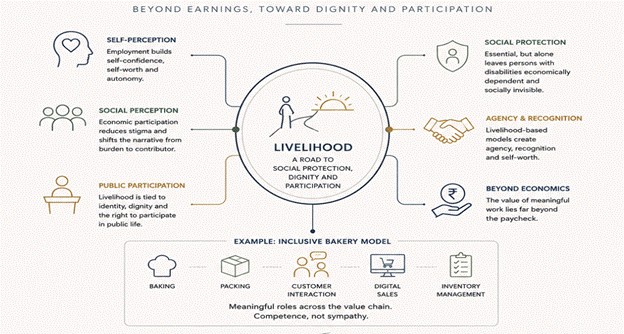
With respect to the disability sector, livelihood should not be understood as earnings alone; rather, it should be considered a road for social protection and dignity.
Many times, for Persons with Disabilities, the pathway of employment shows how they perceive themselves, along with how society perceives them. Economic participation among people with disabilities often tends to make them think that they can reduce the social stigma attached to disability with their peers and society at large. This makes the livelihood framework go beyond the ambit of economics.
The livelihood question connected to disabled persons cannot be just connected to the narrow question of earning income; it is essentially tied to identity and dignity, along with the right to participate in the public sphere. Considering social protection being fundamental, there is a need for greater emphasis on creating opportunities for economic participation coupled with meaningful social inclusion. The effectiveness of livelihood-based models is that they create an agency with recognition. For example, several disability related organisations have established an inclusive bakery, where people with disabilities are involved in packing, baking, customer interaction, digital sales and even inventory management. The significance and the involvement of the people with disabilities in work ideally lies beyond the paycheque.
A person with autism who is essentially managing the orders by billing or even serving customers in a bakery provides a social message that people with disabilities can be effectively utilised for work and uphold the statement that they need to be looked at with competence rather than just sympathy. Through this move, social stigmas can be blurred, and dignity can be restored.
This underscores the concepts of employment rights, education, and accessibility. Even then, the implementation remains uneven. The major question is not whether all disabilities can fit into the mainstream employment system. The question is how to fit them. How can we fit them? What is the best possible way?
The Entrepreneurship Turn in Disability Inclusion
One of the most important developments of the disability sector in India is highlighting the need for self-employment and entrepreneurship. Many employers are still under the assumption that involving the disabled in mainstream economic productivity will lead to operational burden and low productivity. To outgrow this stereotypical mindset, people with disabilities will prefer their own ventures not just by choice but also to uphold their dignity, coupled with the economic contribution, and to avoid exclusion.
There are a couple of attempts that have been made by the government to support this approach. The National Handicapped Finance and Development Corporation (NHFDC), which exclusively provides loans for income-generating activities and education and skill development. So essentially this scheme enables a person with a disability to access the financial support for agricultural activities, small business activities and vocational livelihoods at subsidised rates. Similar schemes like Stand-Up India and Pradhan Mantri MUDRA Yojana are providing an effective financial ecosystem for the disabled entrepreneurs via collateral-free loans coupled with micro-enterprise financing.
But the real challenge even goes beyond the credit.
In true terms, imbibing the entrepreneurial ecosystem essentially requires mentorship coupled with a digital ecosystem, institutional responsiveness, and an accessible banking system. But many entrepreneurs with disabilities encounter problems with respect to the inaccessible application process, lack of information about the scheme, and transportation barriers.
This underscores the need of translating towards an ecosystem-based approach that finely integrates inclusion and livelihood, along with long-term participation beyond the purview of schemes. In order to illustrate with an example, a hearing-impaired artisan in rural parts of Karnataka will essentially require digital marketing support rather than mere financial assistance. On the other hand, a person who uses a wheelchair who has started online consultancy, more than a subsidy, might require accessible co-working spaces coupled with assistive technology.
Policies related to livelihood should shift from the welfare transfers to creating an enabling ecosystem approach.
Technology is Redefining Disability and Work
No doubt technology is one of the biggest tools for shaping the disability sector in India. Screen readers, artificial intelligence, accessible smartphones, voice-recognising systems, mobility devices and accessible work platforms are shifting the idea of what participation is meant to be for the disabled.
In the disability spectrum, visually impaired individuals, with the present AI reading equipment coupled with the navigation systems, have expanded their professional access with educational accessibility. People who are facing issues regarding mobility are finding remote work in a hybrid format more feasible. People with hearing impairment use real-time transcriptional systems along with technology in the workspace and classrooms.
The 2019-20 Covid pandemic situation unintentionally transformed this mode of work throughout the globe. When workspaces were converted online, there was a significant reduction in accessibility barriers, which was linked to physical mobility, which helped a certain section of society, especially the disabled.
This underlines a pertinent issue: the problem is not with the disabilities in themselves but rather how they are designed in real time.
The technology proves that disability is not just a welfare issue per se, but exclusively a question of accessibility, capacity and inclusion. When accessibility is created through technology, disabled participate as learners and workers with dignity rather than dependence.
The Most Difficult Policy Question: Intellectual Disabilities
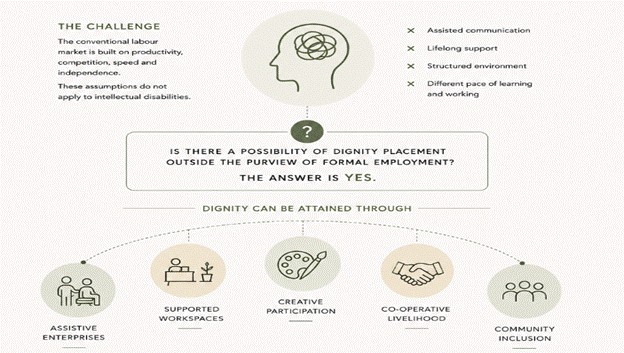
In the disability and inclusion discourse, the pertinent challenge is about tackling intellectual disability. It is important to recognise that the core employment narrative is essential to build around productivity, competition, speed and mainly independence. But these assumptions do not apply to intellectual disabilities. It is quite obvious that, with their present intellectual condition, they may require assisted communication, lifelong support, and a structured environment. It is important to underline in this juncture that the conventional labour market is gradually adapting to accommodate the inclusive work environment and diverse support needs.
This raises a pertinent question: Is there any possibility of dignity placement outside the purview of formal employment, per se?
The answer must be yes.
For persons with intellectual disabilities, dignity can be attained through assistive enterprises, supported workspaces, creative participation, and co-operative livelihood. The question of inclusion cannot be rather confined to a corporate employment matrix.
Across India, there are pertinent efforts by several community organisations and NGOs that are experimenting with the livelihood models. Some of the NGOs run bakery enterprises, sheltered production units, packing services and assisted agricultural practices exclusively for people with intellectual disabilities. To quote an example, Mitti Cafe is a chain of bakery units led by the disabled section across India, they deliver meal services even to the Supreme Court and even to airports. Instead of viewing the disabled through a subsidised lens, these unique models can create a dignified livelihood.
Even though they do not recognise the pattern of the conventional workspace, they create routine, economic contribution, and self-worth. Even the smallest economic participation is assumed as transformative for the family member because there is a pertinent shift from the perception of social cost to participation.
Finally, India’s long-term vision of Viksit Bharat @ 2047 gives reasonable grounds to integrate persons with disabilities into the mainstream economy with dignity and integrity. It is imperative to achieve sustainable and inclusive growth of the country. The current development framework reveals some gaps across the employment systems, education, and skill sets, which underscore the importance of an inclusive economic participatory society.
The underlined challenge here goes beyond the formal inclusion of the PWD; rather, it is the Viksit Bharat, a transformation from the symbolic participation of the PWD to the substantive participation of the PWDs with livelihood opportunities and dignity at the workplace. Where the disabled population is not just a representative part of the system, but rather enables them to effectively and efficiently contribute to themselves and to the larger goal. The vision for attaining the Viksit Bharat, bridging the gap between the actual policy intent translated into employment outcomes, will answer the detrimental question of whether India’s growth story is selectively realised or genuinely inclusive in nature.
These views are personal and do not necessarily reflect the views, policies, or positions of the organization or institution.
About the Author
Gowri Prasad K is a policy fellow at NITI Aayog in the Social Justice and Empowerment Division. Her research focuses on the disability sector, with particular emphasis on advancing an inclusive approach towards Viksit Bharat 2047. This blog was produced under the GRAAM Embark India Fellowship 2025–26.
References
- World Bank. (2007). People with disabilities in India: From commitments to outcomes. World Bank. https://documents.worldbank.org/en/publication/documents-reports/documentdetail/577801468259486686/people-with-disabilities-in-india-from-commitments-to-outcomes
- World Health Organization. (2022). Global report on health equity for persons with disabilities. World Health Organization. https://www.who.int/publications/i/item/9789240063600
- Sen, A. (1999). Development as freedom. Oxford University Press.
- Nussbaum, M. C. (2011). Creating capabilities: The human development approach. Harvard University Press.
- International Labour Organization. (2015). Inclusion of people with disabilities in vocational training: A practical guide. International Labour Office.
- National Handicapped Finance and Development Corporation. (2023). Annual report 2022–23. Ministry of Social Justice and Empowerment, Government of India.
- United Nations Development Programme. (2016). Disability-inclusive development report. UNDP.
- Alam, A. (2021). Inclusive livelihood models for persons with disabilities: The Mitti Café approach. Mitti Social Initiatives Foundation.
- Shakespeare, T. (2013). Disability rights and wrongs revisited (2nd ed.). Routledge.