–Shalini Bose, Embark India Development Fellow
Guided and Mentored by:
- Dr. Mehebub Rahaman, Research Specialist (Data, Urban Dynamics, Poverty, Geospatial Analysis), NIUA
- Mr. Kiran Rajashekariah, Senior Advisor, Sustainable Urban Development-Smart Cities, GIZ-India
- Mr. Sarath Kalliat, Head/Lead- Research & Evaluation, GRAAM
India is urbanizing faster than its governance systems can recognize and catch up. This lag is structural, rooted in two dimensions. The first is a measurement gap, where the official rural-urban classification by the Office of the Registrar General & Census Commissioner, India (ORGI) fails to capture the actual scale and pattern of urbanization; the second is a governance gap, where peri-urban settlements like Census Towns (CTs) are functionally urban, counted as urban, yet administered as rural. In a nutshell, urbanization beyond our Indian cities remains undercounted, under-governed, and unplanned.
1. Invisible Urbanization:
1.1. The Urban Classification Problem
India’s official urbanization data highlights the scale of disconnect between demographic growth and municipal recognition. The Census identifies urban settlements through two parallel routes: Statutory Towns are officially declared through legislative notification by state governments, each applying its own thresholds for population characteristics and economic activity; Census Towns are designated based completely on stipulated population size, density, and workforce composition.
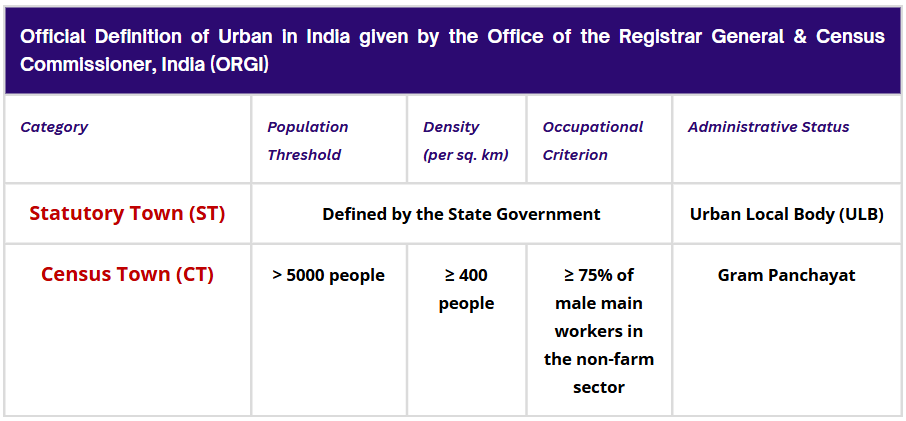
Existing research flags two key measurement problems with India’s urban classification system. First, level of urbanization in the country would be significantly higher under more flexible or internationally comparable thresholds, indicating that the current official criteria underestimate the true extent of urban growth (Dubey et al.,2025)[1]. The now-outdated 2011 Census classified only 31% of India’s population as urban, but the European Union’s satellite-based Degree of Urbanization (DEGURBA) framework estimated it to be nearly 63% in 2015, almost double. Had India used the UK’s population threshold of 10,000, the 2011 urban share would have been 37%. CTs alone accounted for 14% of the officially urban population that year. Second, inconsistencies in how “non-farm” employment is defined for the census exercise complicate both the identification of emerging CTs and the assessment of how fast these settlements are shifting away from agrarian economies (Roy and Pradhan, 2018)[2]. Additionally, settlements that are emerging as functionally urban but fall just short of meeting its official thresholds are yet to be counted.
1.2. Urbanization without Adequate Urban Governance
India’s urban transition is not just a technical challenge of mapping demographic growth but also a governance problem complicated by institutional bottlenecks. Because “urban” is a state subject, urban identification and notification remain discretionary, with state governments using different thresholds and criteria to define Statutory Towns. This creates inconsistencies in how urban areas are measured and, in turn, affects fund devolution. At the same time, the multiplicity of parastatals such as development authorities, industrial boards, and others, often with overlapping jurisdictions and mandates, fragments strategies for planned urban development and slows governance transitions.
Janaagraha’s findings[3] show that, on average, parastatals carry out more than 5 of the 18 functions assigned to ULBs under the Twelfth Schedule, relegating municipalities to merely implementation agencies. Similarly, ULGs, on average, exercise full autonomy in only 4 functions. New Town, a planned urban extension of Kolkata, illustrates this mismatch well: it is functionally urban in planning and service delivery, yet remains embedded in rural local governance and jurisdictional confusion. Although large parts of it fall under a gram panchayat, the New Town Kolkata Development Authority already handles key municipal services, creating a clear mismatch between the area’s urban character and its governance framework. What happens when a would-be town is governed by so many institutions? This is precisely why Census Towns require closer attention. They reflect evolving forms of urbanization that India has yet to adequately capture or incorporate into urban policy before granting them formal municipal recognition.
1.2.1. The Peri-urban Governance Gap
It is well documented that CTs, which are statistically urban settlements under gram panchayats, are growing rapidly. They can drive regional economic integration and absorb metropolitan spillovers. Yet their non-statutory status hinders them from urban-specific fiscal flows such as AMRUT, PMAY-U, and other urban infrastructure grants from the FC, even as their growing densities and non-farm economies demand urban-grade services.
Unlike STs, which have an institutional framework that supports their planned urban growth, CTs have no legal standing, no transition pathway, no institutional framework, and no planning guidelines to manage the service delivery pressures of rapid urbanization because they operate under rural budget allocations. Thus, every CT that is governed as a village means that spatial and economic development beyond our cities stay underfunded, unplanned, and underdeveloped. This is why the 16th FC’s Urbanisation Premium symbolizes a transformative milestone in peri-urban governance.
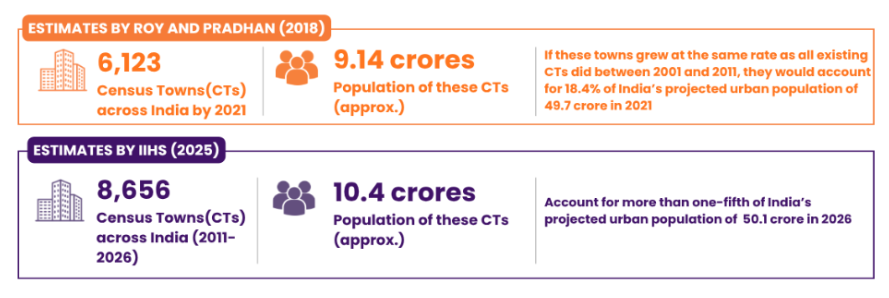
Figure 1: Estimated population living in functionally urban but administratively rural settlements.
2. Funding the Peri-Urbanization: The Urbanisation Premium
The 16th FC’s latest report marks a notable shift in India’s approach to municipal financing. Recognizing that city-focused urban policies have left smaller cities and peripheral towns, especially those near megacities, short of funds and inadequately planned, the FC has taken a pioneering step. It has prioritized the reclassification of peri-urban villages, including CTs, and encouraged their planned transition from rural to urban administrative status through an Urbanisation Premium. This is a dedicated grant of INR 10,000 crores for 2026 –31 to incentivize states to formally merge these areas with adjoining municipal bodies having populations above 1 lakh.
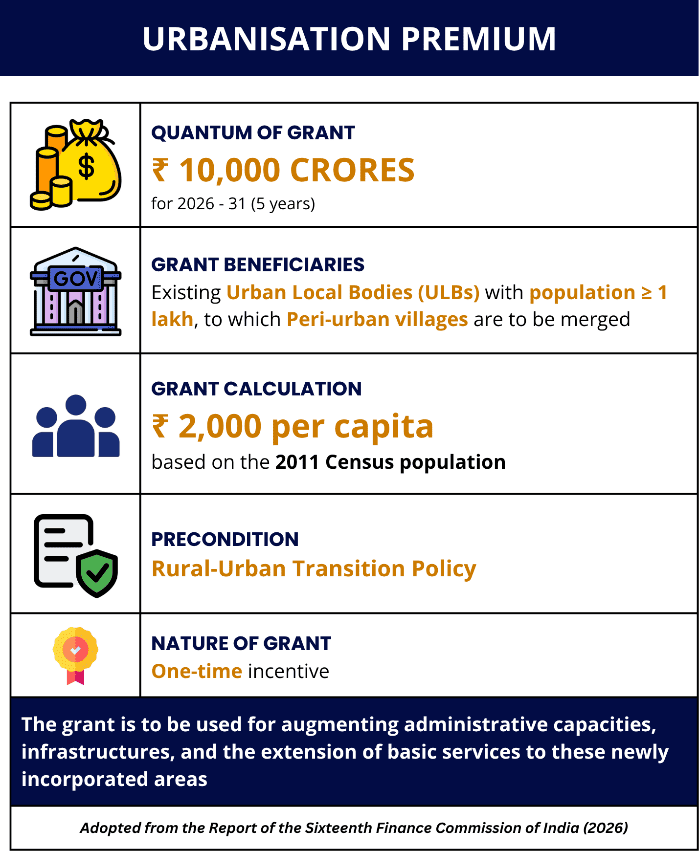
2.1. State Rural to Urban Transition Policy
The premium is not an entitlement. The 16th FC has made the formulation of a “Rural to Urban Transition Policy” a precondition for states to access this grant. This policy must include a transparent, rule-based framework for identifying settlements that have acquired urban characteristics, along with clear timelines for recognition and the transfer of governance responsibilities and capacity building initiatives.
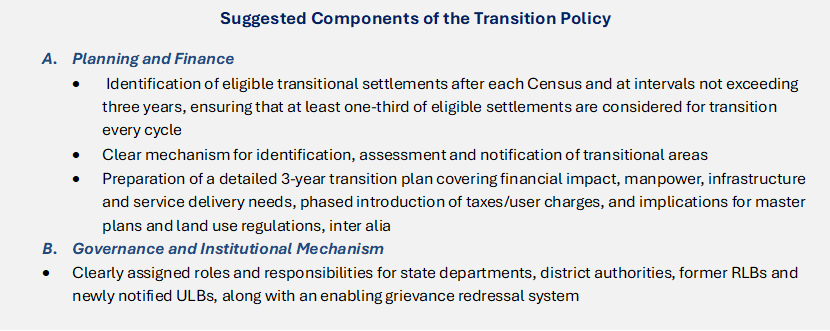
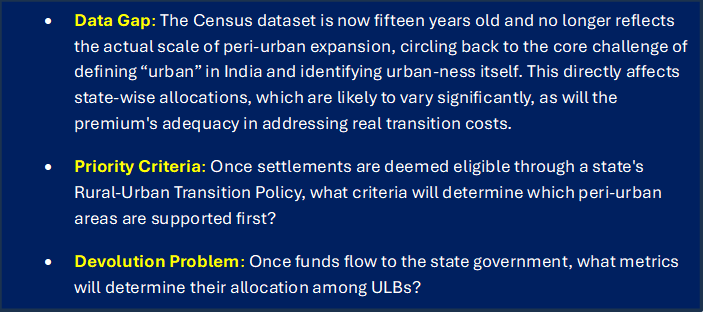
While the Urbanisation Premium’s fiscal nudge to states is a welcome step, its conditional framework warrants more scrutiny:
3. Unpacking the Urbanisation Premium: Will the Premium be Enough?
Initial observations and preliminary assessment by urban experts and practitioners following the grant’s announcement suggest that the premium is likely to serve only as a modest fiscal nudge compared to the scale of the infrastructure and municipal investments actually needed (Hindustan Times, 2026)[4], especially because several statutory towns have been notified since the 2011 census and many villages have effectively become economically urban without being captured in official statistics. To assess this fiscal gap more closely, this piece considers existing Census Towns as transitioning settlements since they are de facto urban but governed under rural panchayats, indicating they are underserved and underresourced compared to their infrastructure needs. The research draws on CT population estimates (2011-2026) and proposed percentage share of Urbanisation Premium to states, as reported in the respective submissions to the 16th FC by IIHS and Janaagraha.
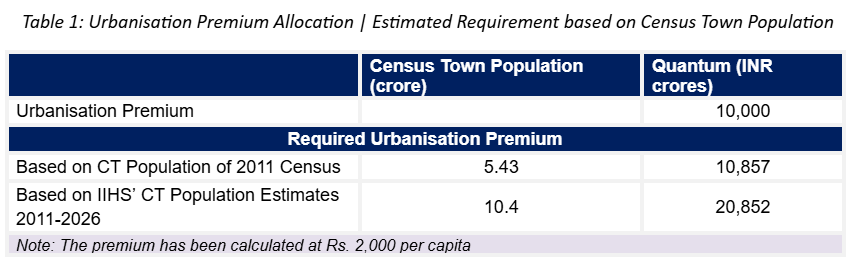
Computing the estimated premium requirement using the 2011 Census CT population clearly highlights a significant funding gap. Based on the 2011 Census CT population alone, the required premium already exceeds the current allocation by Rs. 857 crores. When projected CT population estimates for 2011-2026 from IIHS are used, the gap widens considerably, with the required premium increasing to Rs. 20,852 crores, more than double the current allocation. In other words, the premium is unable to fully cover the fiscal need it is meant to address.
Source: Author Analysis, 2026
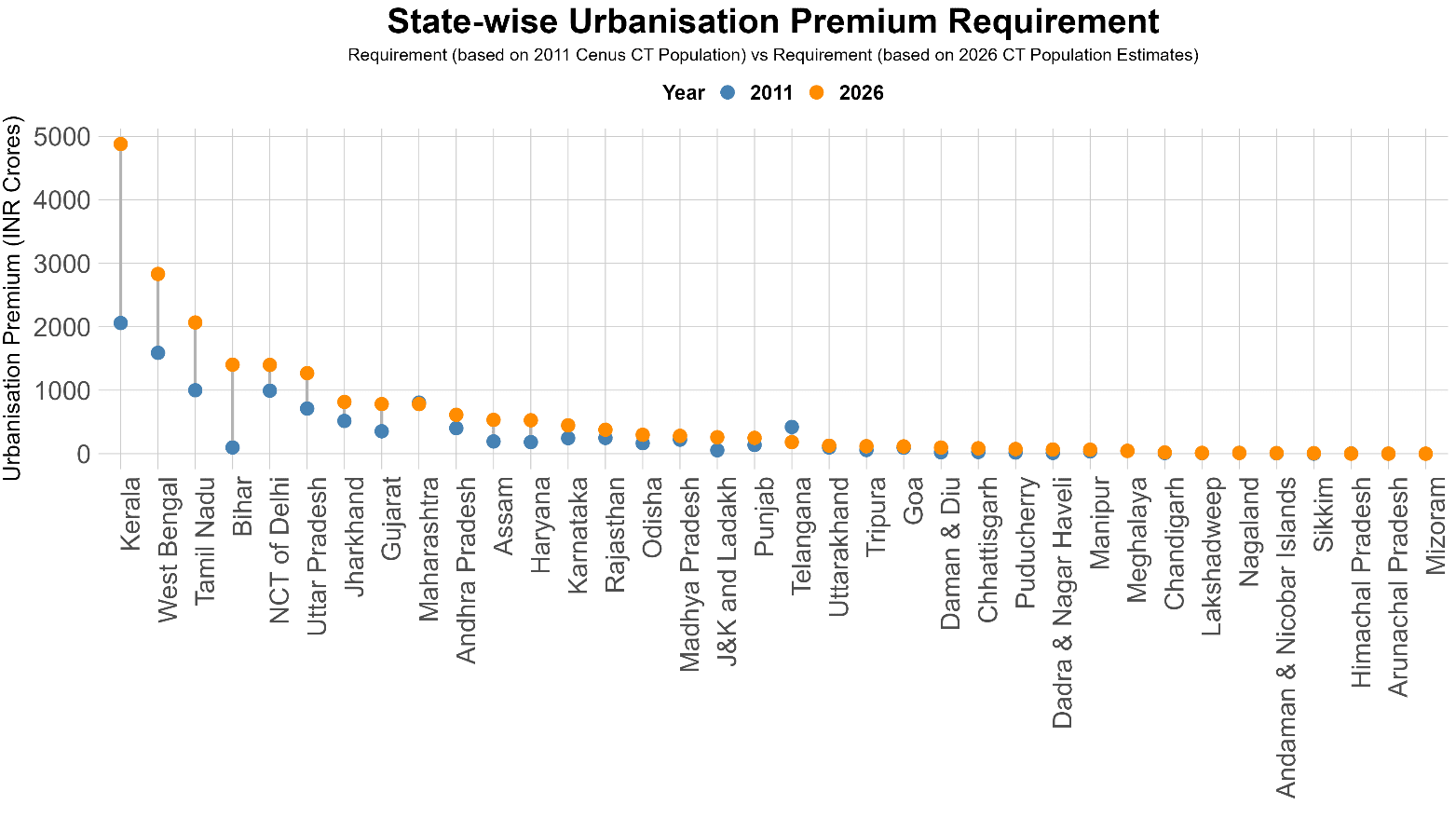
When the required premium amount is mapped across states for 2011 and 2026, it reveals a highly skewed distribution, given that CT populations are already concentrated in just a handful of states and the total premium of Rs. 10,000 crores must be shared across all states. Kerala records the highest requirement in both years, with its estimated needs increasing sharply from about Rs. 2,000 crores in 2011 to approximately Rs. 5000 crores in 2026, accounting for the largest absolute increase among all states. West Bengal, Tamil Nadu, Bihar, and Uttar Pradesh follow a similar pattern, driven by their large number of CTs and correspondingly high projected CT population growth by 2026.
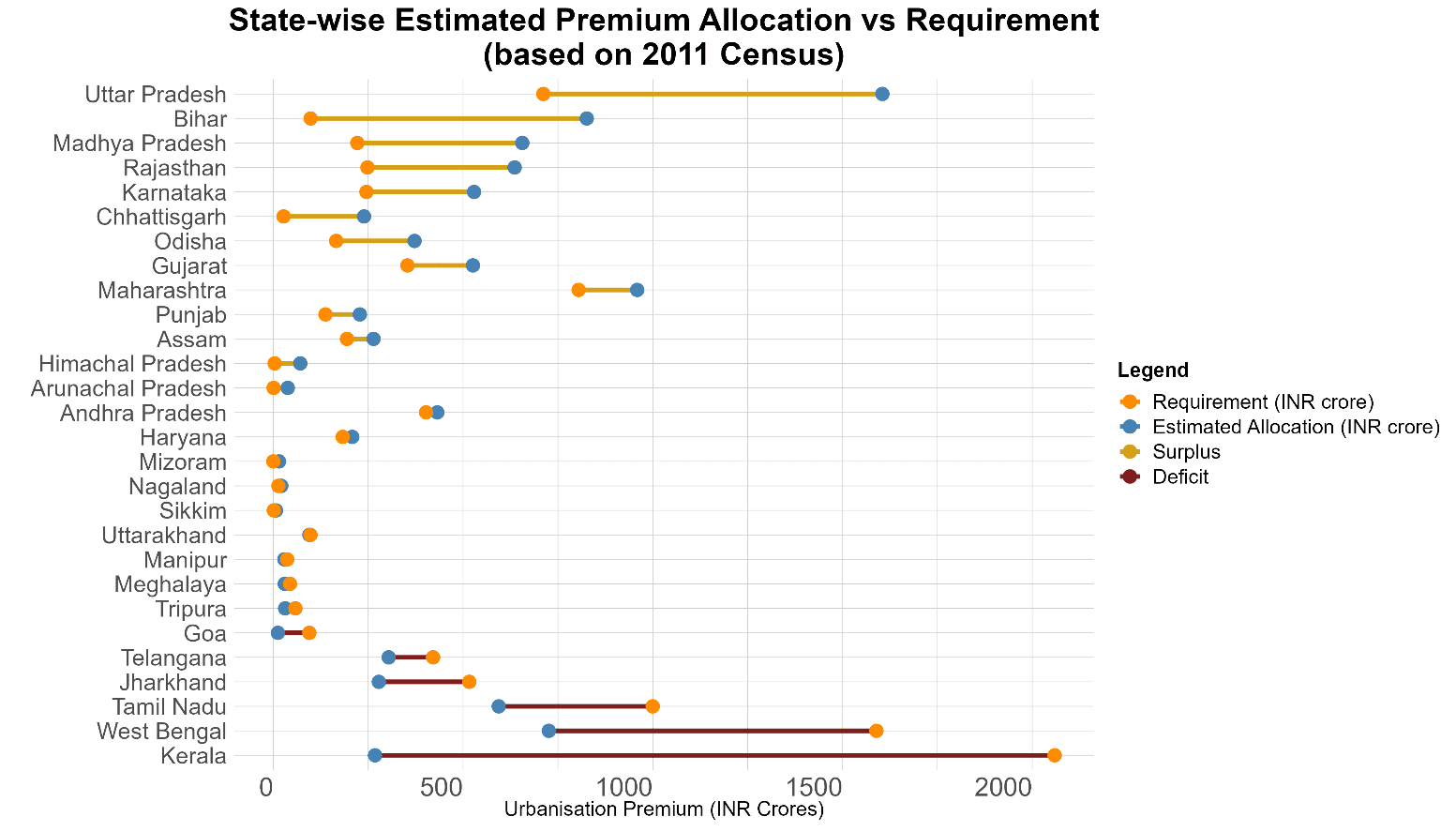
This uneven distribution is accounted for when the proposed state-wise allocations are brought into the picture. Among the three inter-state Urbanisation Premium allocation methods proposed by Janaagraha, this assessment adopts the method[1] that distributes the grant across states based on Census 2011 population and area, weighted in a 90:10 ratio, to quantify estimated state-wise allocations. While Janaagraha had originally proposed a premium of Rs. 20,000 crores, the present analysis applies the same allocation methodology to the actual Rs. 10,000 crores announced by the 16th FC. State-wise Premium requirement is derived using the Census 2011 CT Population.
Source: Author Analysis, 2026
When state-wise allocations are compared with estimated requirements, the current formula seems to address the concentration of CTs. However, this adjustment raises a new concern: states with the highest CT populations and perhaps acute urbanization pressures may end up at a disadvantage. For example, Uttar Pradesh, Bihar, Madhya Pradesh, Rajasthan, and Karnataka receive allocations that exceed their requirements, resulting in a premium surplus. Contrastingly, Kerala, West Bengal, and Tamil Nadu experience substantial shortfalls, with their allocations falling well below estimated needs. If newly identified or prevailing urbanizing gram panchayats are included in the pool, this method would significantly alter the estimated state-wise requirements for the premium. Therefore, census-based calculation alone is insufficient to capture the magnitude of urbanization needs; they must be complemented with emerging geospatial methods to more accurately estimate urbanization beyond municipalities, so that urban-like large villages around cities as well as Census Towns that have substantial infrastructure and service gaps, are not overlooked altogether. Accordingly, the effectiveness of the premium will depend greatly on how it is operationalized at the state level.
With a fixed funding limit and uneven needs across states, it is essential for states to first establish clear procedures for identifying eligible transitional peri-urban villages, set criteria for selection among them, and specify the conditions for grant disbursement to the respective gram panchayats.
Conclusion
India’s Urbanisation Premium signifies a pivotal shift to support the planned transition to municipal governance and peri-urban growth. However, whether it can rise to the challenge remains uncertain. As the preliminary findings suggest, the funding can substantially miss the mark in meeting the actual needs of transitioning settlements, both today and as urbanization accelerates. A fiscal incentive can give impetus to planned urbanization at the periphery and is a much-needed boost. However, it cannot substitute the fundamental structural barriers that underlie transitioning from rural to urban governance. In layman’s terms, the premium is aimed at funding a transition that India’s governance system has yet to figure out for most states.
Further, the current official urban definition itself remains inadequate to capture the full extent of urbanization, making it difficult to allocate resources where they are most needed. Consequently, some states may be overfunded for CT transitions while leaving others, facing comparable or even greater pressures, underfunded. As highlighted earlier, how urban a state is can vary considerably depending on which definition of urban is applied. It is no longer disputed that census classification underestimates the extent of urbanization. This underscores the need for a more adaptive framework for defining rural and urban areas, including the use of alternative geospatial datasets to identify and map settlements that fall outside conventional census criteria. Such an approach would generate a more complete picture of urban expansion beyond municipal boundaries.
This raises questions worth pursuing. How would the Urbanisation Premium change if India were to adopt more flexible thresholds for determining statutory urban status? And beyond population size and workforce criteria, what indicators could also capture functional urbanization, and in turn, make the premium more responsive to where the need is greatest? The answers could decide whether the premium can really facilitate rural-urban transitions, or remain a well-intentioned but limited fiscal push.
About the Author
Shalini Bose is an urban researcher and practitioner, currently working as a Fellow under the Embark India Development Fellowship, placed at the National Institute of Urban Affairs (NIUA). Her research explores the intersection of urbanization data, peri-urban governance gaps, and planning needs through the lens of the newly introduced Urbanisation Premium grant under the Sixteenth Finance Commission of India.
Endnote:
[1] Method 3, which distributes the Urbanisation Premium based on a state’s population and area, weighted 90:10, using data from the 2011 Census. While this method does not directly capture urbanisation potential, it offers a balanced and administratively simple approach that reflects both demand (population) and delivery complexity (area). Importantly, it accounts for both rural and urban characteristics, aligning with the grant’s dual focus on transitioning and newly transitioned local governments. This approach ensures that no state is unduly advantaged or penalised due to data volatility or definitional ambiguities.”
Citations:
[1] Dubey, M., Bazaz, A., Ghoge, K., Sami, N., Raveendran, S., Anand, S., Nagpal, S., Gulabani, H., & Bhatikar, T. (2025). Identification and Financing of Urbanisation in India. Indian Institute for Human Settlements (IIHS).
[2] Roy, S. N., & Pradhan, K. C. (2018). Predicting the Future of Census Towns. LIII(49), 70–79.
[3] Janaagraha Centre for Citizenship and Democracy. (2024). A Roadmap for India’s City-Systems Reforms. https://www.janaagraha.org/wp-content/uploads/2024/12/A-Roadmap-for-Indias-City-Systems-Reforms.pdf
[4] Finance Commission boost for urban infrastructure with ₹3,56,257 crore grant (Hindustan Times, 2026)
References:
- Chatterjee, S. (2026). Finance Commission boost for urban infrastructure with ₹3,56,257 crore grant.
- Dubey, M., Bazaz, A., Ghoge, K., Sami, N., Raveendran, S., Anand, S., Nagpal, S., Gulabani, H., & Bhatikar, T. (2025). Identification and Financing of Urbanisation in India. Indian Institute for Human Settlements.
- Janaagraha Centre for Citizenship and Democracy. (2024). A Roadmap for India’s City-Systems Reforms.
- Janaagraha Centre for Citizenship and Democracy. (2025). A Blueprint for Urban Fiscal Devolution: Recommendations to XVI Finance Commission.
- Janaagraha Centre for Citizenship and Democracy. (2026). Janaagraha’s Analysis of XVI Finance Commission Grants for Urban India.
- Roy, S. N., & Pradhan, K. C. (2018). Predicting the Future of Census Towns. LIII(49), 70–79.
- Sixteenth Finance Commission. (2026). Report of the Sixteenth Finance Commission for 2026-31 Volume 1. Governmemt of India.