
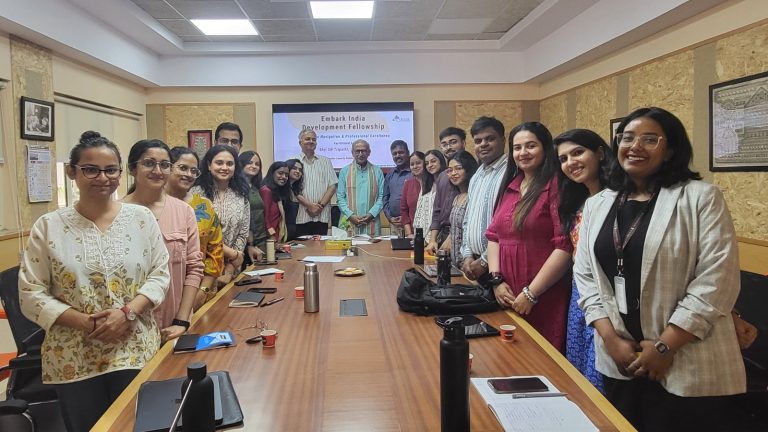
– Damini B. Bhoge, Embark India Development Fellow
Co-Authored and Mentored by Dr. Ananya Samajdar, Deputy Director for Research, GRAAM.
INTRODUCTION
In the financial year 2023–24, Indian companies spent ₹34,909 crore on Corporate Social Responsibility, funds towards education, healthcare, livelihoods, and the environment (National CSR Portal, 2024). That is a big number, and it has been growing steadily every year since the law came into force in 2014.
But when you look at where that money actually went, a very different picture appears.
Mizoram, one of India’s smaller northeastern states, received ₹4.48 crore. Tripura received ₹9.45 crore. A district in Nagaland called Kiphire, one of the poorest in the country, received nothing at all across five years in a row (Morung Express, 2025). At the same time, Maharashtra received over ₹5,375 crore in that single year, more than the combined total of all eight northeastern states (Dataful, 2025).
To understand the scale of this disparity, it helps to look at it on a normalized basis. On a per-square-kilometre basis, the imbalance is stark: Maharashtra received about ₹1.97 lakh per sq km, while the Northeast received only ₹27,000 per sq km. Despite covering nearly 8% of India’s land area, the Northeast continues to receive less than 1% of CSR funds (MHA, 2021), a disparity that is difficult to dismiss
“This blog tries to understand why that gap exists.”
Some Background: What the Law Says
India’s CSR law, Section 135 of the Companies Act, 2013, requires any company with a net worth of ₹500 crore, turnover of ₹1,000 crore, or net profit of ₹5 crore (or more) to spend at least 2% of its average net profits from the last three years on approved social causes. (Companies Act, 2013). Since 2014, this framework has channelled over ₹2.21 lakh crore social investment nationally (MCA, 2024).
On the surface, this looks like a success. The money is being spent. Companies are complying. Reports are being filed.
However, the original law had an inherent challenge. It asked companies to give preference to the areas where they operate. (Companies Act, 2013). Since most large companies are headquartered in Maharashtra, Gujarat, and Karnataka states, which together account for a disproportionate share of corporate offices and manufacturing units, the law was essentially directing corporate money toward states that are already relatively well-off. A 2025 analysis found that six industrialised states Maharashtra, Tamil Nadu, Karnataka, Gujarat, Andhra Pradesh, and Delhi-NCR — together receive roughly 60% of all national CSR funds (LetItCount, 2025). In January 2021, the Ministry of Corporate Affairs removed this local area preference clause through the Companies (Corporate Social Responsibility Policy) Amendment Rules, 2021 (Companies [CSR Policy] Amendment Rules, 2021). Even so, the money has continued to flow to the same places.
That is the puzzle this research is trying to solve: why has the geographic pattern not changed, even after the rule changed?
The Problem
India’s CSR law was designed to direct corporate money toward social good, toward the communities with the least, not the most. The Northeast fits that description clearly. These eight states consistently rank among the lowest in India on poverty measures. They face gaps in healthcare, schools, jobs, and basic infrastructure. The ecological fragility of the region adds another layer of urgency (NITI Aayog, 2023).
Yet the data show that around 90% of district-level CSR spending goes to areas with relatively low poverty. Only 3 of India’s 54 most poverty-affected districts are among the top CSR-receiving districts in the country (IndiaSpend, 2025).
This isn’t due to companies breaking the law. In fact, most are simply following the system’s guidance. The challenge lies in the system design, which may not fully align with the goal of directing funds to the most needy areas.
Current Approach
There are some efforts to channel CSR toward underserved areas. The government launched the Aspirational Districts Programme (ADP) in 2018 with the broader aim of accelerating development across 112 of India’s most lagging districts, many of which are in the Northeast. As part of this initiative, companies were encouraged to direct CSR investments toward these districts. However, participation remains voluntary, and there are no strong compliance incentives or financial benefits to encourage companies to join (DIU, 2025). Data suggest that only about 2% of total CSR spending from 2014 to 2022 reached aspirational districts, even though these districts are home to over 15% of India’s population (LetItCount, 2025).
Central Public Sector Enterprises (CPSEs), government-owned companies, perform somewhat better than private companies in reaching these districts. A study by the Developmental Intelligence Unit found that CPSEs allocate a higher share of their CSR budgets to aspirational and rural districts compared to private sector counterparts, though the absolute amounts remain small (DIU, 2025). Private sector investment in the Northeast remains minimal.
Some state governments have proactively built frameworks to attract CSR investment. The Maharashtra government has held formal consultations with corporate representatives to align CSR spending with state development priorities, identified nine priority sectors, and set up mechanisms to connect companies with vetted projects (Business Standard, 2016; Government of Maharashtra, 2021). Karnataka has linked CSR spending to its education priorities. These state-level efforts help create an environment that makes Maharashtra and Karnataka preferred destinations for corporate CSR. Northeastern states are working toward building similar frameworks, and further development of these systems could significantly improve CSR attraction.
Key Challenges / System Gaps
Three factors are working against the Northeast, and they reinforce each other.
1.Companies go where they know
Most of the companies that have to spend the most on CSR are headquartered in Mumbai, Pune, Bengaluru, or Ahmedabad. For years, India’s CSR law directed companies to spend near their operations, and even after the local area preference clause was removed in 2021, they continue to spend in familiar locations near their offices, suppliers, media, and investors (Business Standard, 2016; Government of India, 2021). This pattern is consistent with strategic CSR logic (Porter & Kramer, 2011) and legitimacy theory (Suchman, 1995): spending in a distant northeastern state like Nagaland may not generate the same strategic benefit as spending near a company’s home base.
2.It is harder to spend money in the Northeast
CSR money does not go directly from a company to a community. It usually goes through an implementing organisation, an NGO or trust that runs the actual programme on the ground. The Northeast has far fewer registered and verified organisations than Maharashtra or Karnataka. So even a company that genuinely wants to invest in Manipur or Arunachal Pradesh may struggle to find a trustworthy partner. Add difficult roads, limited internet, and complex reporting requirements, and the practical obstacles become real (LetItCount, 2025).
3.No map of where the need is
Most companies decide where to spend their CSR money without a clear picture of where development gaps are deepest. The government’s National CSR Portal (csr.gov.in) does not currently include a tool that shows which districts have the highest poverty or the lowest CSR coverage. Without such guidance, companies follow the pattern established in their sector, what DiMaggio and Powell (1983) call mimetic isomorphism: copying what similar companies do. If companies in a given sector are all directing funds to the same region, new entrants will likely do the same. For example, If other IT companies in Bengaluru are funding schools in Karnataka, a new IT company will likely do the same.
This is compounded by the fact that northeastern states have not yet built the infrastructure to attract CSR investment: no state CSR priority lists, no directories of ready-to-implement projects, and no single points of contact for companies. It becomes a cycle:
No systems to attract investment → no investment → no reason to build systems (Decade of CSR in NER, 2024).
By contrast, states such as Gujarat, Karnataka, Maharashtra, and Odisha have adopted proactive measures, including CSR priority lists, project directories, and dedicated facilitation cells, which make it easier for companies to identify opportunities and channel CSR funds effectively (Samarthya Portal, Government of Gujarat; Odisha CSR Facilitation Cell, 2023).
Way Forward
There is no single fix. But based on what the evidence shows so far, a few directions seem worth exploring. These are early thoughts; they will be tested and developed in an upcoming research paper.
- Make geographic choices visible: If companies were required to report the poverty level of the areas where they spend CSR money, it would create natural pressure to think more carefully about where the need is. The European Union has moved in this direction with its sustainability reporting rules.
- Give companies a reason to go to high-need areas: One idea is to let companies count CSR spending in the poorest districts at a slightly higher rate for compliance purposes so that ₹1 spent in a high-poverty district counts as ₹1.25 toward the requirement. This does not force anyone, but it changes the calculation.
- Help northeastern states attract CSR: State governments in the Northeast could build simple systems, a list of vetted NGOs, a priority areas document, and a single contact point to make it easier for companies to invest there. A few states have started doing this; more should follow.
- Use government companies to lead the way: Since CPSEs already invest more in lagging districts than private companies do, the DPE could formalise this as a requirement, setting a minimum share of CPSE CSR that must go to aspirational districts. (DIU, 2025)
- MCA policy direction: The MCA, through its CSR policy architecture, Section 135 of the Companies Act, the CSR Rules of 2014 as amended in 2021, and its circulars, has significant scope to issue guidance encouraging companies to direct funds toward aspirational districts and underserved regions. A formal policy circular from the MCA explicitly naming the Northeast and other underserved regions as priority geographies could shift corporate behaviour without requiring new legislation.
Conclusion
India has built something genuinely remarkable: a law that requires companies to invest in society, at scale, every year. A decade in, it is working in the sense that money is being spent and reports are being filed.
But if the goal was to direct corporate resources toward the communities that need them most, there is room for improvement in the current distribution pattern. The Northeast is a place of extraordinary diversity, ecological importance, and real development needs. It is also a place that most of India’s corporate CSR money never reaches.
That does not have to be permanent. The money is there. The need is there. What is missing is smarter design rules and systems that connect the two.
About the Author
Damini B. Bhoge is a fellow with the Embark India Development Fellowship, placed at the North Eastern Development Finance Corporation (NEDFi) in Guwahati, under the Department of Public Enterprises (DPE), Ministry of Finance, Government of India. Her fellowship research examines regional disparities in India’s CSR fund allocation, focusing on the structural and policy barriers that limit corporate social investment in the North Eastern Region.
References:
- Business Standard. (2016, January 4). Maharashtra govt to hold meet with corporates on CSR spending. https://business-standard.com/article/pti-stories/maharashtra-govt-to-hold-meet-with-corporates-on-csr-spending-116010400893_1.html
- Census of India 2011 population projections for India and states 2011 – 2036. https://nhm.gov.in/New_Updates_2018/Report_Population_Projection_2019.pdf
- Companies Act, 2013, § 135 & Schedule VII. Parliament of India. https://ibclaw.in/section-135-of-the-companies-act-2013-corporate-social-responsibility/
- Companies (Corporate Social Responsibility Policy) Amendment Rules, 2021. S.O. 582(E). Ministry of Corporate Affairs, Government of India. https://taxguru.in/company-law/corporate-social-responsibility-csr-section-135-companies-act-2013.html
- CSR Box. (2025). CSR Outlook Report 2025.
- https://csrboximpact.in/storage/publications/Official%20ICOR%20Report%202025_Publication_Website.pdf
- Dataful. (2025). Where the CSR money went – tracking CSR spending in India. https://insights.dataful.in/articles/where-the-csr-money-went-tracking-csr-spending-in-india
- A decade of NE CSR – northeastcsrforum.in.
- https://northeastcsrforum.in/wp-content/uploads/2025/07/A-Decade-of-North-East-CSR.pdf
- Developmental Intelligence Unit (DIU), Sambodhi Research & Transform Rural India. (2025). CSR spending and rural development needs: A district-level analysis. [Report cited in Business Standard, August 7, 2025.] https://www.business-standard.com/india-news/csr-funds-misaligned-rural-needs-diu-report-rqol-index-125080700434_1.html
- DiMaggio, P. J., & Powell, W. W. (1983). The iron cage revisited: Institutional isomorphism and collective rationality in organizational fields. American Sociological Review, 48(2), 147–160. https://doi.org/10.2307/2095101
- European Commission. (2022). Corporate Sustainability Reporting Directive (CSRD). https://finance.ec.europa.eu/capital-markets-union-and-financial-markets/company-reporting-and-auditing/company-reporting/corporate-sustainability-reporting_en
- Government of Maharashtra, Tribal Development Department. (2021). Implementation of corporate social responsibility activities: Government resolution. GR No. GAS 2021/C.R.65/DESK 13A. https://gr.maharashtra.gov.in/Site/Upload/Government%20Resolutions/English/202108101643392124.pdf
- Go Care || CSR portal || Govt. of odisha. GO CARE || CSR Portal || Govt. Of Odisha. (n.d.). https://csr.odisha.gov.in/
- IndiaSpend. (2025). How India’s Rs 34,000 crore CSR spending is distributed. https://www.indiaspend.com
- LetItCount. (2025). The geography of corporate social responsibility in India. https://letitcount.com/blog/the-geography-of-corporate-social-responsibility-in-india/
- Ministry of Corporate Affairs. (2024). National CSR Portal: Annual data. Government of India. https://csr.gov.in
- Ministry of Home Affairs. (2021). North-East division – basic data on NE states. Government of India. https://www.mha.gov.in/en/commoncontent/north-east-division
- Morung Express. (2025). CSR spending in Nagaland rising gradually, but remains marginal nationally. https://morungexpress.com
- NITI Aayog. (2023). National multidimensional poverty index: A progress review. Government of India. https://niti.gov.in
- Porter, M. E., & Kramer, M. R. (2011). Creating shared value. Harvard Business Review, 89(1/2), 62–77. https://hbr.org/2011/01/the-big-idea-creating-shared-value
- Project Samarthya. Govt. Of Gujrat. http://samarthya-dmf.apphost.in/
- Suchman, M. C. (1995). Managing legitimacy: Strategic and institutional approaches. Academy of Management Review, 20(3), 571–610. https://doi.org/10.5465/amr.1995.9508080331





This is indeed a well-summarised article, highlighting a significant gap and a great scope for the improvement and upliftment of the people. Very well written. Keep up the good work.