– Bhavesh Wadhwani, Embark India Development Fellow
Mentored by:
- Ms. Ruchi Gupta Team Lead (Urban Planning), NIUA
- Ms. Moumita Shaw (Program Manager, CITIIS 2.0), NIUA
- Mr. Sarath Kalliat Head (Research & Evaluation), GRAAM
On getting down from the autorickshaw, I joined the crowd rushing towards the Bettiah railway station on a hot April morning. With the main terminal undergoing a facelift, much of the front plaza is cordoned off from passengers. A brand-new module, somewhat isolated, sits in front of an aging extended terminal. The station and the improving connectivity point to visible progress. Bettiah, the largest settlement of West Champaran, seems to be undergoing a renewal.
Once at the centre of the historic Satyagraha of 1917, Champaran (East & West) sits on some of India’s most fertile agricultural plains, irrigated and flooded by the river systems that feed into the Ganga. Travelling through the district, into the remotest rural settlements, I found not just an agrarian landscape rich in promise, but also a region where this promise is unevenly realised. While the fertile plains offer an enduring image of agricultural abundance, interaction with farmers invariably shifted to their abject living conditions. Farming, while being at the heart of Champaran’s landscape and economy, appears fragile, vulnerable, but emergent.
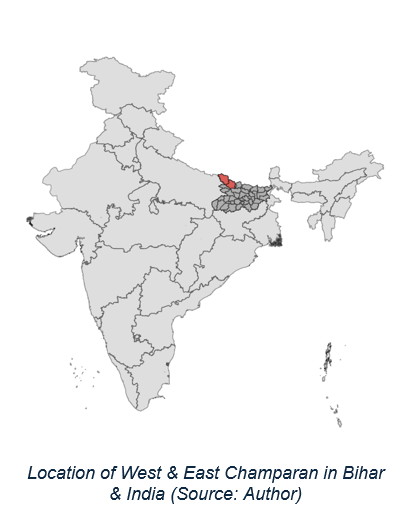
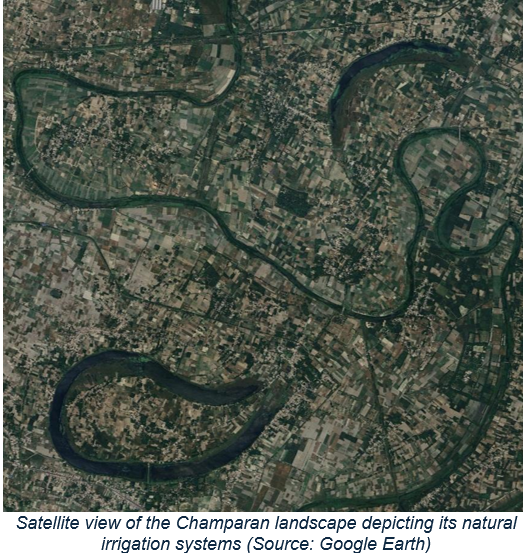
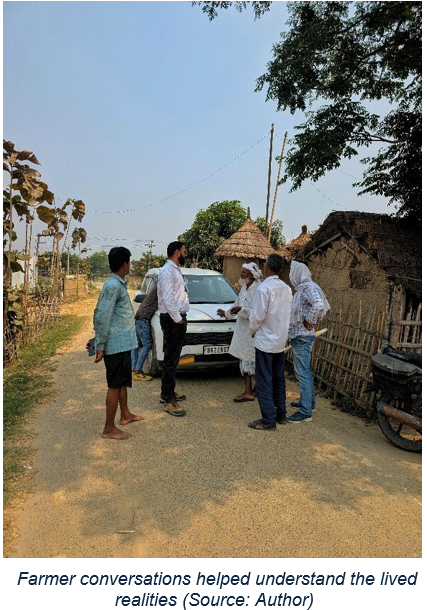
“I had a permanent job in railways, yet I left everything and returned to tilling my half acre farm. I was missing my land”, claimed a farmer in Narkatiaganj. “However, I insisted that my son study, and today he is a doctor in Ranchi. I was confident that he would not be able to labour the field like I do. You see, the newer generation does not have that attachment to the land”, he reflected.
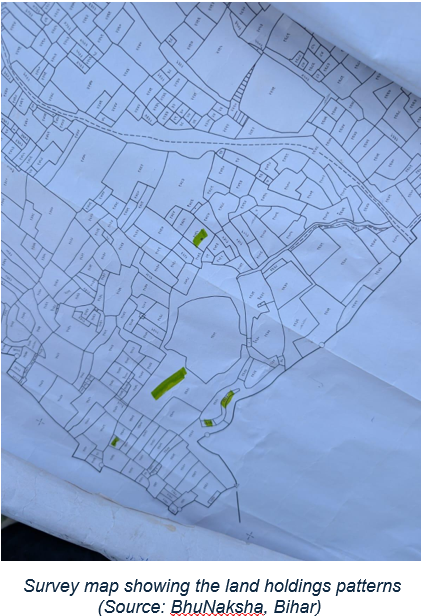
According to the official definition, a farm is categorised as marginal if it is less than 1 hectare, while farmers with 1-2 hectares of land are considered small farmers[1]. While marginal landholding is a pan-India phenomenon, it manifests as an acute, existential crisis in Bihar. The legacy of zamindari, inheritance laws and social stratification have resulted in over 91% of all agrarian land being held by marginal and small farmers, with an average holding of just 0.3 hectares[2]. Fragmented farm lands place serious limitations on agricultural productivity and deepen rural poverty. They are often too small to insure against risks, too isolated to connect to the markets, too fragmented to invest in mechanisation, and too fragile to absorb the shocks of floods and droughts. If individually, a 0.3 hectares production unit cannot resolve such structural challenges, can it be networked into a larger productive system?
Connectivity is crucial to any such network. Between 2005 and 2020, the road network in Bihar expanded by over 300%, while the national average was about 50%[3]. While on field, every major intersection bore a Pradhan Mantri Gram Sadak Yojana (PMGSY) signboard, highlighting this progress. With rural roads reaching the hinterlands, access to wider markets has improved and commerce appears to be diversifying. During his own field visits to rural Samastipur, Gregory Randolph, an American scholar, observes that remittances are fuelling a new service sector and reducing dependence on agriculture, shaping a non-farm economy along the improved transport networks.
This transition, he argues, is supported by a dense population that spans across rural Bihar. Challenging the conventional notions of urbanization, Gregory concludes that the state is “urbanizing from within”[4].
While this idea of an expanding service sector remains to be validated across Champaran, the signs of an emergent, dense urban life around these markets were hard to overlook.
At 1,106 persons per square kilometre, Bihar has the highest population density in India, roughly three times the national average. Yet its official urbanisation rate is one-third of Indian average, indicating significant scope for planned growth[5].
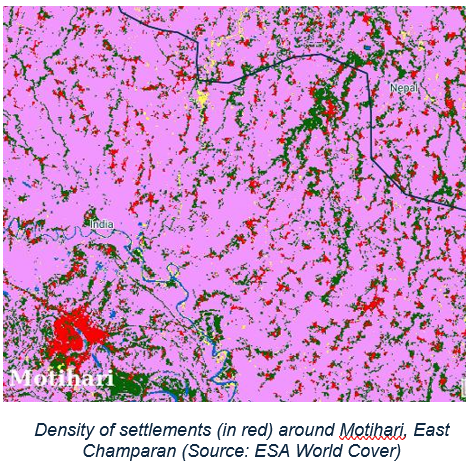
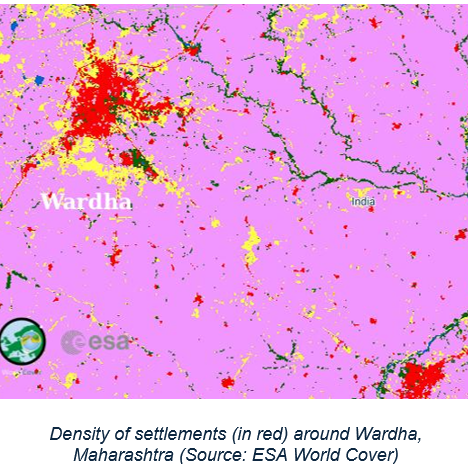
Champaran, much like Bihar, presents a condition of density without urbanity. It is statistically rural, physically dense, and economically suspended between a farming life that can barely sustain itself and emerging non-farm aspirations. What happens when these evolving urban aspirations intersect with a pre-existing, albeit struggling, agrarian society and its built environment?
As I notice the approaching train, the platform fills with the announcement of its arrival. On my way back to Patna, I keep circling back to a possible intersection between the two questions, untapped agrarian potential and emerging urban ambition. To me, Champaran’s, and to a larger extent Bihar’s imminent transition, appears to dwell in these interlinked narratives.
Fertile Land, Fragile Livelihood
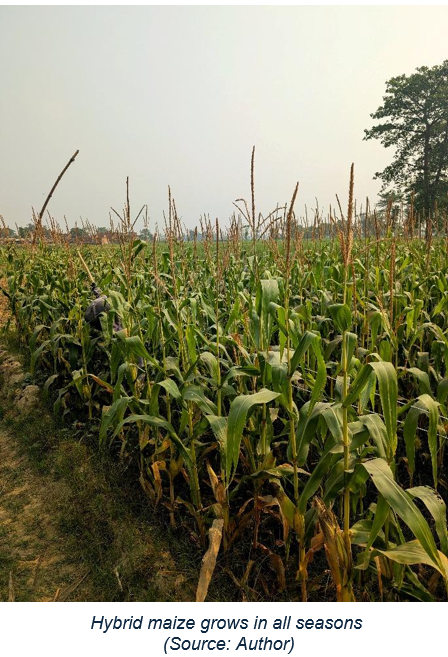
Bihar contributes close to 6% of national food grains[6], while ranking among the top-five fruit and vegetable producing states in India[7]. East & West Champaran are significant producers of sugarcane, maize, rice and wheat while horticulture remains a key strength with crops like litchi, mango, potatoes, cauliflower, etc. Agriculture and allied sectors contribute roughly 21% to the state’s GSVA (Gross State Value Added), while nearly 77% of the population is dependent on it[8]. The fertility of its alluvial soil can best be understood in Dr. Rajendra Prasad’s description of the land in his book Satyagraha in Champaran. Referring to the abundance of Majhowa, a village in West Champaran, he writes, “Majhowa is a wonderful country where even crows do not care for rice”.
While a lot grows on this land, not much reaches the farmer in value. Revenue structures extracted the bulk of agrarian surplus during the zamindari era, followed by incomplete land reforms in the state post-independence. This compounded the distress that continues to undermine agriculture’s viability as a livelihood. Bihar experienced only modest gains in yield and cropping intensity across much of the twentieth century, making it one of the slowest states in agriculture growth. In the same time, the population of agricultural workers in the state tripled[9], reducing per‑capita output and further shrinking the land available per cultivator. While marginal farm lands brought a challenge of scale, commercial farming was unviable also due to lack of infrastructure.
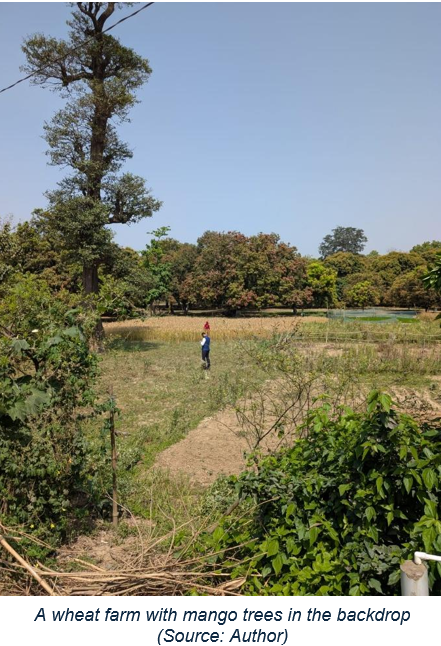
The rise of Naxalite movements and political instability in post-independence Bihar severely constricted long-term investments in rural infrastructure. While irrigation expanded in states like Punjab and Haryana, Bihar did not gain considerably. The limited infrastructure that did exist, suffered chronic underinvestment and deterioration. Annual flooding on the other hand affected the Kharif season, submerging much of northern Bihar and introducing a seasonal pattern of distress even in the productive years.
The post harvest scenario has not improved even in the twenty-first century. With inadequate storage, cold chain, and processing infrastructure, farmer interactions revealed an estimated 10% to 40% spoilage in horticulture, with highly perishable crops like litchi and tomato at the upper end of that range. In 2006, the state government repealed the APMC (Agriculture Produce Marketing Committee) system with the expectation that deregulation would attract private investment and liberate farmers from inefficiencies of a mandi. While it did give farmers more freedom to sell, it took away security, price stability and infrastructure. Under a constant threat of floods, informal procurement networks continue to take advantage of the inadequate infrastructures, leaving farmers with no option but to sell in distress.
Over the past two decades, the Bihar state government has recognised the scale of this gap. It appears that the state is making a rightful transition from an input-focused farm policy to a more structured agribusiness strategy. In its fourth consecutive instalment, the 2023-28 Krishi Road Map is promoting mechanisation, market integration and sustainability, while the Bihar Agri-Investment Promotion Policy (BAIPP) pushes private investment, processing, value addition, and jobs in agro-based industries. Dormant sugar mills are being revived under state initiative while private corporations are gradually entering the grain storage infrastructure. At the national level, “World’s Largest Grain Storage Plan in Cooperative Sector”, launched in 2023, attempts to converge multiple schemes and strengthen PACS (Primary Agricultural Credit Societies) as nodes for decentralised storage, procurement and primary processing.
While policies are attempting to address both fronts of the sector, in a landscape defined by systemic agricultural weakness, it is essential to do so simultaneously. Yield improvements without market access can leave the farmers dependent on middle men. Processing investment without first mile aggregation can leave smallholders outside the value chain. The Green Revolution, often celebrated as a narrative of convergence, ultimately faced structural limitations due to its asymmetric focus on productivity[10]. In a state like Bihar, where issues like marginality, flooding, minimal storage infrastructure and fragile procurement systems converge, policy reforms can only succeed if they simultaneously strengthen the backward and forward linkages.
Linkages as Urbanisation
Backward linkages determine what grows and how productively, by providing inputs, credit, mechanization, and agronomic support until harvest. Forward linkages, through storage, processing, logistics, and market access, determine how much value farmers actually retain. With production potential in place, effective spatial organisation and distribution of these linkages can positively address the region’s agrarian crisis. A processing plant in isolation at best can generate some employment and support nearby farmers, but when integrated into a regional network, it can reorganize the entire agrarian economy.
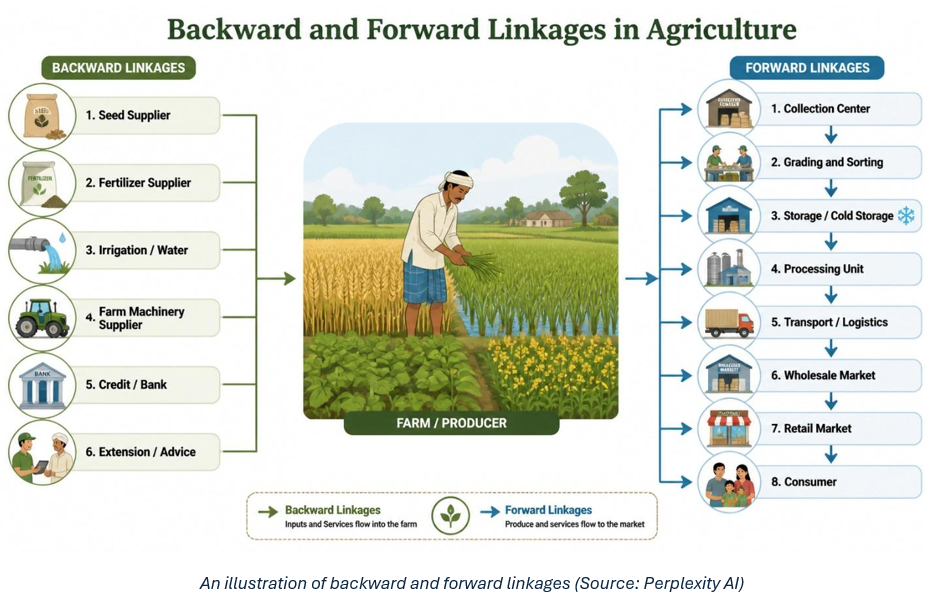
While optimising the agricultural value chain, linkages can also alter the spatial character of rural settlements. A processing unit can pull in labour from surrounding villages, create demand for repair services, logistics and anchor a cluster of ancillary activities around it. Essentially, backward and forward linkages can induce urbanisation. Not by building cities in the conventional sense, but by thickening the economic and infrastructural tissue of existing settlements until they acquire the density of exchanges that actually defines urbanisation. In this scenario, urbanization is not an escape from the farm, but an evolution springing from its shoulders.
To justify this relationship, it is essential to acknowledge the narrow perceptions of urbanisation as a concept. Urbanization is often narrated as a tale of migration from rural areas to bulging cities. Global urban theory is ‘city dominated’, with limited distinction between what is a city and what is urbanisation, leading to both being used interchangeably[11]. A linear model is commonly used to describe rural to urban transition, with the study of agrarian contexts and small towns a blind spot in urban policy and research. Bihar is perhaps the clearest example of this. The state’s out-migrants are often regarded as an essential work force in any major Indian city, while its productive landscapes barely sustain rural livelihoods.
Expanding the definition of urbanisation can directly impact where investment flows, what infrastructure gets built, and how landscapes get planned. With much of India’s urbanisation still unfolding in small towns, market centres and agrarian settlements rather than metropolitan areas, urban policies need to create linkages with its agrarian roots. If agro-economies are treated as important drivers of regional urbanisation, they can functionally transform many smaller and medium-sized settlements, while also acting as vehicles to modernise agriculture. Champaran’s land, agriculture and evolving socio-economic aspirations testify to the need to not only decentre the city, but also to recentre the agrarian in a way that transforms both in the process[12].
Bihar is not a region that is waiting to be urbanised. With remittances, an evolving service sector and density, it is already urbanising on its own terms, without the infrastructure to make it coherent. In this context, the correlation between urbanization and agriculture certainly leaves a few questions. Does urbanisation that is driven by natural population growth, rather than in-migration, require a different approach to planning? Can dense, agrarian and non-metropolitan places like Champaran, present an alternative to the mega-city model? Can urbanization directly reach the agrarian communities and serve the same marginal farmer who returned to his land?
About the Author:
Bhavesh Wadhwani is a Research Associate at National Institute of Urban Affairs (NIUA). With a background in urban planning, policy design and architecture, his research focuses on communities and landscapes that formal planning frameworks have failed to see. At NIUA, his work investigates the intersection of agricultural value chains and spatial planning in the context of urbanising agrarian landscapes. This blog was produced under Embark India Development Fellowship (2025-26).
References:
- Department of Agriculture, Cooperation & Farmers Welfare. (2019). Agriculture Census 2015–16: All-India report on number and area of operational holdings.
- Government of Bihar, Finance Department. (2025). Bihar Economic Survey 2024–25.
- Government of India, Ministry of Road Transport & Highways. (2025). Year end review 2025: Ministry of Road Transport & Highways.
- Randolph, G. F. (2026). Urbanization from within: A theory of urban transition from 21st-century India. Oxford University Press.
- Government of India, Office of the Registrar General & Census Commissioner. (2013). Census of India 2011: Provisional population totals. New Delhi: Government of India.
- Government of Bihar, Agriculture Department. (2021). Status of agriculture in Bihar (State profile)
- Government of India, Ministry of Agriculture & Farmers Welfare, Department of Agriculture & Farmers Welfare. (2021). Production of fruits and vegetables (Press Information Bureau release, 29 November 2021).
- Government of Bihar, Finance Department. (2025). Bihar Economic Survey 2024–25.
- Kishore, A. (2005). Understanding agrarian impasse in Bihar. Economic and Political Weekly, 40(3), 123–131
- Pingali, P. L. (2012). Green Revolution: Impacts, limits, and the path ahead. Proceedings of the National Academy of Sciences, 109(31), 12302–12308.
- Gururani, S., & Dasgupta, R. (2018). Frontier urbanism: Urbanisation beyond cities in South Asia. Economic and Political Weekly, 53(12), 41–45.
- Gururani, S., & Dasgupta, R. (2018). Frontier urbanism: Urbanisation beyond cities in South Asia. Economic and Political Weekly, 53(12), 41–45.