
-Arkraj Biswas, Embark India Development Fellow
Co-Authored by Shri Anand Mohan (CEO, National CAMPA); Dr. Balu I (Senior Research Fellow, GRAAM), and Mr. Kiran DM (CEO, Sewa Bridge).
I. THE BURNING SUBCONTINENT
A Climate Reality Check
The last two years (2024 and 2025) stand out as a turning point in the climatic history of the Indian subcontinent. The India Meteorological Department (IMD) has termed 2024 as the hottest year since records began since 1901; this has literally pushed the limits of what people can really stand. The heatwaves didn’t just stick to the places you’d expect, like the arid northwest or in the central plains. Instead, they have also spread and migrated their reach, announcing their presence even in the steamy coastal regions and areas that, until now, had a reputation for far milder weather.
Recent data has made it clear how serious things have become, more than 57 percent of Indian districts now come under highly heat-prone zones, thus leaving almost three out of four people in the country exposed to extreme heat stress (NDMA, 2023; IMD, 2024). In cities like Delhi and across Rajasthan, temperatures have remained dangerously close to 50°C, for multiple days.
But these above numbers only tell you a part of the story. The real, hidden threat comes from the Urban Heat Island (UHI) effect. As rapid and often reckless urbanization sweeps through the country, the green spaces and open ground spaces are getting paved and are getting covered up with concrete, asphalt, glass and other impervious and high heat absorbing materials. These materials soak up the sun’s energy all day and then release it at night, so the city just keeps baking long after the sunset. Research on Delhi’s microclimate documents that the UHI effect raises urban temperatures by 2–7°C above surrounding rural baselines, with peak differentials recorded during summer nights, making dense tree canopy the single most cost-effective passive cooling intervention that is currently available to city planners (Mohan et al., 2012; IMD, 2024).
Because of this high heat stress, life for millions, especially the urban commuters, street vendors, and daily wage earners, has grown much tougher in the cities. A walk down a sun-blasted street, with no trees and green spaces for cover, has become more than just uncomfortable. It’s becoming a major public health risk that one cannot ignore, and as the demand for cooling and air conditioning spikes, the energy grids start to fail, and thus a sharp divide can be seen in who’s able to find relief and who’s not becomes impossible to ignore. Those with money and assets escape indoors to cool air, while the poor and daily wage workers are left to endure the relentless heat outside.
II. THE SHIFT IN PARADIGM
From Welfare to Fundamental Rights
For years, urban forests and city parks in the Global South weren’t taken much seriously. City planners treated them only as afterthoughts, much as fancy green spaces that were meant to please and as a showoff for the rich, with perfectly trimmed lawns and exotic plants that take huge amounts of water along with much need for care. Parks sat low on the list when it came to city budgets, and got quickly sacrificed whenever new roads or buildings or any construction of some sort needed space.
Now, since that old mindset is crumbling, the shift has become impossible to ignore. With heatwaves breaking past records, air thick with pollution, and wildlife disappearing, people have started to see green spaces not just as an upscale decoration but as a public right. Parks aren’t just about looking pretty; they mean survival, they provide cooler air, somewhere to breathe freely, keep you in the right mindset and thus they become as essential as water, power, and sanitation.
Under Article 21 of the Indian Constitution, the Right to Life and Personal Liberty, the Supreme Court has progressively interpreted a clean and healthy environment as an inseparable component of this fundamental right (Subhash Kumar v. State of Bihar, AIR 1991 SC 420). India’s National Heat Action Plan (NHAP, 2019), which was prepared and coordinated by the National Disaster Management Authority (NDMA), further operationalizes this by mandating the heat preparedness protocols for cities, thus placing green infrastructure explicitly within a rights-based, state-obligated governance framework.
THE SCIENCE OF WELL-BEING
Peer-reviewed research also demonstrates that the access to urban green spaces produces measurable psychological and physiological benefits along with guaranteed climatic and ecological advantages. Studies employing the WHO-5 Well-Being Index as a validated psychometric measurement instrument have found that regular proximity to urban greenery significantly reduces anxiety scores, accelerates stress recovery, and is also associated with lower blood pressure readings (Barton & Pretty, 2010; White et al., 2013; van den Berg et al., 2015).
There’s also a hard economic angle. When researchers use the Contingent Valuation Method, they find that people are actually willing to pay significant amounts to keep these urban forests alive. The cooling effect and obvious health benefits speak for themselves.
Governments are now starting to notice. The Ministry of Environment, Forest and Climate Change (MoEFCC), powered by funds from the National Compensatory Afforestation Fund Management and Planning Authority (National CAMPA), rolled out a new plan: the Nagar Van Yojana (NVY). This policy isn’t just about updating the old rules, it’s also about reimagining city parks as vital infrastructure, not just some kind of throwaway luxuries.
III. THE FRAMEWORK
The Nagar Van Yojana
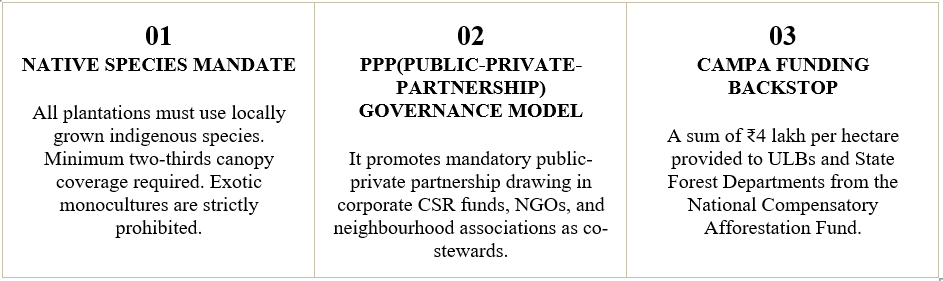
The Nagar Van Yojana (NVY) is an initiative to create 1,000 urban forests (Nagar Vans) and gardens (Nagar Vaticas) across India by 2027 and it is backed by the CAMPA funds, which provide ₹4 lakh per hectare to local bodies. The NVY mandates the use of only the native species, and to reject exotic monocultures. It also employs a mandatory Public-Private Partnership (PPP) model, thus utilizing CSR and the community support to ensure a bottom-up movement. The core policy dictates that at least two-thirds of the area must be dense tree canopy, thus will be very essential for ecological services like carbon sequestration and groundwater recharge.
THE THREE PILLARS OF NVY:
NAGAR VANS AND THE LIVELIHOODS
One of the most significant but also the overlooked aspects of the Nagar Van Yojana is its potential for livelihood generation. For many vendors, the Nagar Van is not just a recreational space or place for a walk, it is their marketplace too, where they can sell their products. The presence of visitors creates a steady demand for their services and for their local products, thus providing a lifeline and support for street vendors who were previously displaced by aggressive urban development. Furthermore, for communities who are dependent on Non-Timber Forest Products (NTFPs), these forests also provide them access to medicinal plants, fruits, and fodder even in an urban setting.
In some states like Jharkhand, the linkage between urban forestry and livelihoods is explicitly integrated through the JOHAR project and the Jharkhand State Livelihood Promotion Society (JSLPS). Here, the women’s Self-Help Groups (SHGs) are empowered enough to run self-grown nurseries and they also know how to grow valuable medicinal plants like lemongrass within and around Nagar Vans. These forests serve their livelihood, driving local incomes and contributing significantly to poverty reduction in peri-urban areas.
SUCCESS STORIES: LOCAL SOLUTIONS ACROSS THE SUBCONTINENT
Let’s dive into some best seen transition through local success stories:
- Gujarat (Sultanabad Coastal Nagar Van, Surat): The Sultanabad Nagar Van serves as a crucial barrier against air pollution and coastal erosion. This Nagar van utilises the Miyawaki Method, and they have planted over 550,000 native trees, thus creating a dense, fast-growing shield that has also opened new streams of eco-tourism revenue for the local vendors.
- Madhya Pradesh (Ahilya Van, Indore): Indore, also famously known as India’s cleanest city, this van turned barren land into a thriving forest by tying urban forestry to waste management. Compost derived and collected from city waste are directed into feeding the saplings of Ahilya Van, thus creating a circular economy. In 2024, the local community also demonstrated its stewardship by planting over a million saplings in a single day.
- Jharkhand (Ranchi’s Livelihood Engine): The collaboration with JSLPS (Jharkhand State Livelihood Promotion Society) has turned Ranchi’s Eco Park into a hub for medicinal plant cultivation, thus proving that urban forests can be both ecological sanctuaries and an economic asset.
- Andhra Pradesh (Kambalakonda, Visakhapatnam): This Nagar Van emerged as a green shield after Cyclone Hudhud. This van is Managed by an Eco Development Committee of local residents, and the park splits tourism proceeds with the community, ensuring that those who protect the forest also benefit from it.
MONITORING, ACCOUNTABILITY & GAPS
Under the NVY, the plantation progress is self-reported by Urban Local Bodies (ULBs) through the PRANA portal, with NDVI-based satellite monitoring through the e-Green Watch platform providing a secondary verification layer (MoEFCC, 2023–24). However, there are currently no mandatory third-party ecological audits that currently exist that can independently verify on-ground canopy coverage targets.
IV. THE PEOPLE’S MOVEMENT
Ek Ped Maa Ke Naam: One Tree in the Name of Mother
No matter how much money you will spend on a policy, it will just not work without the people’s hearts and minds behind it. The Government of India understood this when they rolled out the “Ek Ped Maa Ke Naam” campaign, that is One Tree in the Name of Mother, and it was launched on the World Environment Day in June 2024.
What made this campaign remarkable was its emotional core. It was not just about planting trees, it turned the simple act of restoring nature into a tribute to one’s mother. Suddenly, planting a sapling became deeply personal and connected, as the campaign moved well beyond the paperwork and targets of past programs, sparking one of the largest grassroots environmental movements the world has ever seen. People from every walk of life joined in including citizens, schoolkids, businesses, even the armed forces. They all came up on the MeriLiFE portal to track their efforts, and to share their stories, and to see their contributions in complete action.
The impact has been quite good till now. This campaign has driven genuine enthusiasm across communities, and till now more than 262.4 crore saplings went into the ground all over India, blowing past the original goal. India set the stage for these saplings to thrive for decades by making urban forestry a personal responsibility, not just some bureaucratic task. People are now personally more invested in nurturing and protecting them. However, it is also crucial that we recognize that major metropolitan cities like Delhi and other big cities still require significantly more parks and tree cover to effectively and efficiently counteract this increasing effect of urban heat island.
KEY CONCEPTS & GLOSSARY
| UHI Effect | Urban Heat Island is the phenomenon where built surfaces trap and radiate heat, raising city temperatures by 2–5°C above surrounding rural areas. |
| Nagar Van Yojana | MoEFCC’s flagship scheme targets 1,000 urban forests across India by 2027, funded via National CAMPA at ₹4 lakh per hectare. |
| Miyawaki Method | A dense multi-layer native planting technique pioneered by Japanese botanist Akira Miyawaki, enabling forests to grow 10× faster than conventional plantations. |
| WHO-5 Index | World Health Organization’s Five Well-Being Index — a validated psychometric tool measuring psychological well-being in research settings. |
| CVM | Contingent Valuation Method is an economic technique revealing citizens’ willingness-to-pay for non-market goods like clean air and green space access. |
| CAMPA | National Compensatory Afforestation Fund Management and Planning Authority — the financial backbone of India’s urban and compensatory forestry programmes. |
| PPP | Public-Private Partnership is the mandatory governance model under NVY combining government funds, corporate CSR, and community participation. |
| Article 21 | Right to Life and Personal Liberty under the Indian Constitution; judicially interpreted to include the right to a clean and healthy environment. |
| NHAP | National Heat Action Plan (2019) — NDMA’s framework mandating heat preparedness protocols for Indian cities. |
| PRANA Portal | Portal for Regulation of Arboriculture and National-level Afforestation is the MoEFCC platform for self-reported NVY plantation data by ULBs. |
| e-Green Watch | Satellite-based NDVI monitoring platform for tracking plantation coverage under CAMPA and NVY schemes. |
ABOUT THE AUTHOR
Arkraj Biswas is a Research Associate at National CAMPA, Ministry of Environment, Forest and Climate Change (MoEFCC), Government of India. His research evaluates the socio-economic, psychological, and governance outcomes of the Nagar Van Yojana across India. This blog was produced under the GRAAM Embark India Fellowship 2025–26, mentored by Shri Anand Mohan (CEO, National CAMPA), Dr. Balu I (Senior Research Fellow, GRAAM), and Mr. Kiran DM (CEO, Sewa Bridge).
References
- Barton, J., & Pretty, J. (2010). What is the best dose of nature and green exercise for improving mental health? A multi-study analysis. Environmental Science & Technology, 44 (10), 3947–3955. https://doi.org/10.1021/es903183r
- India Meteorological Department. (2024). Annual climate statement 2024. Ministry of Earth Sciences, Government of India.
- Jharkhand State Livelihood Promotion Society. (2022). JOHAR project: Urban forestry and livelihood linkages — Progress report. Government of Jharkhand.
- Ministry of Environment, Forest and Climate Change. (2023–24). Annual report 2023–24. Government of India. https://moef.gov.in
- Ministry of Environment, Forest and Climate Change. (2024). Ek Ped Maa Ke Naam: Campaign impact report. MeriLiFE Portal, Government of India.
- Miyawaki, A. (1998). The healing power of forests: The philosophy behind restoring Earth’s balance with native trees. Storey Publishing.
- Mohan, M., Kandya, A., & Battiany, A. (2012). Analysis of the diurnal variation of the urban heat island effect over the city of Delhi using microwave satellite data. Natural Hazards, 62 (2), 545–562. https://doi.org/10.1007/s11069-012-0098-5
- National Compensatory Afforestation Fund Management and Planning Authority. (2024–25). Annual report 2024–25. Ministry of Environment, Forest and Climate Change, Government of India.
- National Disaster Management Authority. (2019). National heat action plan: Measures for preventing and mitigating heat wave. Government of India. https://ndma.gov.in
- National Disaster Management Authority. (2023). Annual report 2022–23 [Heat-prone district and population exposure data]. Government of India. https://ndma.gov.in
- Supreme Court of India. (1991). Subhash Kumar v. State of Bihar, AIR 1991 SC 420.
- van den Berg, M., Wendel-Vos, W., van Poppel, M., Kemper, H., van Mechelen, W., & Maas, J. (2015). Health benefits of green spaces in the living environment: A systematic review of epidemiological studies. Urban Forestry & Urban Greening, 14 (4), 806–816. https://doi.org/10.1016/j.ufug.2015.07.008
- White, M. P., Alcock, I., Wheeler, B. W., & Depledge, M. H. (2013). Would you be happier living in a greener urban area? A fixed-effects analysis of panel data. Psychological Science, 24 (6), 920–928. https://doi.org/10.1177/0956797612464659



An insightful article emphasizing the vital role of green spaces in building healthier and more climate-resilient cities. At Ardini Farms, we share this commitment to sustainability through managed farmland near Bangalore, where responsible land stewardship and green landscapes create lasting value for both people and the environment.
Excellent article arkraj. I particularly appreciate how it highlights the Nagar Van Yojana as a practical, long-term climate adaptation measure rather than just an afforestation initiative. As India experiences more frequent and intense heatwaves, urban green infrastructure will become increasingly critical.
One aspect that could further strengthen the article is a discussion on capturing the true impact of heatwaves on mortality. Current data systems often report very different numbers—for example, in Telangana, NCRB recorded 116 heatstroke/sunstroke deaths in 2024, while the state's Heatwave Action Plan 2026 recorded only 10 deaths for the same period, primarily due to differences in reporting methodologies. Highlighting such discrepancies would reinforce the need for standardized heat-health surveillance and better evidence for policy and planning. Overall, this is a well-researched and highly relevant piece