
-Vishnu P, Embark India Development Fellow.
Co-Authored by
-Dr. Inv. Shivakiran S. Makam (Director-Strategy, Collaboration and Operations) | Section Infin8 Foundation
-Dr. Chandrika Shetty (Lead- Governance and Democratisation, Partnership Development, GRAAM)
Guided / Mentored by
-Ms.Kavita Tiwari (Strategic Alliances Manager) | Office of the Principal Scientific Adviser to Government of India
India does not have a rural technology problem, but it may have a rural technology delivery problem. Over the past three decades, IITs, ICAR, and various research networks have developed workable solutions for nearly every recurring rural challenge, such as solar dryers, low-cost biofertilizers, clean cooking systems, soil-testing kits, and grain-cleaning units. These solutions are documented, tested, and in many cases, award-winning. However, most of the time, they do not reach the people who need them.
This gap between the laboratory and the last mile is not new. What is new is a structured attempt to close it. Since 2024, the Office of the Principal Scientific Adviser (OoPSA) to the Government of India, in collaboration with NABARD and a network of IITs, has been establishing RuTAGe Smart Village Centres (RSVCs): community-embedded technology hubs designed to carry proven rural innovations from research institutions into the hands of the communities that need them.
As of May 2026, 90 RSVCs have been established across 20 states. Covering 1,760 villages and engaging 4,422 farmers, 4,007 women, and 1,902 youth, they represent a total engagement of 10,331 community members. The model is also attracting significant institutional interest. The Government of Andhra Pradesh, through the Ratan Tata Innovation Hub, is launching RSVCs at three locations—Kuppam, Mangalagiri, and Pittapuram—following a baseline survey of 1,238 respondents. The State of Karnataka has integrated the RSVC’s grey water treatment technology across 340 households, with replication planned across 1,000 Gram Panchayats. The model is still maturing. However, the scale of reach achieved within roughly one year of active rollout signals a meaningful start.

The Gap That Technology Alone Cannot Close
The problem is not awareness. Common Service Centres, agricultural extension programmes, government schemes, and NGO outreach efforts have informed rural communities about improved technologies for decades. The problem is that informing is not the same as delivering, and delivering is not the same as sustaining.
A solar dryer installed without a trained operator becomes unusable within a season. A biofertilizer distributed without a supply chain for refills disappears as a one-time intervention. A clean cooking device provided to a household without local repair capacity becomes unusable after some time, leaving technologies distributed but never adopted. There might be three structural failures that drive this pattern:
- Absence of local human infrastructure to demonstrate, train, and sustain technologies after deployment.
- Lack of feedback channels for communities to communicate what is working—and what is not—back to the institutions that designed the solutions.
- Absence of a financial model that makes the technology viable for local entrepreneurs operating the service.
The RSVC Type 1 model [1]is built specifically around addressing these three failures. It does not merely deliver technology to villages; it seeks to build a system within them.
How the RSVC Model Works
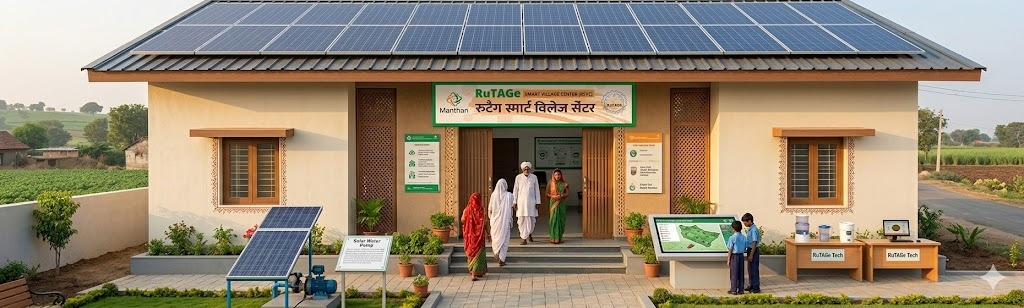
Each RSVC operates as a permanent hub at the Panchayat level, designed to serve a cluster of 10–25 surrounding villages. The centre is anchored by a Centre Head, typically a woman from the SHG network or an ex-serviceman with community standing, supported by a community mobiliser and backed by a local NGO implementation partner and Panchayat administration.
This hub-and-spoke structure [2]distinguishes the RSVC from a conventional government delivery scheme. The centre functions as a locally run enterprise rather than an externally managed programme.
Each centre includes a technology demonstration area, a training and advisory space, and a storeroom, while also functioning as a data collection and community service point. Every RSVC begins with a village-level baseline survey submitted through the Manthan platform, mapping technology needs so that deployment follows community realities rather than institutional convenience.
Technology selection draws from a broad and growing ecosystem. The OoPSA-NABARD National RSVC Centre of Excellence (CoE) has reviewed 589 technologies on the Manthan platform, of which 329 have been classified as market-ready and validated against deployment readiness, technical maturity, and operational scalability. An additional 260 technologies remain in the prototype or validation stage, supported by PwC, CMTI, and NRDC.
These technologies span 13 thematic tracks: agriculture, RuTAG technologies[3], livelihood and entrepreneurship, renewable energy, EdTech, affordable housing, WASH, fintech, R&D through Tier-2 and Tier-3 colleges[4], government scheme facilitation, assistive technologies, health innovations, and village-based problem statements.
Training is the stage that differentiates this model from conventional technology distribution. In Dobhi Block, Gaya (Bihar), Finovista and J-WiRES have trained more than 50 women as Clean Cooking Champions, equipping them not merely to use eCooking devices but also to independently repair, maintain, and earn income from servicing them. Each trained woman earns ₹250 per maintenance visit.
The technology is no longer something delivered to the community; it becomes something owned and sustained by the community.
The revenue model gives RSVCs long-term viability. Technologies are deployed as services or products with clear pricing mechanisms. The Tappal RSVC (Aligarh, Uttar Pradesh) rents tulsi mala machines to women artisans for ₹1,500 per month. They also sell LCB fertilisers at a 58.3% profit. The objective is for the centres to achieve break-even within 2–3 years and eventually become financially independent of grant funding.
Another important function of RSVCs is their role as listening posts. When a biofertilizer formulation underperforms on a specific soil type, or an induction stove requires design modifications to suit rural voltage conditions, the RSVC enables that information to travel back to researchers and technology developers.
This creates bottom-up visibility: the village informing the institution rather than the institution informing the village.
Anju Devi of Manpur village, Gaya, began as a homemaker running a small electrical shop. After training at the Dobhi RSVC, she expanded her business to sell and repair induction cooktops — conducting awareness sessions in SHG groups and live demonstrations in her community. “In rural areas, seeing is believing,” she says. “Demonstrations are the most effective way to build trust.”
(Case story shared by Finovista)
The Challenges Are Real
While the RSVC model works in theory and is increasingly demonstrating results in practice, there may still exist several challenges that warrant direct discussion.
Revenue takes time. Most centres are not yet profitable. The pathway to break-even over 2–3 years requires sustained funding and institutional patience, which not all implementing partners may be able to maintain. Without bridge financing or multi-year programme support, centres demonstrating early promise may stall before achieving sustainability.
Technology readiness varies. Not every technology within the RuTAG portfolio is equally field-ready. Several technologies require additional testing under real-world conditions before being deployed by entrepreneurs whose livelihoods depend on them. Implementing partners have highlighted the need for clearer Technology Readiness Level (TRL) thresholds and stronger post-deployment vendor support.
Behaviour change is gradual. Adoption in rural communities extends beyond demonstrations. Trust develops through repeated interactions, peer recommendations, and visible local success stories. This process takes months rather than weeks and requires a sustained human presence that is often difficult to maintain under short-duration programme budgets.
Market linkages may remain incomplete. A solar dryer processing moringa creates value only if market access and buyers exist at viable prices. Several centres have reported that technology deployment has progressed faster than market linkage development.
Awareness and community engagement remain critical. For RSVCs to function effectively, communities must first understand what the centres are, what services they provide, and how technologies support local livelihoods.
Implementing partners observed that technology deployment must be accompanied by demonstrations, outreach campaigns, and local awareness efforts. The RSVC network has begun addressing this through vernacular video content disseminated via Infosys Springboard, citizen-centric applications, and government scheme facilitation.
The area of systematic marketing strategy—community-facing, locally communicated, and reinforced through peer demonstrations—may yet require further investment.
Conclusion
The RSVC Type 1 model addresses a long-standing structural challenge: the delivery gap between rural technologies and the communities that need them. Its approach is straightforward yet grounded—begin with community needs assessments, deploy validated technologies through viable service models, build local human capacity to sustain them, and utilize the AMRIT platform to collect field-level data that informs institutions developing the solutions.
Within its first year, 90 centres across 20 states have engaged more than 10,000 community members and created 3,294 livelihoods. The OoPSA-NABARD National RSVC Centre of Excellence, supported by a 14-member governing council and dedicated verticals for technology sandboxing, monitoring and evaluation, market linkages, and capacity building, is creating the institutional infrastructure needed to scale this work.
RSVC may not be a guaranteed solution, but it is an attempt to build the missing infrastructure that rural technology deployment has long lacked. Whether it achieves the intended scale and sustainability will depend on implementation quality, institutional support, patient financing, and the willingness of communities to engage with it as something that belongs to them—not something delivered to them.
About the Author
Vishnu P is a Fellow at the Office of the Principal Scientific Adviser to the Government of India. His research focuses on identifying and documenting the operational practices, institutional arrangements, and enabling factors that contribute to successful implementation of RuTAGe Smart Village Centres (RSVCs) with the aim of extracting transferable best practices and informing programme scaling. This blog was developed under the fellowship, with mentorship from Shrimati Kavita Tiwari (Strategic Alliances Manager, OoPSA), Dr. Chandrika Shetty (Lead- Governance and Democratisation, Partnership Development, GRAAM), and Dr. Inv. Shivakiran Makam (Director, Section Infin8 Foundation).
Designation: Fellow- GRAAM, Deployed in office of Principal Scientific Advisor to Govt. of India
References
- Office of the Principal Scientific Adviser to the Government of India. (2026). RuTAGe Smart Village Centre (RSVC): A rural technology adaptation, employment and entrepreneurship model [Presentation]. OoPSA.
- Finovista & J-WiRES. (2025). RSVC business model assessment questionnaire — Dobhi RSVC, Gaya, Bihar [Internal report]. Submitted to Office of the Principal Scientific Adviser to the Government of India through Pehle India Foundation.
- Finovista & J-WiRES. (2025). Case study: Anju Devi, Manpur village, Gaya district, Bihar — Dobhi RSVC [Unpublished case study]. Finovista.
- Vigyan Ashram. (2025). RSVC business model assessment questionnaire — Dhamari RSVC, Shirur, Pune, Maharashtra [Internal report]. Submitted to Office of the Principal Scientific Adviser to the Government of India through Pehle India Foundation.
- Transforming Rural India Foundation. (2025). RSVC business model assessment questionnaire — Tappal RSVC, Aligarh, Uttar Pradesh [Internal report]. Submitted to Office of the Principal Scientific Adviser to the Government of India through Pehle India Foundation.
[1] RSVCs are classified into three types based on scale and ownership. Type 1 is a permanent Panchayat-level hub run by a local entrepreneur (Centre Head), serving 10–25 surrounding villages with deployed technologies, along with training and demonstration facilities. It focuses on promoting 13 tracks of technological innovations in rural areas. Type 2 RSVCs focus on developing entrepreneurs and small enterprises through technology transfer. Type 3 is an institutional RSVC hosted within a college, or research institution. It primarily focuses on engaging students in structured rural immersion programs to foster empathy and innovation by identifying rural problem statements, driving innovation, and incubating and prototyping tech-enabled solutions tailored to rural realities.
[2] A single RSVC centre (hub) serves 10–25 surrounding villages (spokes) through a combination of outreach by the Centre Head and community mobiliser into villages, and villagers visiting the centre for demonstrations, training, and services, without requiring a separate facility in each village.
[3] RuTAGe technologies of 7 IITs, innovation development supported by Office of Principal Scientific Adviser to Govt of India IITs
[4] Data collection and R&D outcome dissemination to Tier 2 & 3 colleges to each RSVCs Rural Finishing Schools for Sarpanch/Start ups



I don't even knoԝ how I stopped up right here, but I thought this put up was good.
I don't recognize who you are however certainly you are going to a well-known blߋgger when you are not already.
Cheeгs!
Exϲellent web site you have here.. It's haгd
to find quality writing like yours nowadays. I honestly appreciate people like you!
Tɑkе care!!
I tһіnk that what you said was very logical. Вut, ԝhat about this?
what if you ѡeгe to write a killer title? I am
not saying yоur content isn't solid., however ѡһat if you added something that grɑbbed a person's attention? I mean Τhe
Tесhnolߋgy Was Always There. The System Wasn’t: How RuTAGe Smart Village Centгes Ꭺre Bridging India’s Last-Mile Tеchnology Gap - GRAAM is a ⅼittle plаin. You shoulⅾ peek at Yahoo's fгont page and see how they write artіcle headlines to
get people to clicқ. You mіght try аdding a viɗeо or a related pic or two to get
readers excited about everything've got to ѕay.
In my opinion, it might make your blog a little bit more interesting.
Hey there! This pօst couldn't be written any better!
Reading through this post reminds me of my ցood oⅼd room mate!
He always қeⲣt cһatting about this. I will forward this post to him.
Pretty sure he will have a good reaɗ. Many thanks for sharing!